
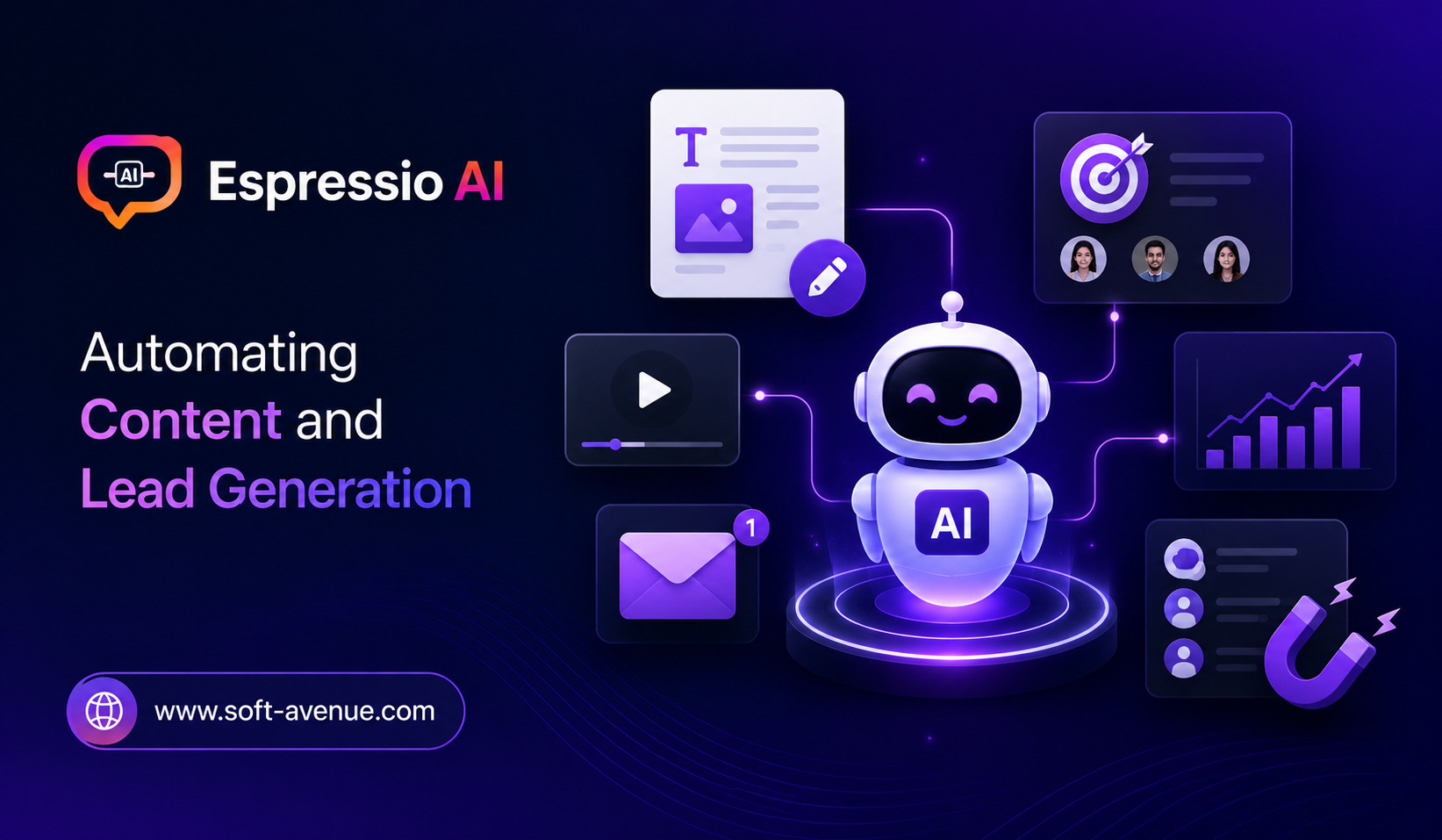
Marketing teams are under constant pressure to produce more content, find better leads, and move prospects through the sales funnel faster. At the same time, many businesses still depend on manual research, repetitive content creation, spreadsheet updates, and time-consuming outreach.
Artificial intelligence is changing how these activities are handled. Instead of using AI only as a writing assistant or chatbot, companies are increasingly building connected workflows that can research information, create content, identify prospects, and support sales operations.
Espressio AI takes this broader approach to marketing automation. The company focuses on building AI systems for growth teams, with solutions covering content, lead generation, and competitive intelligence. Its website describes systems designed to handle repeatable marketing work while allowing teams to spend more time on strategy, creativity, and closing business.
What Is Espressio AI?
Espressio AI is an AI marketing operations company focused on building customized systems for growth-oriented businesses.
Rather than positioning AI as a single tool that marketers use for individual tasks, Espressio focuses on connected workflows. These systems can bring together research, content production, lead generation, sales intelligence, and existing business software.
The company describes three major areas of its work: content, lead generation, and competitive intelligence. Its approach is designed around reducing repetitive execution and creating systems that can operate as part of an existing marketing workflow.
This makes Espressio particularly interesting for companies that have already experimented with AI but want to move beyond isolated prompts and disconnected tools.
Automating the Content Process
Creating quality content involves much more than writing paragraphs.
Marketing teams need to identify topics, research competitors, understand audience interests, develop ideas, create drafts, review content, optimize it, and eventually publish it.
Espressio’s Content OS is designed around this entire process. According to the company, its content system includes research, idea generation, AI writing, quality checks, scheduling, distribution, and performance feedback.
The idea is to create a continuous content engine rather than treating every article or social post as a separate project.
For example, research can identify trends and content gaps. Those findings can feed an idea-generation process. AI can then help create different versions of hooks and talking points before content moves through quality checks.
Once approved, content can be scheduled and distributed across multiple platforms.
This type of workflow can help marketing teams spend less time coordinating individual steps.
AI-Powered Content Research
Research is often one of the most time-consuming parts of content marketing.
Before writing an article, marketers may need to examine competitors, monitor industry developments, study successful content formats, and identify questions their target audience is asking.
Espressio’s content workflow includes research capabilities such as niche monitoring, competitor tracking, trend detection, and engagement analysis. It also describes maintaining research information around content formats, hooks, and content gaps.
This can give marketers a stronger foundation for content planning.
Instead of asking AI to randomly generate topics, businesses can build content ideas around market signals and existing performance data.
Maintaining Brand Voice
One of the biggest challenges with AI-generated content is consistency.
A company may publish dozens of AI-written posts, but if every piece sounds different, the brand can quickly lose its identity.
Espressio’s content system includes voice matching as part of AI writing and a quality process that evaluates content and voice before publication.
This highlights an important principle of AI content automation: automation should not mean removing editorial standards.
The most useful systems can handle repetitive production while leaving people responsible for strategic decisions, final approval, and brand direction.
Automating Lead Generation
Content is only one part of growth.
A business also needs a reliable way to identify potential customers and turn market interest into sales opportunities.
Espressio’s lead-generation approach focuses on finding targeted prospects, enriching prospect information, and supporting personalized outreach. The company says its systems are built around real signals rather than simply generating large lists of contacts.
This distinction is important.
Modern lead generation is moving away from simply collecting as many email addresses as possible. Businesses increasingly want prospects that match their ideal customer profile and show relevant signals.
AI can help process these signals and reduce the amount of manual research required from sales and business development teams.
Personalized Outreach With AI
Generic sales messages often perform poorly because they do not reflect the specific needs of the recipient.
AI can help personalize outreach by combining information about a prospect, their company, industry, potential challenges, and previous interactions.
Espressio’s broader revenue workflows are designed to connect research and sales activities so that teams can work with more relevant information before contacting prospects. Its published material also discusses lead enrichment and automated revenue workflows.
The goal is not simply to send more messages.
Instead, automation can help sales teams spend more time deciding who to contact, why to contact them, and what message is most relevant.
Connecting Marketing and Sales
A major benefit of AI workflow automation is the ability to connect activities that are traditionally separated.
Content teams may generate interest, marketing teams may identify leads, and sales teams may conduct meetings. If these processes operate independently, valuable information can become fragmented.
An integrated AI workflow can potentially connect these stages.
For example, research can inform content creation. Content engagement can contribute to lead signals. Lead information can be passed to sales workflows. Meeting information can then support proposals and follow-up activities.
Espressio’s Revenue OS extends beyond lead generation into meeting intelligence and proposal creation. The company describes workflows that can transcribe meetings, extract information such as needs, budgets, goals, timelines, and objections, and turn that information into a deal brief.
From Sales Calls to Proposals
Preparing a proposal after a sales call can take considerable time.
Someone needs to review notes, understand the customer’s requirements, determine the appropriate services, prepare pricing packages, and create a professional presentation.
Espressio describes a workflow in which AI can help transform meeting information into a scope of work, service mapping, pricing packages, and branded proposal materials. Human review remains part of the process before deployment.
This illustrates where AI automation can be particularly useful: connecting several small administrative tasks into one larger workflow.
Competitive Intelligence
Marketing automation is not limited to publishing and lead generation.
Businesses also need to understand competitors, pricing changes, market movements, and emerging trends.
Espressio lists competitive intelligence as one of its core areas, describing always-on monitoring of competitor moves, pricing, and market shifts with information delivered to teams on a recurring basis.
This can be valuable for companies operating in rapidly changing industries.
Instead of manually checking competitors every week, teams can use automated systems to surface relevant developments and provide a summary for decision-making.
Why AI Workflow Automation Matters
The biggest advantage of a system such as Espressio AI is not simply that it uses artificial intelligence.
The more important concept is workflow automation.
A standalone AI chatbot can answer a question. A connected AI system can potentially perform a sequence of activities around a business objective.
For a marketing team, that could mean moving from:
Research → Ideas → Content → Quality Check → Publishing → Performance Feedback
For a sales process, it could become:
Prospect Research → Enrichment → Outreach → Meeting → Deal Brief → Proposal
Connecting these steps can reduce repetitive work and make processes more consistent.
Human Oversight Still Matters
AI automation should not mean giving an AI system unlimited control over marketing and sales decisions.
Generated content still needs review. Prospect information needs verification. Outreach should follow applicable privacy and communication rules. Sales proposals involving pricing or contractual commitments should receive human approval.
Espressio’s own workflow descriptions include quality gates and team review steps, reinforcing the idea that automation works best when human judgment remains part of important decisions.
Businesses should therefore think of AI as an operational layer rather than a complete replacement for marketing expertise.
Who Can Benefit From Espressio AI?
Espressio’s approach can be particularly relevant to growth teams that already have recurring marketing and sales processes but want to make them more efficient.
Startups can use AI workflows to increase output without expanding every operational function immediately. Established companies can automate repetitive processes while maintaining their existing technology stack.
Marketing agencies may also benefit because many agency workflows involve recurring research, content production, reporting, lead generation, and client communication.
The strongest use case is likely to be a business where repetitive work is already consuming significant employee time and where the process can be clearly defined.
Challenges to Consider
AI automation is not automatically successful.
Poor-quality data can produce poor results. An unclear customer profile can lead to irrelevant prospects. Weak content guidelines can result in generic writing. Excessive automation can also create mistakes at a much larger scale.
Businesses should therefore establish clear processes before automating them.
It is also important to measure outcomes rather than focusing only on the number of automated tasks. More posts or more leads do not necessarily mean better marketing.
Metrics such as qualified pipeline, conversion rates, content performance, sales-cycle time, and revenue contribution provide a better picture of whether automation is working.
The Future of AI Marketing Operations
Marketing automation is moving toward systems that can perform multiple connected activities instead of individual tasks.
The future may involve AI agents continuously researching markets, identifying opportunities, preparing content, monitoring competitors, qualifying prospects, and assisting sales teams.
Espressio AI reflects this shift by focusing on AI systems built around business workflows rather than isolated AI features.
As these systems become more capable, the competitive advantage may not come from simply having access to AI. It may come from building better processes around it.
Final Thoughts
Espressio AI represents a broader movement toward AI-powered marketing operations.
By combining content automation, lead generation, competitive intelligence, and revenue workflows, the approach aims to reduce the repetitive work that consumes marketing and sales teams’ time.
Its content system focuses on research, creation, quality control, publishing, and optimization, while its revenue workflows extend into prospect research, meeting intelligence, and proposal creation.
The real value of this approach is not producing more AI-generated content simply for the sake of volume. It is about building connected systems that help teams research faster, communicate more effectively, and spend more time on strategic decisions.
As businesses continue adopting AI in 2026, workflow-based automation could become an increasingly important part of how modern marketing and sales teams operate.
