AI writing has changed the way people create content. What once required hours of brainstorming, research, drafting, editing, and formatting can now be completed with the help of AI-powered tools. However, using AI for writing is not always a single-step process.
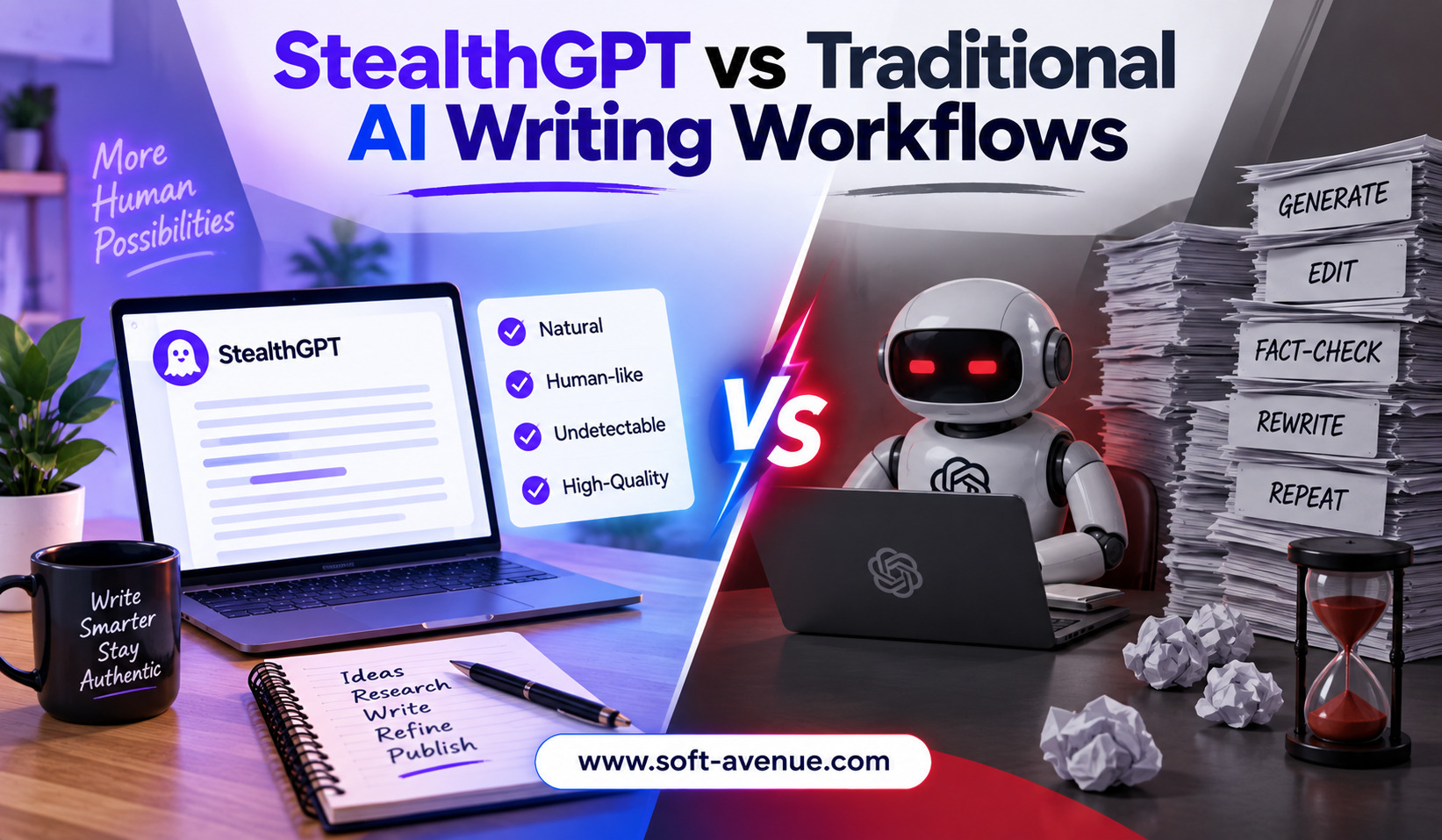
A traditional AI writing workflow may involve generating content with one tool, checking the information with another, rewriting sections manually, improving the tone, adding citations, and then preparing the final piece for publication. This approach can work, but managing several separate steps can become time-consuming.
StealthGPT takes a different approach by combining several writing-related functions into a more connected workflow. Its current platform includes tools such as an AI humanizer, Stealth Writer, Stealth Agent, SEO Writer, AI detector, and document-focused features.
So, how does StealthGPT compare with a traditional AI writing workflow, and which approach makes more sense for content creators?
What Is a Traditional AI Writing Workflow?
A traditional AI writing workflow usually starts with a general-purpose AI writing assistant.
The writer provides a topic or prompt, receives a draft, reviews it, and then makes changes. If the content requires research, the writer may separately search Google or academic databases. If citations are required, another tool may be used. For SEO content, a separate keyword research or optimization platform may also be involved.
The workflow might look something like this:
Research → outline → AI draft → human editing → fact-checking → SEO optimization → formatting → publication
This approach offers considerable flexibility. Writers can choose the best tool for each task and maintain complete control over the process.
The downside is that every additional tool introduces another step. Content may need to be copied between applications, and writers have to keep track of multiple subscriptions, interfaces, and workflows.
What Is StealthGPT?
StealthGPT is an AI writing platform focused on generating, rewriting, humanizing, and analyzing written content.
Its current feature set includes an AI Humanizer for rewriting existing text, Stealth Writer for generating long-form content, Stealth Agent for research and content creation, an AI Detector, an SEO Writer, and tools for working with PDFs.
The platform positions itself as a way to bring several stages of AI-assisted content creation into one environment.
Its Stealth Agent, for example, is designed to research a topic, create a draft, perform fact-checking, and humanize the resulting content within a connected workflow.
This makes the platform different from a basic AI text generator.
StealthGPT vs Traditional AI Writing
The biggest difference is workflow structure.
With a traditional setup, a writer may use one AI model for drafting and then move the text to another platform for rewriting or checking. Additional tools may be needed for citations, research, grammar, and SEO.
StealthGPT attempts to combine many of these functions.
For example, its Stealth Agent is designed to perform web research before writing and includes an optional fact-checking stage before humanization. According to its documentation, the process is divided into dedicated stages for research, drafting, fact-checking, and final humanization.
That can reduce the amount of manual movement between tools.
Research and Information Gathering
Research is an important part of producing useful content.
With a traditional AI workflow, a writer may research a topic separately, collect sources, and then provide relevant information to an AI writing assistant.
StealthGPT’s Stealth Agent is designed to incorporate web research into the content-generation process. The platform says the research stage is intended to ground drafts in real sources before the writing stage begins.
This can be convenient for content creators who want research and writing connected together.
However, convenience should not eliminate source verification. Writers should still review important sources, especially when an article contains statistics, scientific claims, financial information, or other facts that require high accuracy.
Drafting Long-Form Content
Traditional AI writing tools can create long-form content from a detailed prompt or outline. The writer typically needs to refine the result afterward.
StealthGPT’s Stealth Writer is designed specifically for longer content such as articles, essays, and research-oriented writing. Its documentation describes features such as outlining, tone selection, and formatting options.
For a blogger, this can make the initial production stage more streamlined.
Instead of creating a rough article in one tool and then transferring it elsewhere for rewriting, the writer can use a platform designed around multiple stages of the same process.
Humanization and Editing
One of the most recognizable differences between StealthGPT and a conventional AI writing workflow is its emphasis on humanization.
StealthGPT’s Humanizer is designed to rewrite AI-generated or existing text to make the language sound more natural. The company says the tool changes sentence structures, wording, and writing patterns rather than simply replacing individual words.
In a traditional workflow, this could require manual editing or a separate rewriting tool.
However, humanization should not be confused with genuine human authorship. Rewriting AI-generated content can change its style, but it does not automatically turn the work into independently researched or personally authored material.
SEO Content Production
SEO writing often involves more than simply generating an article.
Writers need to understand search intent, organize headings, use relevant terminology naturally, answer reader questions, and make the article useful.
StealthGPT includes an SEO Writer and says its Stealth Agent can produce SEO-oriented content with keyword research and search-focused structure.
A traditional workflow may require separate keyword research, writing, editing, and SEO tools.
Having these functions connected can potentially reduce the number of steps required to prepare an article.
Still, SEO performance cannot be guaranteed simply because an article was generated by a particular AI platform. Search visibility depends on many factors, including content quality, competition, authority, technical SEO, relevance, and user experience.
Citations and Research Documents
Academic and professional writing often requires citations.
In a traditional workflow, writers may manually collect sources and use a reference manager or citation generator to format them.
StealthGPT promotes features for adding citations and generating bibliographies, while its Stealth Agent documentation describes research and citation-oriented workflows.
This can save formatting time, but citations still need to be checked. A citation is useful only when it actually supports the claim it is attached to.
For academic work, users should also follow their institution’s policies regarding AI-assisted writing.
Speed and Convenience
The main practical advantage of an integrated AI writing platform is convenience.
A traditional workflow may require multiple browser tabs, applications, subscriptions, and copy-and-paste steps.
StealthGPT attempts to reduce this fragmentation by bringing research, writing, rewriting, detection, SEO, and other features into one platform. Its own documentation describes the Stealth Agent as a workflow that combines research, drafting, fact-checking, and humanization.
For someone producing content frequently, fewer workflow changes can translate into a simpler production process.
Where Traditional AI Workflows Still Have Advantages
An integrated platform is not automatically better for everyone.
Traditional AI workflows provide flexibility. A writer can choose a specific model for brainstorming, another application for research, a specialist SEO platform for keyword analysis, and a separate editor for final proofreading.
This can be useful for experienced content teams that already have a preferred technology stack.
Traditional workflows can also encourage greater human involvement because writers naturally move between research and writing tools rather than relying on one platform for everything.
Important Considerations When Using StealthGPT
Before choosing StealthGPT or any similar platform, consider your actual requirements.
If you mainly need grammar correction or brainstorming, a complete AI writing suite may be unnecessary. If you regularly produce researched SEO articles, long-form content, or large volumes of AI-assisted writing, an integrated workflow may provide more value.
Privacy should also be considered when uploading documents. Confidential business material, unpublished research, or sensitive information should only be uploaded after reviewing the platform’s privacy and data-handling policies.
Most importantly, do not treat claims about “undetectable” content as absolute guarantees. StealthGPT itself notes that detector results can vary by detector version, content length, and engine, and its published claims should therefore be understood in that context.
Which Workflow Is Better?
The answer depends on your goals.
A traditional AI writing workflow may be better for writers who want maximum control over individual tools and already have an established content-production system.
StealthGPT may be more appealing to users who prefer an integrated environment where research, drafting, rewriting, SEO assistance, and other writing functions are available together.
For frequent content production, reducing repetitive tool switching can be a meaningful advantage.
For high-value content, however, the quality of the final result still depends heavily on human involvement.
Final Thoughts
StealthGPT and traditional AI writing workflows represent two different approaches to AI-assisted content creation.
Traditional workflows typically divide research, writing, editing, SEO, and verification across several tools. This provides flexibility but can also create additional work.
StealthGPT attempts to bring many of these activities together. Its current platform includes writing, humanization, research, SEO, document analysis, and detection-related features, while Stealth Agent is designed to combine research, drafting, fact-checking, and humanization into one workflow.
For bloggers, marketers, businesses, and other frequent content creators, that integrated approach can make content production more streamlined.
Ultimately, the best workflow is not the one that generates text the fastest. It is the one that helps you produce accurate, useful, original, well-researched, and audience-focused content efficiently. AI can handle many repetitive tasks, but human judgment remains essential for deciding what deserves to be published.
