Artificial intelligence has become an important tool for research, learning, writing, brainstorming, coding, and everyday problem-solving. But as the number of AI models grows, another challenge is emerging: which AI answer should you trust?
Different AI models can respond differently to the same question. One may provide a concise explanation, another may offer more context, while a third may identify details that the others overlook.
This makes comparing AI responses increasingly useful.
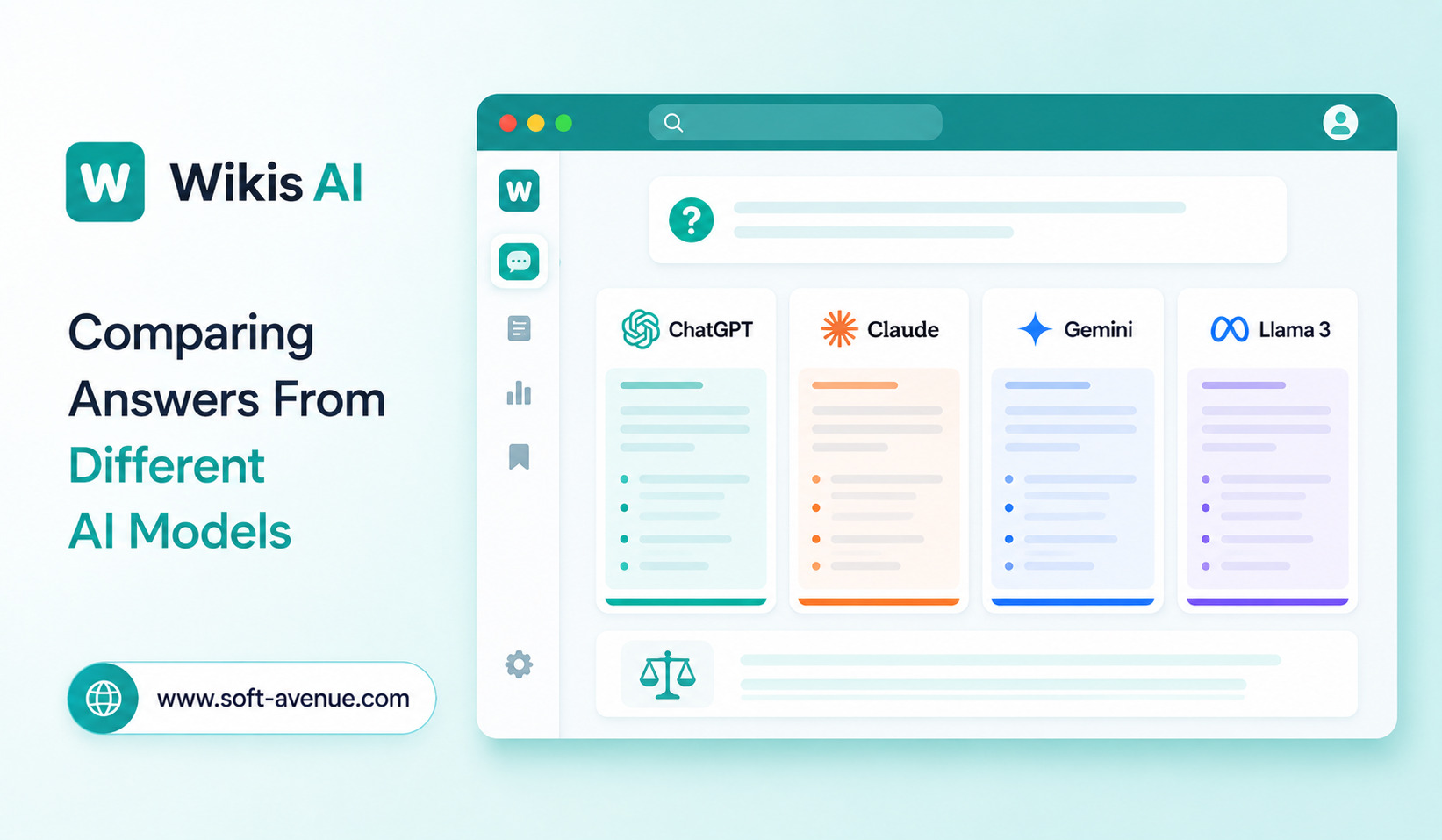
Wikis.ai takes this approach by allowing users to ask a question once and compare answers from multiple AI models in one workspace. Its website describes a multi-model chat experience where independent responses can be viewed side by side, followed by additional conversation with the models the user finds most useful.
The platform also combines this comparison experience with an AI Wiki containing structured guides on AI concepts and related topics.
What Is Wikis.ai?
Wikis.ai is a multi-model AI platform designed around comparing responses from different AI systems.
Instead of opening several chatbot websites and entering the same prompt repeatedly, users can submit one question and review multiple model responses together.
The platform currently showcases models from different AI ecosystems, including GPT, Claude, and Gemini, with other models also available depending on the service.
Its main purpose is not simply to generate an answer.
It is to help users compare perspectives.
This distinction makes Wikis.ai interesting for research, education, content creation, AI experimentation, and situations where users want to evaluate more than one response before reaching a conclusion.
Why Compare Answers From Multiple AI Models?
AI models are trained and developed differently, so they can approach the same question in different ways.
One model might focus on a straightforward explanation. Another might emphasize exceptions or limitations. A third could provide practical examples.
Comparing these answers can reveal useful differences.
It can also help users identify claims that deserve additional verification.
For example, if three models agree on a basic concept but disagree about a specific statistic or historical detail, the disagreement provides a reason to investigate that detail further.
AI comparison should not be treated as automatic fact-checking. Several models can still make the same mistake. However, comparing outputs can make weaknesses and disagreements easier to notice.
How Wikis.ai’s Multi-Model Chat Works
The basic workflow is designed to reduce repetitive prompting.
A user enters a question and selects the AI models they want to compare. The responses are then presented together in a side-by-side layout.
Wikis.ai describes this as a stable grid where users can scan different approaches and identify which response best fits their needs.
This can save time compared with manually opening multiple AI services.
It also creates a more direct comparison because the models receive the same basic question.
Seeing Independent Responses
One important feature of multi-model comparison is keeping the responses independent.
Instead of immediately combining several answers into one AI-generated summary, users can see what each model actually produced.
This matters because a synthesized response can hide disagreement.
For research, seeing different interpretations can be more useful than receiving one blended answer.
Users can examine the wording, reasoning, assumptions, and level of detail in each response before deciding which information deserves further attention.
Agreement Can Be a Useful Signal
Wikis.ai also highlights areas where multiple models agree. Its homepage describes consensus as a starting signal while keeping differences and nuance visible.
Agreement can be useful when exploring a subject.
If several independent models provide the same basic explanation, that information may be a reasonable starting point.
However, agreement should not be confused with proof.
AI systems can share similar training patterns and can reproduce the same incorrect information. Important claims should therefore still be checked against authoritative or primary sources.
The real advantage is that model comparison encourages users to question and verify, rather than simply accepting the first answer.
Wikis.ai for Research
Research is one of the strongest potential applications.
Suppose someone wants to understand a new technology, business concept, scientific topic, or AI development.
Instead of asking one model for an explanation, they can compare multiple responses.
This can reveal:
- Common explanations shared by several models
- Different interpretations
- Missing context
- Contradictory claims
- Areas that require additional research
The process can be especially useful during the early stages of research, when the goal is to understand a topic before investigating it in depth.
AI Wiki for Structured Learning
Wikis.ai goes beyond live model comparison by providing an AI Wiki.
The site describes the Wiki as an editorially structured collection of guides covering AI concepts, infrastructure, agents, safety, and other topics.
Examples include guides explaining what an LLM is, how AI works, AI algorithms, AI detectors, and other concepts.
This creates a useful combination.
A user can first read a structured explanation and then ask follow-up questions using multiple AI models.
Instead of starting with a completely blank chat window, the Wiki can provide background information before deeper exploration.
Moving From Reading to Conversation
A traditional article usually ends when the reader reaches the final paragraph.
An AI-powered knowledge platform can make the experience more interactive.
Wikis.ai allows users to continue from a Wiki answer into a conversation, according to its website.
For example, after reading an explanation of large language models, a user could ask a more specific question.
They might want to understand model training, context windows, AI costs, or the difference between various architectures.
This creates a transition from reading information to exploring information.
Use Cases for Students
Students can use multi-model AI comparison as a learning technique.
A difficult concept can be explained by several models using different styles.
One explanation may be highly technical, while another may use a practical example.
Comparing them can help students understand the subject from multiple angles.
However, students should use AI responsibly. Generated explanations should support learning rather than replace independent study, and important academic information should be checked against textbooks, course materials, and reliable sources.
Use Cases for Writers and Content Creators
Writers can also benefit from multiple perspectives.
A content creator researching a topic can ask several models for potential angles, questions, examples, or explanations.
Instead of accepting the first generated outline, the writer can compare different approaches.
One model may identify an angle that another missed.
The writer can then combine useful ideas while applying human judgment and independent research.
This can make AI brainstorming more diverse.
Use Cases for Developers
Developers can use multi-model comparison when exploring technical questions.
For example, a developer could ask several models to explain an API concept, troubleshoot a coding problem, or suggest different implementation approaches.
Comparing solutions can expose alternative strategies.
One model may prioritize simplicity, another performance, and another maintainability.
The developer can then test the proposed solutions rather than blindly accepting generated code.
Comparing Models for AI Evaluation
Wikis.ai can also be useful for people who actively evaluate AI systems.
Prompt designers and AI enthusiasts may want to know how different models respond to the same instruction.
A single prompt can reveal differences in:
- Accuracy
- Explanation style
- Reasoning
- Conciseness
- Creativity
- Handling of ambiguity
This makes multi-model comparison useful not only for getting answers but also for understanding the behavior of AI models.
Following Up With the Most Useful Model
Sometimes one response stands out.
Perhaps one model provides the clearest explanation, while another offers better examples.
Wikis.ai allows users to continue conversations with models they find useful, rather than stopping after the initial comparison.
This creates a two-stage workflow.
First, users compare.
Then, they go deeper with the model or models that provide the most useful results.
That can be more efficient than choosing a model before seeing how it handles the actual question.
Current Information and Web Search
AI knowledge can become outdated, particularly for topics that change quickly.
Wikis.ai’s platform also highlights web search for current answers as part of its broader feature set.
This can be useful when researching changing subjects.
However, users should still examine the underlying information and verify important claims through trustworthy sources.
Web-enabled AI can improve access to current information, but it does not eliminate the need for source evaluation.
The Limitations of Multi-Model Comparison
Using multiple AI models does not automatically make an answer correct.
There are several reasons.
Models can repeat the same incorrect information. They can misunderstand ambiguous prompts. They may also provide different answers because they interpret the question differently.
There is another practical issue: too many responses can create information overload.
For a simple question, comparing several models may take more time than necessary.
The best use of multi-model AI is therefore for questions where different perspectives actually add value.
Privacy and Responsible AI Use
Users should also consider privacy before entering information into any AI platform.
Sensitive personal information, confidential business documents, passwords, financial details, and proprietary material should be handled carefully.
Before using an AI service for sensitive work, users should review its privacy and data-handling policies and understand which underlying AI providers may process their information.
Convenience should always be balanced with responsible data practices.
The Future of AI Answer Comparison
As the AI ecosystem continues to expand, users will have increasingly more models to choose from.
This could make model comparison a normal part of AI-assisted work.
Instead of asking, “Which AI is the best?” users may increasingly ask, “Which AI gives me the best answer for this particular question?”
Platforms such as Wikis.ai are built around that idea.
The future could involve AI workspaces where users compare several models, identify areas of agreement, investigate disagreements, and then continue working with the most useful responses.
This approach treats AI models as different sources of perspective rather than assuming one system is always superior.
Final Thoughts
Wikis.ai offers a practical approach to comparing answers from different AI models in one workspace.
Its side-by-side multi-model chat makes it easier to examine independent responses, while its AI Wiki provides structured explanations that can serve as a starting point for further exploration.
For students, researchers, writers, developers, and everyday AI users, comparing multiple responses can provide useful perspectives and make disagreements easier to identify.
The most important benefit is not simply having more AI answers.
It is having the ability to compare, question, verify, and choose.
As AI becomes more diverse, tools that help users evaluate different models may become just as valuable as the models themselves.
