Creating quality content has traditionally involved several separate stages. Writers research a topic, develop ideas, create an outline, write a first draft, edit the language, check facts, optimize the content for search engines, and finally prepare it for publication.
As content demands continue to grow, this process can become difficult to manage. Businesses may need blog posts, social media updates, product descriptions, emails, landing pages, and other forms of content regularly.
AI writing tools are changing this workflow by helping creators handle repetitive tasks more quickly. Instead of replacing writers completely, these tools can work alongside people throughout different stages of content production.
The result is a workflow that can be faster, more flexible, and easier to scale while still requiring human creativity and editorial judgment.
What Are AI Writing Tools?
AI writing tools are software applications that use artificial intelligence to generate, rewrite, summarize, expand, or improve written content.
Modern tools can assist with everything from brainstorming a headline to creating a first draft. They can also help rewrite sentences, adjust tone, summarize research, generate content ideas, and identify areas that need improvement.
For content teams, their value comes from reducing the amount of time spent on repetitive writing tasks.
However, AI-generated text should not automatically be considered finished content. Human review remains important for accuracy, originality, brand voice, context, and quality.
AI Is Changing the Content Creation Process
The biggest change is not simply that AI can write paragraphs. The larger change is how content teams organize their entire workflow.
Previously, each stage of content creation could require a different tool or manual process. AI can bring assistance into several of these stages.
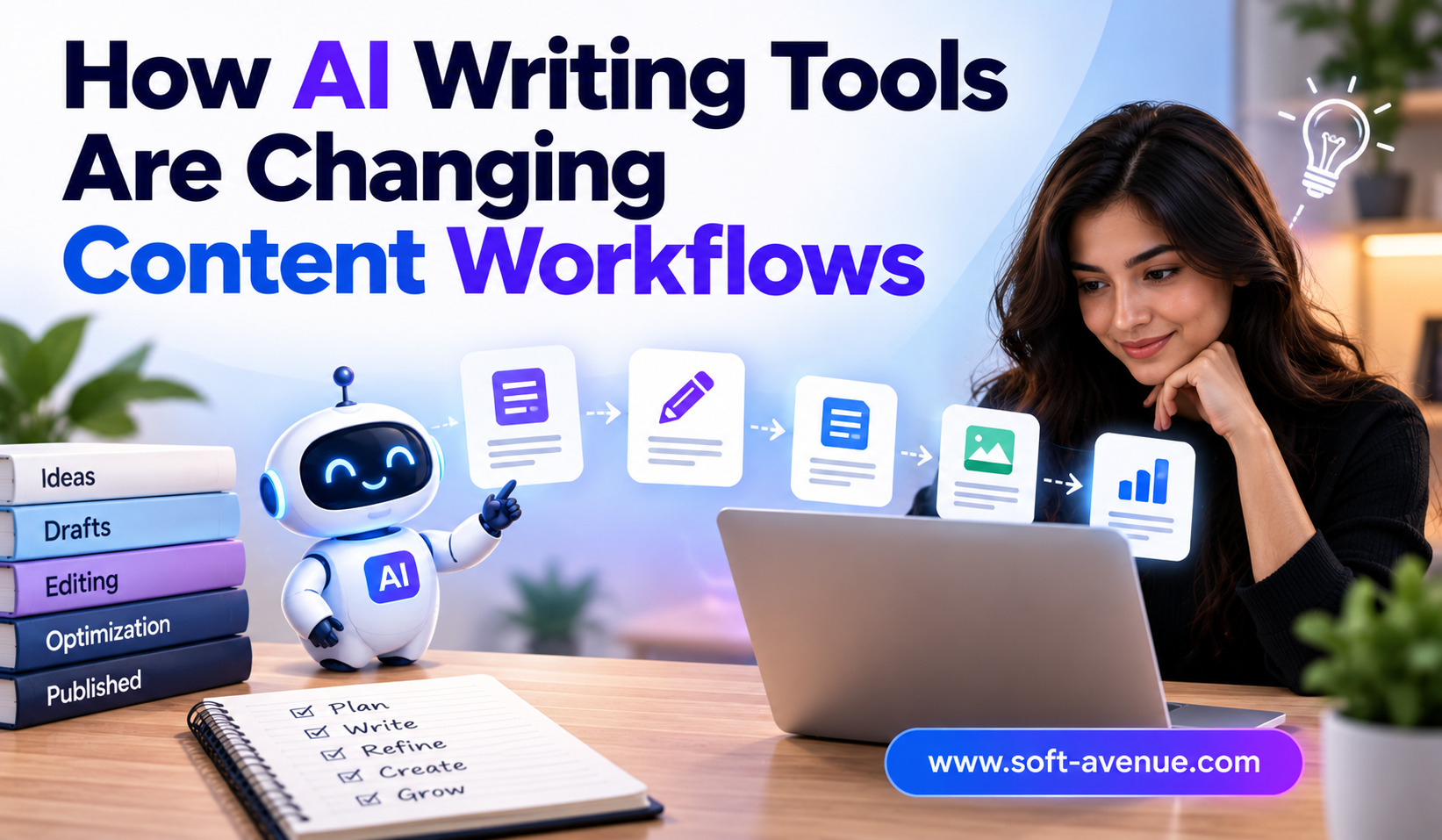
A typical modern workflow might begin with AI-assisted research, move into brainstorming and outlining, continue with human-led drafting supported by AI, and finish with editing and optimization.
This allows creators to spend less time on repetitive activities and more time making strategic decisions.
Faster Content Ideation
One of the most common challenges for writers is deciding what to write.
Coming up with new content ideas consistently can become difficult, especially for websites publishing several articles every week. AI tools can generate topic suggestions based on a subject, audience, industry, or content goal.
For example, a fitness website could ask an AI tool for article ideas related to beginner workouts, nutrition habits, recovery, or home exercise.
The writer can then evaluate those ideas and select topics that are actually useful for the target audience.
AI therefore works well as a brainstorming partner. Instead of starting with a blank page, writers can begin with multiple possibilities and develop the strongest ones.
Research Becomes More Structured
Research can consume a significant portion of the content creation process.
Writers often need to review articles, reports, studies, websites, and other sources before starting an article. AI tools can help summarize long documents, identify key concepts, and organize information.
This can be particularly useful when dealing with lengthy research material.
However, AI summaries should not replace reading important primary sources. Writers still need to verify facts, understand context, and make sure claims are supported by credible information.
The role of AI is to make the research process easier to navigate, not to remove the responsibility of checking information.
Creating Outlines More Quickly
A strong outline provides structure before the writing begins.
AI tools can generate possible headings and organize a topic into logical sections. Writers can then modify the outline according to their audience and content goals.
For example, an article about digital marketing might be divided into sections covering strategy, audience research, content creation, measurement, and common mistakes.
Having this structure before drafting can reduce unnecessary rewriting later.
The writer remains responsible for deciding what belongs in the article, while AI can help create an initial framework.
Faster First Drafts
Creating a first draft is often one of the most time-consuming stages of writing.
AI can generate an initial version from a prompt, outline, or set of notes. This gives writers something to review and improve rather than requiring them to create every sentence from scratch.
This approach can be particularly useful for repetitive content such as product descriptions, internal documents, basic announcements, or variations of existing marketing copy.
For high-quality editorial content, however, the first AI draft should usually be treated as raw material. Writers need to add original insights, examples, accurate information, and a natural voice.
Editing and Rewriting Become Easier
AI writing tools are also useful after the first draft has been created.
Writers can use them to identify awkward sentences, simplify complicated language, improve readability, or adjust the tone of a passage.
A technical explanation could be rewritten for beginners, while a casual paragraph could be made more professional for a business audience.
This can save editors time during the polishing stage.
Still, automated editing can sometimes remove personality from writing. Human editors should therefore make the final decision about style and voice.
AI and SEO Content Optimization
Search engine optimization is another area where AI writing tools are becoming part of content workflows.
AI can help identify related concepts, suggest headings, generate title ideas, improve readability, and organize content around a target topic.
Writers can also use AI to identify questions readers might have and ensure an article addresses them.
However, SEO should not become an exercise in inserting keywords repeatedly. Search-focused content still needs to satisfy the reader’s intent and provide genuinely useful information.
The best workflow uses AI to support optimization while keeping quality and user experience at the center.
Scaling Content Production
Businesses often struggle to increase content output without increasing workload at the same rate.
AI can help teams scale certain parts of production. A content team might use AI for brainstorming, research summaries, outlines, first drafts, metadata suggestions, or content variations.
This can allow writers and editors to handle more projects within the same timeframe.
Scaling does not mean publishing everything AI generates. Quality control becomes even more important as production increases.
A strong editorial process can help ensure that content remains accurate, useful, original, and aligned with the company’s goals.
Personalized Content at Scale
Another important development is the ability to create different versions of content for different audiences.
A company may need separate messaging for beginners, experienced users, business customers, or different stages of the buying journey.
AI can help adapt the same core information to different audiences while maintaining the underlying message.
Human review is still necessary to make sure personalization feels relevant rather than generic.
Changing the Role of Content Writers
AI writing tools are not simply changing how writers produce words. They are also changing which skills are most valuable.
Writers increasingly need to be good researchers, editors, strategists, fact-checkers, and communicators.
Prompting can help, but knowing what questions to ask and how to evaluate the output is more important than generating text quickly.
A writer who understands an audience and can add original insight may produce much stronger content with AI assistance than someone who simply publishes automated drafts.
The Importance of Human Creativity
Despite rapid improvements in AI, human creativity remains an important part of effective content.
AI can recognize patterns in existing information, but strong content often requires personal experience, unique perspectives, emotional understanding, and creative judgment.
Readers can also recognize when an article feels generic.
The most effective approach is therefore collaborative. AI handles suitable repetitive tasks while humans provide direction, originality, experience, and final judgment.
Challenges of AI-Powered Content Workflows
AI writing tools also introduce new challenges.
Incorrect information is one concern. AI can produce statements that sound convincing but are inaccurate. Writers must verify important claims before publication.
Originality is another issue. Content teams need to avoid producing repetitive material that sounds similar to thousands of other AI-generated articles.
There are also concerns around privacy, copyright, brand consistency, and the responsible use of AI-generated material.
These challenges make editorial oversight more important, not less.
How to Build a Better AI Writing Workflow
A practical AI-assisted workflow can begin with a clear content brief. Define the target audience, search intent, main topic, desired tone, and purpose before using AI.
Next, use AI for brainstorming and research organization. Create an outline and review it manually before drafting.
During writing, AI can help create a starting point or improve specific sections. Afterward, a human editor should fact-check the content, remove generic language, add original insights, and make sure the article genuinely helps the reader.
Finally, review the content for SEO, readability, accuracy, and brand consistency before publishing.
This approach gives AI a useful role without allowing automation to control the entire process.
Final Thoughts
AI writing tools are changing content workflows by making many time-consuming stages faster and more manageable. From idea generation and research to drafting, editing, and SEO optimization, AI can assist content creators across the production cycle.
The biggest opportunity is not simply producing more words. It is creating a better workflow where writers can spend more time on strategy, creativity, research, and quality.
Businesses and creators that use AI effectively will likely be those that combine automation with strong human oversight. AI can accelerate content production, but people still determine whether the final content is accurate, useful, original, and worth reading.
The future of content creation is therefore unlikely to be purely human or purely AI. It will be a collaboration in which technology handles repetitive work while human creators remain responsible for ideas, judgment, and the final voice.
