
Artificial intelligence has changed how businesses, developers, and individuals work with software. AI models can write content, analyze information, generate code, summarize documents, and perform complex reasoning tasks. However, frequent AI usage can also create challenges related to cost, speed, and resource consumption.
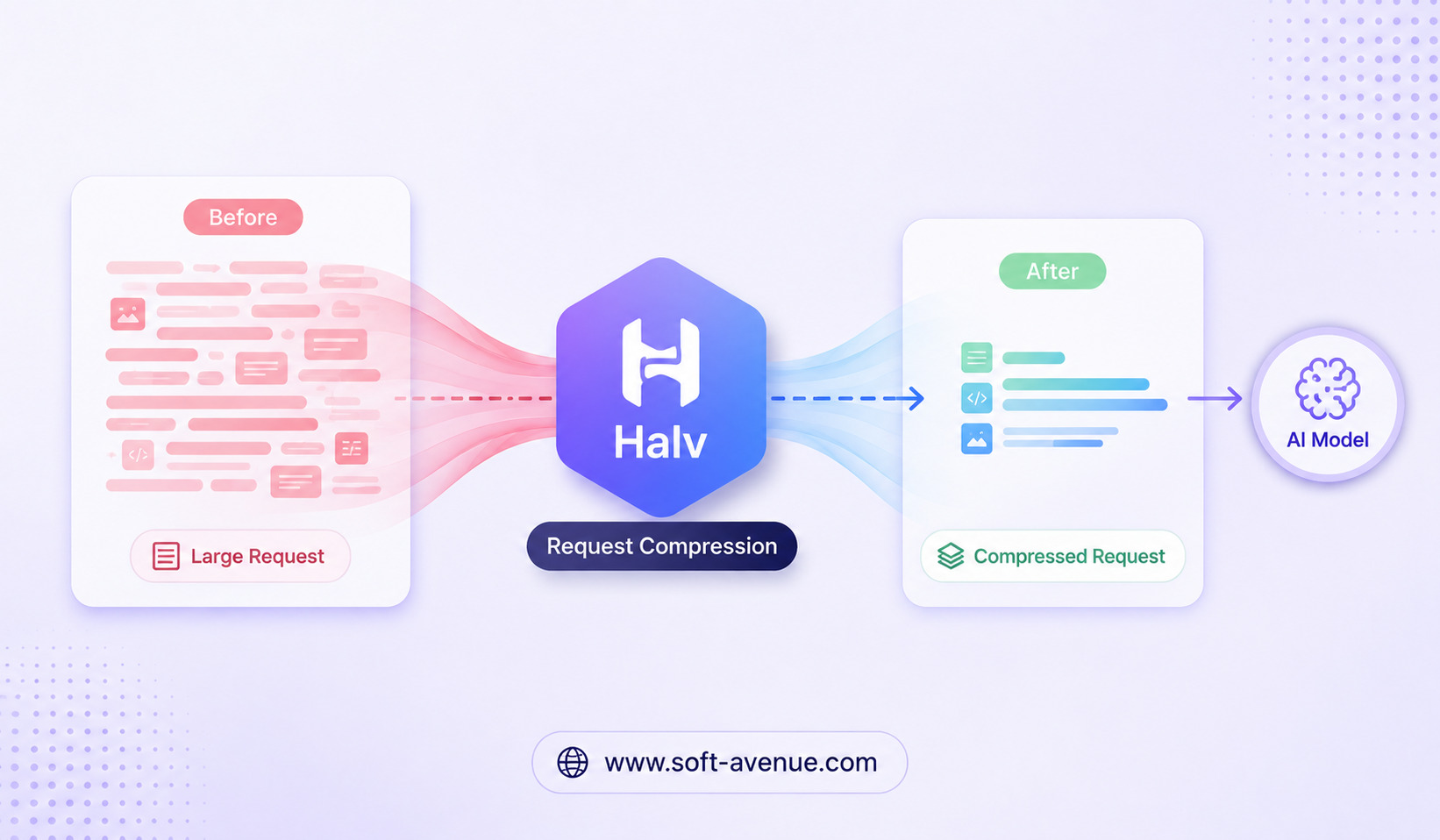
As AI applications become more sophisticated, developers are looking for ways to make requests more efficient without reducing the quality of the final result. One approach is request compression, where unnecessary information is reduced before a request reaches an AI model.
Halv is associated with this approach, focusing on reducing the amount of information that needs to be processed by AI models. Instead of simply sending every piece of available context to a model, request compression aims to make the input more compact and efficient.
This concept is becoming increasingly relevant as applications move from occasional AI prompts toward continuous AI-powered workflows.
What Is Halv?
Halv can be understood through the broader idea of AI request compression. When an application communicates with an AI model, the request can contain instructions, conversation history, documents, previous outputs, metadata, and other contextual information.
Not all of that information is equally important.
As an AI application grows, requests can become unnecessarily large. A chatbot may carry a long conversation history, while an AI coding tool may repeatedly send large sections of a project to a model.
Halv’s core concept is to reduce this unnecessary request overhead so that AI systems can work with a smaller and more focused input.
The objective is not simply to remove information. Effective compression needs to preserve the context that actually matters for the model’s task.
Why AI Requests Become Expensive
AI model usage is often influenced by the amount of information processed during a request. Depending on the provider and model, input and output usage can contribute to overall consumption.
Consider a customer-support application. A conversation may contain dozens of previous messages, even though only a few are relevant to the customer’s latest question.
Sending the entire conversation every time can increase the amount of context the model needs to process.
The same problem can occur in programming assistants. A developer may ask an AI model to modify one function, but the application could potentially include large amounts of unrelated code and project information.
Request compression attempts to solve this type of inefficiency.
Understanding Request Compression
Request compression is the process of making an AI request smaller while retaining the information necessary to complete the task.
A useful way to think about it is similar to cleaning up a document before sending it to someone. You remove repetition, irrelevant sections, and unnecessary details while keeping the important information.
For AI applications, this can involve reducing duplicated context, shortening previous conversations, filtering irrelevant information, or creating compact representations of larger data.
The goal is straightforward:
Less unnecessary input can mean more efficient AI usage.
However, compression needs to be handled carefully. Removing too much context can cause an AI model to misunderstand the task or produce weaker results.
How Halv Can Help Reduce AI Model Usage
The value of a request-compression approach becomes clearer in applications that make frequent AI calls.
Instead of repeatedly sending the same large context, a compression layer can attempt to identify the information that matters most.
For example, imagine an AI assistant working with a long conversation. The early messages may contain details that are no longer relevant. A compressed request could preserve important decisions and instructions while removing repetitive exchanges.
The model receives a more focused request without necessarily losing the context required to answer correctly.
This can potentially reduce unnecessary model usage while making requests easier to manage.
Benefits of Request Compression
Lower AI Usage
One of the main reasons developers explore compression is to reduce the amount of information sent to AI models.
When an application makes thousands or millions of requests, even relatively small reductions can become significant at scale.
Potential Cost Savings
For applications where AI usage contributes directly to operating costs, reducing unnecessary input can improve cost efficiency.
This is particularly important for startups and businesses building AI-powered products. Lower request overhead can make it easier to control infrastructure and model-related expenses.
Faster Requests
Smaller requests may also reduce the amount of data that needs to be transmitted and processed.
The actual improvement depends on the AI provider, model, network conditions, and implementation, but reducing unnecessary context can contribute to a more streamlined workflow.
Better Context Management
Compression is not only about saving money. It can also encourage developers to think more carefully about what information an AI model actually needs.
Instead of treating the entire history of an application as relevant, developers can build systems that prioritize useful context.
Improved Scalability
An AI application that works efficiently with context can be easier to scale.
A system processing a few requests per day may not notice excessive context. A production application handling thousands of interactions can face much greater consequences.
Compression becomes more valuable as request volume increases.
Common Examples of AI Request Compression
Request compression can be useful across many AI applications.
Chatbots can summarize older conversations instead of sending complete chat histories repeatedly.
AI coding assistants can focus on relevant files, functions, or errors rather than transmitting an entire repository for every request.
Document assistants can retrieve only relevant sections of a large document instead of providing the entire file every time.
Customer-service systems can maintain compact summaries of previous interactions and send only the information needed for the current problem.
AI agents can benefit from compressed memory when they perform multiple steps over a long period.
These examples show why compression is becoming an important part of AI application design.
Request Compression vs Simply Using a Smaller AI Model
Request compression and model selection solve different problems.
Using a smaller model can reduce the computational requirements of an AI application, but it may also affect reasoning ability, accuracy, or the types of tasks the model can handle.
Compression takes a different approach.
Instead of immediately switching to a smaller model, developers can attempt to make the request itself more efficient.
In some applications, the two strategies can work together. A developer could use a capable model while reducing unnecessary context to improve overall efficiency.
Challenges of AI Request Compression
Compression is not automatically beneficial in every situation.
The biggest challenge is deciding what information can safely be removed.
If important instructions or relationships between pieces of information disappear during compression, the model may produce an incorrect or incomplete response.
Another challenge is maintaining consistency. A compressed summary needs to represent the original information accurately.
There can also be additional processing requirements. If compression itself requires another AI call or expensive computation, the savings may be reduced.
For this reason, developers need to evaluate compression based on actual workloads rather than assuming that smaller requests will always produce better economics.
Why Context Efficiency Matters for AI Agents
AI agents make request compression particularly interesting.
Unlike a simple chatbot interaction, an agent may perform multiple steps. It can inspect information, make decisions, call tools, receive results, and continue working.
Over time, the amount of accumulated context can become large.
If every subsequent request includes all previous information, usage can grow unnecessarily. A compression strategy can help maintain a smaller working context while preserving important decisions and task information.
This can make long-running AI workflows more practical.
The Future of Efficient AI Requests
As AI applications become more widespread, developers will likely focus increasingly on context efficiency.
The next stage of AI optimization is not necessarily about making models larger. It is also about making the systems around those models smarter.
Developers can improve efficiency through better retrieval, caching, summarization, context filtering, prompt design, and request compression.
Tools and platforms built around these ideas can help businesses control AI costs while maintaining useful model performance.
Halv fits into this broader movement toward more efficient AI infrastructure by highlighting the importance of reducing unnecessary information in model requests.
Final Thoughts
Halv represents an important idea in modern AI development: AI applications do not always need to send everything they know to a model.
Through request compression, developers can attempt to remove redundant or irrelevant information while preserving the context required for a useful response.
The potential benefits include lower AI usage, improved scalability, faster workflows, and better control over model-related costs. However, compression must be implemented carefully because removing the wrong information can reduce response quality.
As businesses increasingly depend on AI models for everyday operations, efficient request management will become an important part of building sustainable AI applications. Whether used in chatbots, coding assistants, document tools, or autonomous agents, request compression offers developers another way to make AI workflows more efficient without simply reducing their capabilities.
