
Introduction
Software is evolving faster than ever, and modern businesses rely on multiple applications to manage daily operations. From banking and e-commerce to healthcare and education, organizations use different systems for customer management, payments, inventory, analytics, and communication. When these applications cannot share data efficiently, businesses face delays, duplicate work, and higher operating costs.
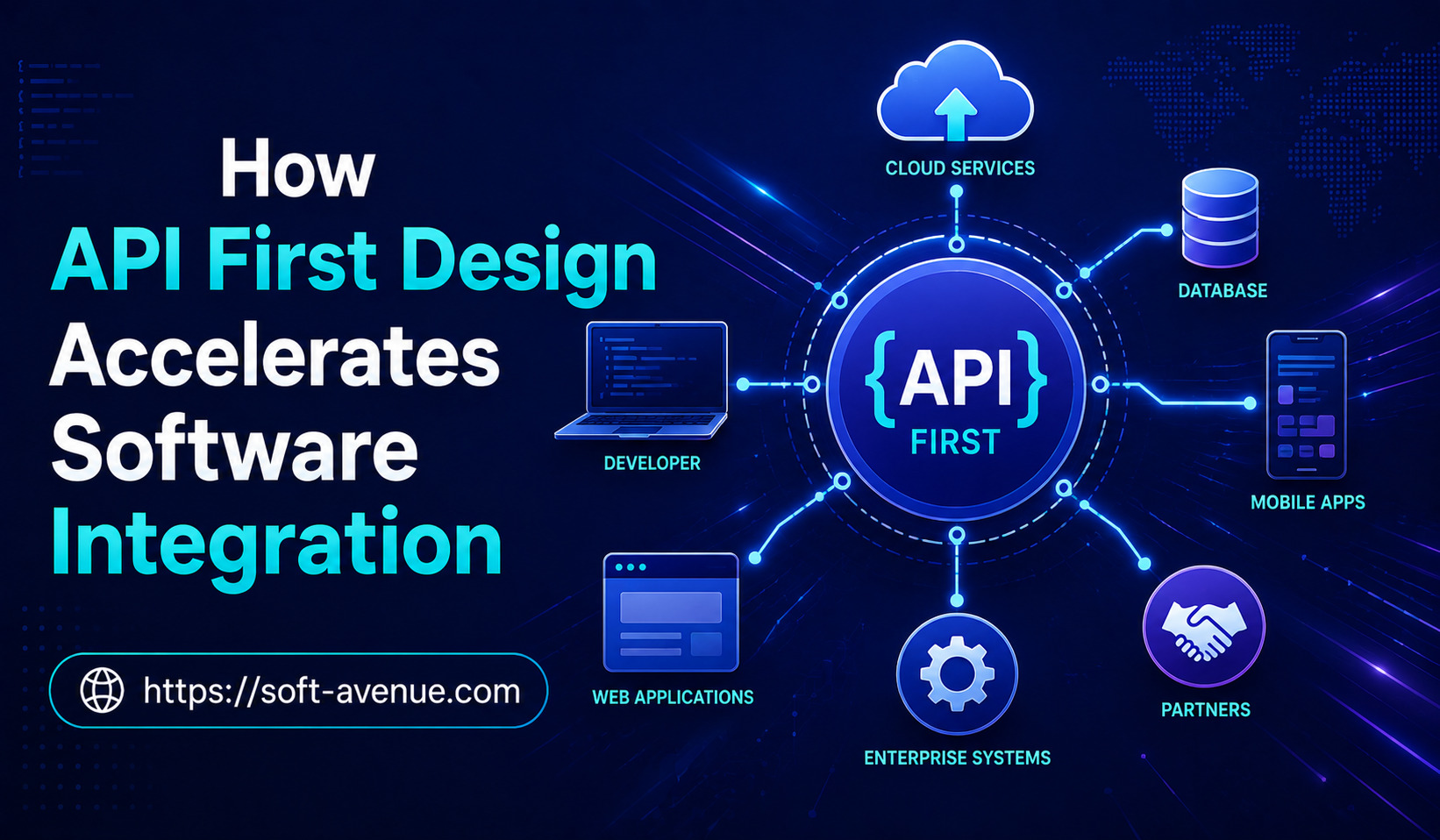
To solve this challenge, many companies are adopting API-first design. Instead of building software first and adding APIs later, developers design and document APIs before writing the application code. This approach makes it easier for different systems to connect, simplifies software integration, speeds up development, and creates scalable, future-ready digital solutions. As digital transformation continues in 2026, more businesses are turning to API-first design to build applications faster and connect their systems more efficiently.
Understanding API-First Design
API-first design is a software development approach where APIs are created before application development begins. An API acts like a bridge that allows different software applications to communicate and share information securely. With an API-first approach, developers begin by defining how these applications will interact, including how requests and responses are structured, how users are authenticated, how errors are handled, and how data is exchanged. This creates a clear foundation before the actual development begins.
This API specification serves as a contract between development teams. Once the contract is finalized, backend developers can begin implementing business logic while frontend developers simultaneously create websites, mobile applications, or dashboards using mock APIs. Because every team follows the same API documentation, software components fit together smoothly when development is complete.
Unlike traditional software development, where integration often becomes a separate phase near the end of a project, API-first development incorporates integration planning from day one. This proactive approach minimizes redesign, reduces delays, and enables organizations to launch products faster.
Why Software Integration Has Become More Important Than Ever
Businesses today operate in a highly connected digital environment. Customer information might be stored in a CRM system, financial records in an ERP platform, marketing campaigns in automation software, and inventory data in a warehouse management system. Although each platform serves a different purpose, they all need to work together seamlessly to keep business operations running smoothly.
Take an online retail business as an example. The moment a customer places an order, several systems need to work together instantly to process it smoothly. The website sends order details to the inventory system, which updates stock levels. Payment gateways verify the transaction, shipping software generates delivery labels, CRM platforms update customer records, and analytics tools track purchasing behavior. If any one of these systems fails to communicate effectively, the customer experience suffers.
As organizations continue adopting cloud applications, mobile platforms, artificial intelligence, IoT devices, and SaaS solutions, software integration becomes even more complex. Traditional point-to-point integrations are no longer sufficient because every new application increases the number of connections that developers must maintain. API-first architecture solves this challenge by providing standardized communication interfaces that allow new services to connect without extensive redevelopment.
How API-First Design Accelerates Software Integration
One of the biggest advantages of API-first development is that it makes software integration easier from the very beginning. Instead of adding APIs after development, teams design them first, so everyone knows how different systems will communicate. This allows frontend, backend, and testing teams to work in parallel, reducing delays and speeding up project delivery.
API-first also brings consistency and reusability. Standardized APIs can be used across multiple applications, reducing the need for custom integrations and lowering maintenance costs. It also gives businesses greater flexibility—whether adding a new payment gateway, CRM, or AI service, developers can integrate new tools quickly without making major changes to the existing software.
Faster Collaboration Across Development Teams
Modern software projects involve specialists from multiple disciplines, including backend engineers, frontend developers, DevOps professionals, QA engineers, UI/UX designers, security experts, and product managers. In traditional development environments, these teams often depend heavily on one another, creating bottlenecks that delay project completion.
API-first development eliminates many of these delays by establishing a common interface before coding begins. Everyone understands how the application will exchange data, allowing different teams to work independently while maintaining compatibility.
This improved collaboration also reduces communication errors. Instead of repeatedly clarifying technical requirements during development, teams rely on detailed API documentation as the single source of truth. As a result, projects experience fewer misunderstandings, fewer integration conflicts, and fewer costly redesigns.
The benefits extend beyond internal development teams. External partners, third-party vendors, and enterprise customers can also integrate more efficiently because APIs are clearly documented and standardized from the beginning.
API-First Enables Reusable Software Components
API-First Enables Reusable Software Components
One of the most valuable aspects of API-first development is reusability. Rather than building similar integration logic for every application, organizations can create APIs that serve multiple platforms simultaneously.
For instance, the same customer API can provide information to a company website, mobile application, customer support portal, analytics dashboard, and partner platform. Likewise, a payment API can process transactions across e-commerce websites, mobile apps, subscription platforms, and point-of-sale systems without requiring separate implementations.
Reusable APIs reduce duplicate development efforts and ensure consistency across digital products. Updates made to an API automatically benefit every connected application, making maintenance significantly easier. This approach not only accelerates software integration but also lowers long-term operational costs while improving system reliability.
Why Businesses Are Investing in API-First Development
The rapid growth of cloud computing, artificial intelligence, remote work, and digital services has transformed software into a connected ecosystem rather than a collection of isolated applications. Organizations recognize that successful digital transformation depends on seamless integration between systems, making API-first development a strategic investment rather than simply a technical choice.
Companies adopting API-first methodologies often report faster product launches, improved developer productivity, easier third-party integration, stronger customer experiences, and greater flexibility when adopting emerging technologies. These benefits allow businesses to innovate more quickly while reducing the complexity traditionally associated with enterprise software integration.
As organizations continue modernizing their technology infrastructure, API-first design is increasingly becoming the preferred approach for building scalable, secure, and future-ready applications.
Major Benefits of API-First Development
API-first development helps organizations improve not just software development but overall business efficiency. By designing APIs before coding starts, teams can avoid integration issues, work more efficiently, and focus on delivering valuable features.
A major benefit is faster time-to-market. Frontend, backend, testing, and DevOps teams can work in parallel using a shared API design, reducing delays and speeding up product launches. API-first also improves scalability, making it easier to add new applications, cloud services, or third-party tools without changing existing systems.
It also enhances software quality. Since API designs are reviewed early, potential issues are identified before development begins, resulting in fewer bugs, less rework, and more reliable, maintainable software.
The business advantages include:
- Faster software development and deployment.
- Reduced integration costs.
- Improved collaboration between technical teams.
- Easier third-party and partner integrations.
- Better customer experiences through connected digital services.
- Greater flexibility for future technology upgrades.
Rather than being just a technical methodology, API-first development has become a business strategy that enables organizations to innovate continuously while maintaining stable and secure software systems.
API-First and Microservices Architecture
The growing popularity of microservices architecture has significantly increased the adoption of API-first design. Unlike traditional monolithic applications, where every feature exists within a single codebase, microservices divide software into smaller, independent services. Each service performs one business function and communicates with others using APIs.
For example, an e-commerce platform may separate customer management, product catalog, inventory, payment processing, shipping, and notifications into individual services.Each service can be developed, tested, deployed, and updated on its own, without disrupting the rest of the application.
| Microservice | Business Function |
| Customer Service | User registration and profile management |
| Product Service | Product catalog and search |
| Inventory Service | Stock availability and warehouse updates |
| Order Service | Order creation and processing |
| Payment Service | Online payment transactions |
| Shipping Service | Delivery tracking and logistics |
| Notification Service | Email, SMS, and push notifications |
This architecture offers greater flexibility because organizations can scale only the services experiencing high demand instead of scaling the entire application. If an online store receives a large number of orders during a holiday sale, only the payment and order processing services may require additional computing resources.
API-first design provides the communication framework that makes this architecture possible. Since every microservice follows standardized APIs, services remain loosely coupled while still exchanging information efficiently.
API Documentation Improves Development Efficiency
Documentation is often overlooked in software projects, yet it plays a critical role in successful integration. Poor or incomplete documentation forces developers to spend valuable time understanding API behavior, leading to delays and implementation errors.
API-first development treats documentation as part of the design process rather than an afterthought. Before coding begins, teams document endpoints, request formats, authentication methods, response structures, validation rules, and error messages. This documentation becomes the official reference for developers, testers, partners, and third-party vendors.
Comprehensive API documentation offers several advantages. New developers can understand the system more quickly, reducing onboarding time. External partners can integrate their applications without extensive support from the internal engineering team. Automated testing also becomes easier because testers can validate API responses against predefined specifications.
As software ecosystems continue expanding, well-maintained API documentation becomes one of the most valuable assets an organization can possess.
Stronger Security Through Standardized APIs
Security is a key part of API-first development, especially when businesses handle sensitive data like financial records, healthcare information, or customer details. Instead of adding security later, API-first design includes it from the planning stage.
Teams define authentication, authorization, encryption, and access rules before development begins, ensuring consistent protection across all APIs. Common security methods like API keys, OAuth 2.0, JWT tokens, and role-based access control help prevent unauthorized access. Combined with continuous monitoring and logging, this approach makes APIs more secure and helps organizations detect threats quickly.
Supporting Cloud-Native and Hybrid Infrastructure
Cloud computing has transformed how businesses deploy and manage software. Organizations now operate applications across public clouds, private data centers, and hybrid environments. This distributed infrastructure requires reliable communication between services regardless of where they are hosted.
API-first architecture naturally supports cloud-native development because APIs provide standardized communication independent of the underlying infrastructure. Whether an application runs on a virtual machine, container platform, Kubernetes cluster, or serverless environment, APIs ensure that systems continue exchanging data consistently.
Businesses also gain greater flexibility when migrating workloads between cloud providers. Since applications communicate through APIs rather than tightly coupled integrations, organizations can modernize their infrastructure with minimal disruption to business operations.
Real-World Industry Applications
API-first development has become an essential component of digital transformation across numerous industries. Organizations are using APIs to improve operational efficiency, connect cloud platforms, automate workflows, and deliver better customer experiences.
| Industry | How API-First Improves Operations |
| Banking & FinTech | Open banking, digital wallets, secure payment processing, fraud detection |
| Healthcare | Electronic health records, telemedicine, laboratory integration, patient portals |
| E-commerce | Inventory synchronization, payment gateways, order management, logistics |
| Manufacturing | IoT connectivity, production monitoring, predictive maintenance |
| Education | Learning management systems, online examinations, student information platforms |
| Travel & Hospitality | Flight booking, hotel reservations, digital payments, customer loyalty programs |
| Logistics | Fleet tracking, warehouse automation, shipment visibility |
| Media & Entertainment | Video streaming, subscription management, personalized recommendations |
These industries demonstrate that API-first development is not limited to technology companies. Any organization managing multiple digital systems can benefit from standardized software integration.
Challenges Organizations May Face
Although API-first development delivers significant advantages, successful adoption requires careful planning and governance. Organizations transitioning from legacy systems often encounter challenges because older applications were not designed with reusable APIs in mind. Modernizing these systems may require additional development effort before they can participate in an API-first ecosystem.
Another common challenge involves API governance. Without clear standards for naming conventions, versioning, documentation, authentication, and lifecycle management, organizations may create inconsistent APIs that become difficult to maintain over time. Establishing governance policies early helps ensure long-term consistency across development teams.
Employee training is equally important. Developers, architects, testers, and product managers must understand API-first principles to realize the full benefits of the methodology. Organizations that invest in training and standardized processes typically achieve faster adoption and better project outcomes.
Best Practices for Successful API-First Development
Successful API-first adoption is not just about creating APIs—it’s about managing them as valuable business assets. Organizations that follow this approach build software that is easier to maintain, scale, and integrate over time.
Some best practices include designing and reviewing APIs before development, keeping documentation up to date, using consistent naming and versioning, implementing strong security, monitoring API performance, and building reusable APIs that can support multiple applications. Following these practices helps businesses create reliable, scalable, and future-ready software systems.
Conclusion
As businesses use more cloud platforms, mobile apps, and third-party services, software integration has become more important than ever. Traditional integration methods are often slow and complex, making it harder for organizations to innovate quickly.
API-first design solves this by planning APIs before development begins. It enables faster collaboration, easier integration, better scalability, and reusable components that simplify future development. As technologies like AI, cloud computing, IoT, and automation continue to grow, API-first development is becoming a key strategy for building flexible, future-ready software.
Frequently Asked Questions (FAQs)
1. What is API-first design?
API-first design is a software development methodology where APIs are designed, documented, and approved before application development begins, ensuring smooth integration and collaboration.
2. How does API-first accelerate software integration?
It standardizes communication between systems from the start, allowing multiple development teams to work simultaneously and reducing integration delays.
3. Why is API-first important for cloud applications?
Cloud-native applications rely on APIs to connect distributed services securely and efficiently, making API-first an ideal approach for modern cloud environments.
4. Which industries benefit the most from API-first development?
Banking, healthcare, e-commerce, manufacturing, logistics, education, travel, and media industries all benefit from faster, more secure software integration.
5. Is API-first suitable for small businesses?
Yes. Even small businesses can reduce future integration costs, improve scalability, and simplify connections with third-party applications by adopting API-first principles.
