Artificial intelligence has changed the way people create written content. AI writing assistants can produce articles, emails, reports, product descriptions, social media posts, and academic-style text within seconds. While this can save time, AI-generated writing can sometimes sound repetitive, overly polished, predictable, or different from a person’s natural writing style.
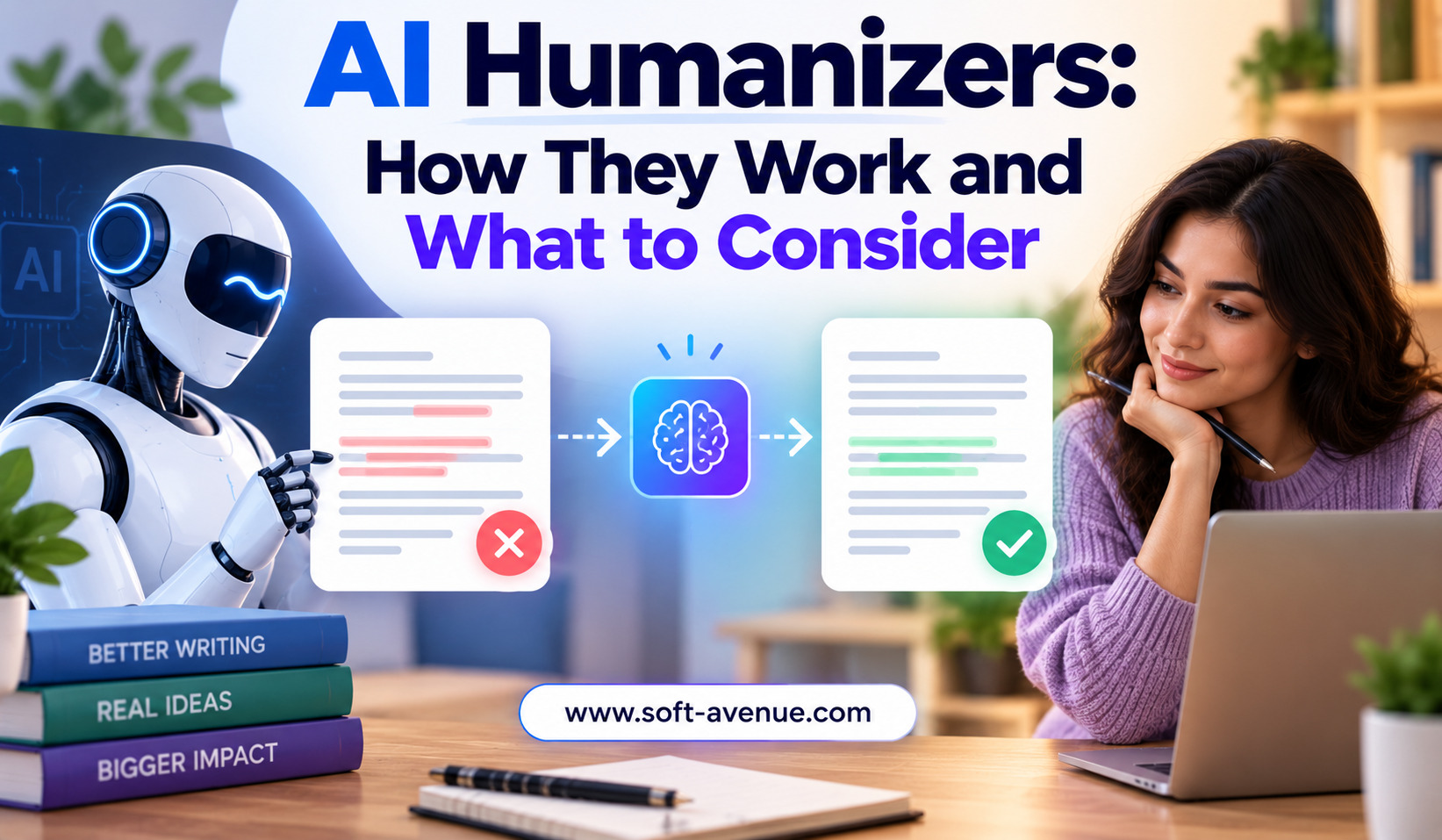
This has led to growing interest in AI humanizers. These tools are designed to rewrite AI-generated or AI-assisted text so that it sounds more natural and conversational. They may adjust sentence structures, word choices, rhythm, and overall tone to create writing that feels less mechanical.
But what exactly does an AI humanizer do, how does it work, and should you use one? Understanding both the benefits and limitations can help you make better decisions.
What Is an AI Humanizer?
An AI humanizer is a software tool that modifies existing text to make its language feel more natural and human-like.
AI-generated writing often follows recognizable patterns. Sentences may have similar structures, transitions can become repetitive, and certain words or phrases may appear more frequently than they would in ordinary human writing.
A humanizer attempts to change these characteristics while preserving the original meaning.
Depending on the platform, it may rewrite sentences, replace certain expressions, vary sentence length, simplify complicated wording, and make the overall tone more conversational.
However, “humanizing” text does not guarantee that the resulting content was written by a person. It simply means the text has been transformed to resemble natural human writing.
How Do AI Humanizers Work?
Most AI humanizers rely on language-processing models to analyze and rewrite text.
The tool first examines the submitted content to understand its meaning, sentence structure, vocabulary, and writing style. It then generates an alternative version using different wording and structures.
For example, a sentence that sounds formal and predictable may be rewritten using a shorter, more conversational structure. Several sentences with similar patterns may also be reorganized to create greater variation.
Some tools focus heavily on readability, while others emphasize tone, vocabulary, sentence variation, or stylistic changes.
The process can be thought of as AI-assisted rewriting rather than simple synonym replacement. A good humanizer attempts to preserve the underlying idea while changing how that idea is expressed.
Why Do People Use AI Humanizers?
There are several legitimate reasons someone might want to humanize AI-assisted writing.
One common reason is readability. AI-generated text can sometimes sound too formal or generic. Rewriting it can make the content feel more approachable.
Another reason is brand voice. A business may use AI to create an initial draft but then want the final version to sound more consistent with its existing communication style.
Humanizers can also be useful when someone uses AI as an editing assistant. For example, a writer might create their own draft, use AI to improve clarity, and then adjust the resulting text so it better reflects their personal voice.
The important distinction is between improving AI-assisted writing and attempting to misrepresent authorship.
AI Humanizers and AI Detectors
AI humanizers are often discussed alongside AI content detectors.
AI detectors attempt to estimate whether text was generated or significantly assisted by AI. They may analyze linguistic characteristics and statistical patterns in the writing.
However, AI detection is not a perfect science. Research has found that detector performance can vary depending on the text, model, length, editing, and other factors. A 2026 study published in Studies in Educational Evaluation found that detector outputs require context-dependent interpretation and that performance can change substantially for hybrid and humanized text.
Other research has also demonstrated the possibility of false positives, where genuinely human-written content is classified as AI-generated. A 2026 exploratory study of authentic Filipino student essays, for example, found inconsistent classifications from two AI detectors.
This means an AI detector score should not automatically be treated as definitive proof of authorship.
Can AI Humanizers Guarantee That Text Will Pass an AI Detector?
No.
This is one of the most important points to understand.
There is no reliable guarantee that text rewritten by an AI humanizer will receive a particular score from an AI detector. Detection systems use different approaches, and their results can change as both generation and detection technologies evolve.
Recent research also highlights an ongoing interaction between AI-generated writing, human editing, and detection systems.
Therefore, choosing a humanizer simply because it promises that content will “always pass” an AI detector should be approached cautiously.
A better reason to use such a tool is to improve readability, clarity, tone, and originality of expression.
Benefits of Using AI Humanizers
One of the main advantages is improved readability. A humanizer can transform stiff or repetitive sentences into language that feels more natural.
It can also help with tone. The same information may need to sound professional in a business report, friendly in a customer email, or conversational in a blog post.
Another advantage is editing speed. Instead of manually rewriting every sentence, a writer can use AI-assisted rewriting to generate alternatives and then choose the version that best fits the intended audience.
Humanizers can also help writers identify places where content feels repetitive. Even when the original writing is human-created, automated rewriting can sometimes provide useful alternative phrasing during the editing process.
Limitations of AI Humanizers
AI humanizers are not perfect.
One problem is that rewriting can accidentally change the meaning of the original sentence. A technically accurate statement may become less precise after several automated transformations.
Another issue is loss of personality. Ironically, attempting to make AI text sound human can sometimes produce another generic form of AI writing.
There can also be factual problems. A humanizer generally focuses on language rather than independently verifying every claim. If the original text contains an incorrect statistic or unsupported statement, rewriting it does not make the information correct.
For important content, fact-checking should therefore remain a separate step.
AI Humanizers Should Not Replace Human Editing
The strongest content usually benefits from genuine human involvement.
A person understands the purpose of the content, the target audience, cultural context, brand personality, and practical experience behind the subject.
AI can suggest improvements, but a human editor can decide whether those suggestions actually make the content better.
For example, a human editor may remove unnecessary sentences, add a personal example, correct an inaccurate statement, or completely rewrite a section that does not sound authentic.
This produces a better result than simply running the entire article through an automated humanizer.
What to Consider Before Choosing an AI Humanizer
If you are considering an AI humanizer, look beyond claims about AI detection.
First, examine how well the tool preserves meaning. A rewrite is only useful if it remains faithful to the original message.
Next, consider readability. The final version should sound clear rather than simply different.
Privacy is also important. Avoid uploading confidential business information, unpublished research, private communications, or sensitive documents without understanding how the service handles submitted content.
Cost matters as well. Some tools offer free limits, while others use monthly subscriptions or usage-based pricing.
Finally, consider whether you actually need a dedicated humanizer. If your main goal is improving grammar, clarity, or tone, a standard writing assistant or careful human editing may be a better solution.
Ethical Considerations
The way an AI humanizer is used matters.
Using AI to improve clarity, rewrite a draft, or adapt content for a particular audience can be a legitimate part of a modern writing workflow.
Problems can arise when someone uses a humanizer to deliberately disguise AI-generated work and misrepresent it as entirely human-created, particularly in situations involving academic submissions, professional credentials, journalism, or contractual work.
Educational institutions and employers may have their own rules about AI-assisted writing. Those rules should be followed rather than relying on a tool to conceal AI involvement.
Transparency is becoming increasingly important as AI becomes part of everyday writing.
How to Use an AI Humanizer Responsibly
A practical approach is to start with your own ideas and research. Use AI when it genuinely helps with drafting, organization, or editing.
After generating or revising text, read the entire piece yourself. Check facts, remove unnecessary wording, restore your natural voice, and make sure the final version accurately represents your intended message.
Instead of asking, “Will this pass an AI detector?” a more useful question is, “Does this sound accurate, useful, original, and appropriate for my audience?”
That shift can lead to much better content.
Final Thoughts
AI humanizers are becoming part of the broader AI writing ecosystem. They can help make AI-assisted text more readable, vary sentence structures, adjust tone, and create writing that feels less mechanical.
However, they should not be viewed as magic tools that can guarantee human authorship or defeat every AI detection system. Detection technology is imperfect, and research shows that results can vary depending on the text and circumstances.
The most effective approach is to treat AI humanizers as editing and rewriting assistants. Combine them with original ideas, reliable research, fact-checking, and genuine human review.
Ultimately, good writing is not defined by whether a machine labels it “human.” It is defined by whether the content communicates ideas clearly, provides value to readers, reflects appropriate expertise, and feels authentic to the person or organization publishing it.
