
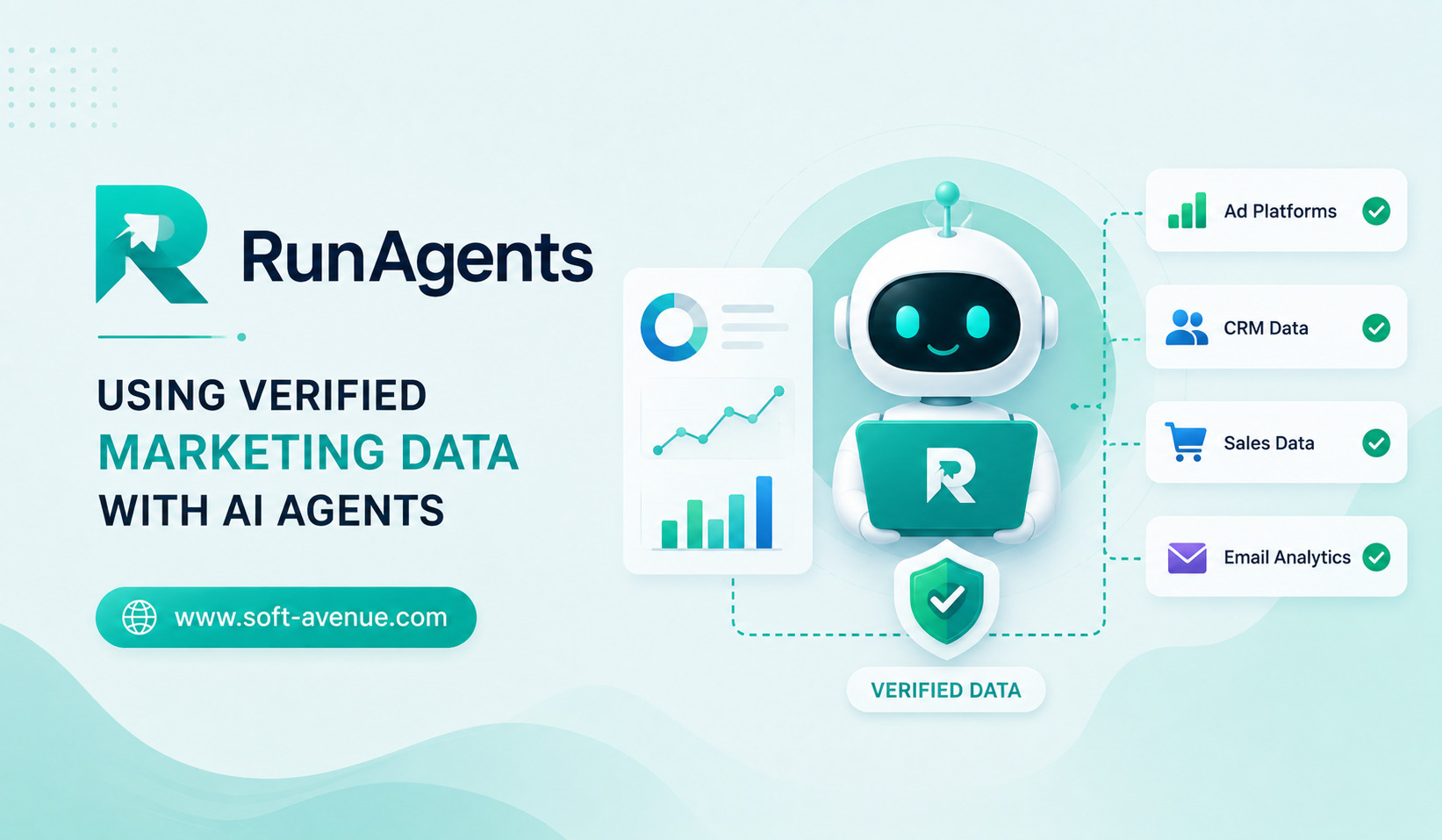
Marketing has become increasingly data-driven. Businesses use information about customers, competitors, campaigns, websites, search behavior, and market trends to make decisions about where to invest their time and money.
At the same time, AI agents are becoming more capable of performing tasks instead of simply answering questions. They can research information, analyze data, generate reports, identify opportunities, and support marketing workflows.
However, AI agents are only as useful as the information they work with.
If an agent relies on outdated, incomplete, or unreliable marketing information, its recommendations can be misleading. This makes verified marketing data an important part of building useful AI-powered marketing systems.
RunAgents represents this approach, focusing on combining AI agents with reliable marketing data to help businesses perform research and make better-informed decisions.
What Is RunAgents?
RunAgents can be understood as an AI-agent approach centered around using marketing data as an input for automated analysis and workflows.
Traditional marketing research often requires people to collect information manually from different sources. A marketer might review competitor websites, analyze search data, examine campaign performance, study customer behavior, and compare market trends before making a decision.
This process can consume considerable time.
AI agents can automate parts of this work, but they need dependable information to produce useful results. A data-focused agent system can therefore combine automation with structured and verified marketing information.
The result is a workflow where AI is not simply generating ideas from a blank prompt. Instead, it can work from a stronger information foundation.
Why Verified Marketing Data Matters
AI systems can produce convincing answers even when the underlying information is incomplete or incorrect.
This is one of the biggest challenges businesses face when using AI for marketing.
Imagine asking an AI agent to identify your company’s strongest competitors. If the data is outdated, the agent could focus on businesses that are no longer major competitors while missing newer companies entering the market.
Similarly, an AI agent analyzing customer trends may reach the wrong conclusion if it receives incomplete information.
Verified data helps reduce these problems by giving the AI a more reliable foundation for analysis.
How AI Agents Can Use Marketing Data
AI agents can potentially work with many different types of marketing information.
This may include customer data, website information, campaign results, keyword information, competitor details, product information, audience research, and other business data.
An agent can then use that information to perform specific tasks.
For example, an AI marketing agent could analyze campaign performance and identify areas that deserve further attention. Another agent could examine competitor information and summarize changes in their positioning.
The key difference is that the AI is working with available evidence rather than relying entirely on general assumptions.
Automating Marketing Research
Marketing research is often repetitive.
A marketer may need to visit multiple websites, collect information, organize findings, compare competitors, and prepare a summary.
An AI agent can potentially automate portions of this workflow.
Instead of manually gathering every piece of information, marketers can establish a process where an agent collects or analyzes approved data and produces a structured result.
This can free marketing professionals to spend more time interpreting the findings and deciding what actions to take.
Competitor Analysis With AI Agents
Competitive research is another area where AI agents can be useful.
Businesses need to understand what competitors are offering, how they position their products, which audiences they target, and how their marketing strategies change over time.
An AI agent can help organize this information and identify notable differences.
For example, it could compare product messaging across several competitors and highlight recurring themes.
However, the quality of this analysis depends on the quality and freshness of the underlying data. Verified information becomes particularly important when businesses are making strategic decisions based on competitive research.
Finding Marketing Opportunities
AI agents can also help businesses discover potential opportunities.
A marketing system might analyze available customer and market data to identify underserved audiences, frequently searched topics, content gaps, or changes in customer interest.
Instead of manually examining large amounts of information, marketers can use AI to identify patterns that deserve closer attention.
This does not mean every AI-generated opportunity will be valuable.
Human marketers still need to evaluate whether an idea fits the brand, audience, budget, and business objectives.
AI can help surface possibilities, while humans decide which ones are worth pursuing.
Improving Marketing Productivity
One of the strongest arguments for AI agents is productivity.
Marketing teams often spend time on tasks that are necessary but repetitive. Data collection, reporting, categorization, summarization, and routine analysis can take hours.
Automating some of these activities can reduce administrative work.
A marketer could potentially ask an AI agent to prepare a campaign summary, organize competitor information, or highlight changes in performance data.
The marketer can then spend more time on creative strategy and decision-making.
Verified Data and AI Hallucinations
The term AI hallucination refers to situations where an AI system generates information that is inaccurate or unsupported.
Using reliable data does not completely eliminate this problem, but it can help create better conditions for evidence-based outputs.
For marketing applications, this distinction matters.
A business should not treat every AI-generated statement as a verified fact. Important claims should be checked against the original data sources, especially when they involve competitors, customers, finances, advertising performance, or strategic decisions.
AI agents should therefore be viewed as analytical assistants rather than unquestionable sources of truth.
Using AI Agents for Reporting
Marketing teams regularly create reports.
These reports may cover website traffic, campaign performance, lead generation, customer engagement, conversions, or content results.
Preparing these reports manually can involve gathering information from multiple systems and converting it into a format that executives or clients can understand.
AI agents can potentially help summarize this information.
For example, an agent could identify significant changes, organize key metrics, and create a first draft of a marketing report.
Human review can then ensure that the conclusions accurately reflect the underlying data.
Benefits for Small Marketing Teams
Small marketing teams can potentially gain significant value from AI agents.
Large companies may have dedicated analysts, researchers, content teams, and performance marketers. A small business may have only one or two people responsible for most marketing activities.
Automation can help smaller teams handle more work without increasing their workload at the same rate.
Verified marketing data gives these teams a stronger foundation for using AI because the system can work with information that is relevant to their actual business.
Challenges of AI-Powered Marketing Data
There are several challenges businesses should consider.
The first is data quality. Even verified information can become outdated, so marketing databases need regular updates.
The second is data integration. Businesses often store information across different platforms. Bringing these sources together can require technical work.
Another challenge is privacy. Customer information should be handled carefully, particularly when AI systems are given access to business databases.
Finally, businesses need to establish clear rules about which data AI agents can access and what actions they are allowed to take.
Human Oversight Remains Important
AI agents can analyze information quickly, but marketing decisions still require context.
A campaign that appears weak based on one metric may actually be supporting another business objective. A competitor’s marketing strategy may look similar to yours but target a completely different audience.
Human marketers understand these nuances.
The best approach is therefore a combination of AI automation and human judgment.
AI can collect information, identify patterns, summarize findings, and suggest possibilities. People can then validate those findings and decide what action to take.
The Future of AI Marketing Agents
As AI agents become more capable, marketing automation could move beyond simple content generation.
Agents may increasingly perform research, monitor market changes, analyze campaign results, identify opportunities, and prepare recommendations.
Verified data will become increasingly important as this happens.
Businesses will not simply need powerful AI. They will need AI systems connected to trustworthy information.
The combination of reliable data and intelligent agents could create marketing workflows that are faster, more consistent, and easier to scale.
Final Thoughts
RunAgents highlights an important principle in AI-powered marketing: intelligent automation needs reliable information.
AI agents can help marketers research markets, analyze competitors, identify opportunities, prepare reports, and automate repetitive tasks. But their usefulness depends heavily on the quality of the data they receive.
Verified marketing data can provide a stronger foundation for AI-assisted decision-making while reducing the risk of relying on outdated or unsupported information.
The future of marketing is unlikely to be about replacing marketers with autonomous systems. Instead, it will increasingly involve humans working alongside AI agents that can process large amounts of reliable information and turn it into useful insights.
For businesses looking to adopt AI in marketing, combining trusted data, intelligent automation, and human oversight can be a practical path toward more efficient and informed decision-making.
