Artificial intelligence development is becoming increasingly multi-model. Instead of relying on one AI provider for every task, businesses and developers are experimenting with different models for coding, reasoning, writing, research, summarization, data analysis, and other workloads.
This creates an opportunity, but it also creates a technical challenge.
Every AI provider can have different APIs, authentication methods, model names, pricing structures, request formats, and usage limits. Managing several integrations separately can make an AI application more difficult to build and maintain.
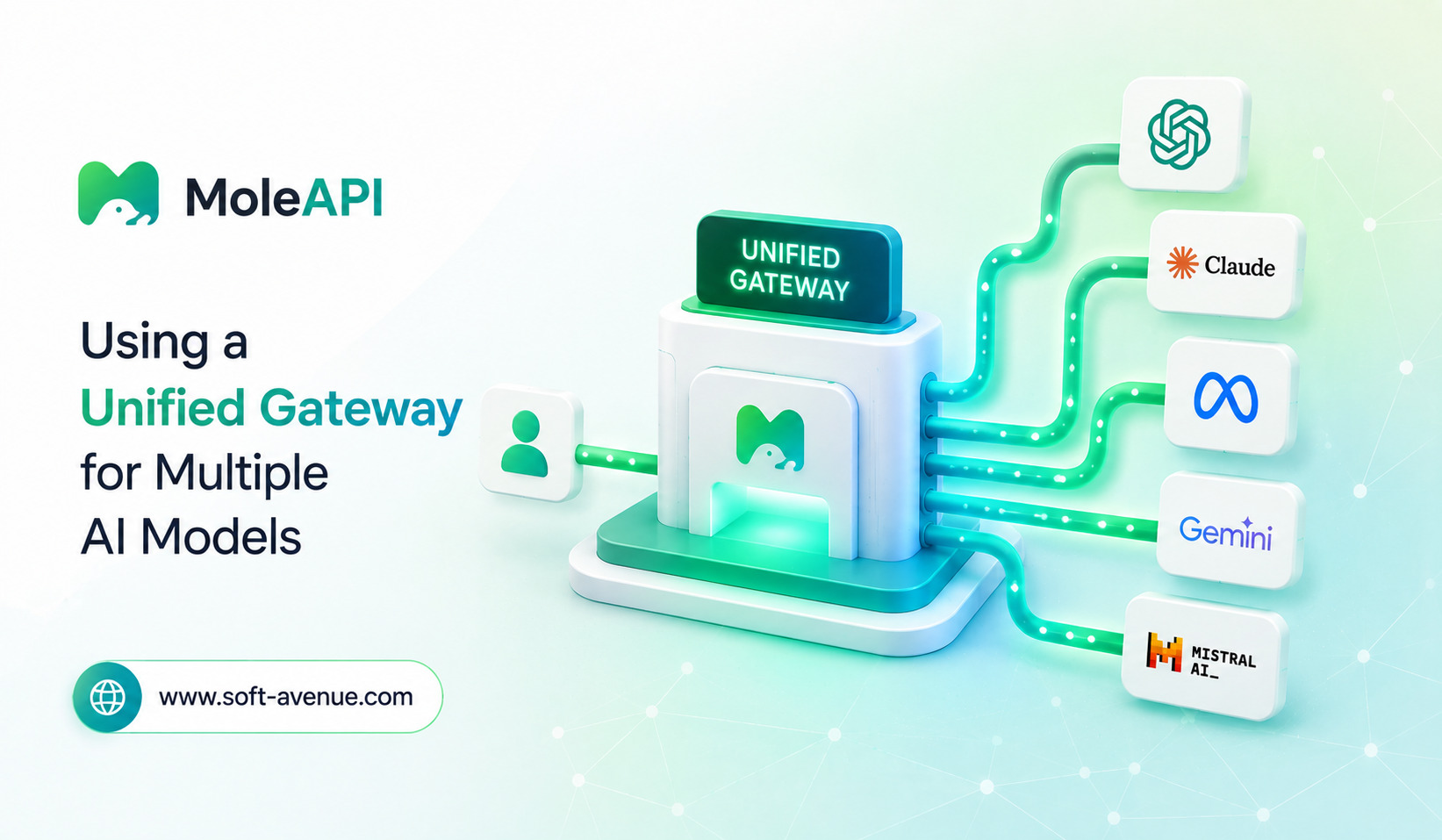
MoleAPI represents the idea of solving this problem through a unified gateway for multiple AI models. Rather than connecting an application independently to every model provider, a gateway can provide a common interface through which developers can access different models.
This approach can simplify development, improve flexibility, and make it easier to experiment with the rapidly changing AI model ecosystem.
What Is MoleAPI?
MoleAPI can be understood as a unified API gateway designed around access to multiple AI models.
The basic concept is straightforward. Instead of an application communicating directly with several AI providers, it communicates with a single gateway.
The gateway can then route requests to the appropriate model.
For developers, this creates an abstraction layer between the application and the underlying AI providers.
That layer can potentially make it easier to change models, compare providers, manage requests, and build applications that are not dependent on a single AI service.
Why Developers Need a Unified AI Gateway
Modern AI applications often use more than one model.
A company may want one model for complex reasoning, another for fast responses, and another for coding or large-context tasks.
Without a unified gateway, developers may need to integrate each provider separately.
That can involve maintaining different SDKs, API credentials, request structures, response formats, and error-handling systems.
A unified gateway can reduce some of this complexity.
Instead of creating multiple integrations, developers can build their application around one interface and select the appropriate model through that gateway.
How a Multi-Model Gateway Works
A typical unified AI gateway sits between an application and several model providers.
The process can look like this:
Application → Unified Gateway → Selected AI Model → Response → Application
A user sends a request through the application.
The gateway receives the request and identifies the model or routing rule associated with it. It then forwards the request to the appropriate AI provider.
The provider generates a response, which travels back through the gateway and reaches the application.
This structure allows developers to work with different models without necessarily exposing every provider integration throughout their application code.
One Interface for Multiple Models
One of the biggest advantages of a unified gateway is consistency.
Different AI providers may use slightly different APIs and conventions.
A gateway can provide a standardized interface so that applications have fewer provider-specific dependencies.
This can be particularly useful when developers want to test several models.
Instead of rebuilding the application every time they change models, they can potentially switch the model configured behind the gateway.
This makes experimentation faster and can reduce development effort.
Switching Between AI Models
The AI market changes quickly.
New models are released regularly, while existing models receive updates, pricing changes, or new capabilities.
A model that is ideal for an application today may not remain the best option forever.
A unified gateway can make switching easier.
For example, a developer could test two different models for the same workflow and compare their output quality, speed, and cost.
If another model becomes more suitable later, the application can potentially be redirected to it without redesigning the entire AI architecture.
This flexibility can be valuable for startups that want to avoid making their entire product dependent on one provider.
Reducing Vendor Lock-In
Vendor lock-in occurs when an application becomes so dependent on one provider that moving elsewhere becomes difficult.
This can happen when provider-specific APIs and features are deeply integrated into the application’s code.
A multi-model gateway can create a layer of separation.
The application communicates with the gateway, while the gateway handles communication with individual model providers.
This does not eliminate vendor dependence completely, but it can make the architecture more flexible.
Developers can potentially introduce alternative models without replacing every AI-related component of the application.
Cost Management
AI model pricing varies considerably.
Some models are designed for high-end reasoning and may cost more per request. Others focus on speed or efficiency and can be more economical for routine workloads.
A unified gateway can help businesses create a multi-model strategy.
Simple requests could potentially use a lower-cost model, while complex tasks could be assigned to a more advanced model.
For high-volume applications, this type of flexibility can become particularly important.
Instead of automatically sending every request to the most expensive available model, developers can evaluate which model provides sufficient quality for each workload.
Intelligent Model Routing
A unified gateway can also become the foundation for intelligent routing.
Rather than requiring users to manually select a model, an application could use predefined rules to determine where a request should go.
For example, a business application might route short classification tasks to a fast model while sending complex analysis to a more capable reasoning model.
Routing decisions can potentially consider factors such as task complexity, response time, model availability, cost, or required context.
This turns the gateway from a simple API connection into an important part of AI infrastructure.
Useful for AI Startups
Startups often need to move quickly.
During the early stages of product development, a team may test several models before deciding which technology best fits its users.
A unified gateway can make this experimentation easier.
Developers can compare different models without building an entirely new integration for each experiment.
This can help startups focus on product development instead of spending excessive time maintaining AI-provider-specific infrastructure.
It can also make it easier to respond when the AI market changes.
Enterprise AI Applications
Larger companies can also benefit from a multi-model architecture.
Enterprises often operate multiple AI projects across different departments.
Customer service may require one type of model, internal knowledge search another, and software development yet another.
A unified gateway can provide a common layer for accessing these models.
Organizations can potentially centralize aspects of authentication, monitoring, usage management, and model selection.
This can make a multi-model AI strategy easier to manage as the number of applications grows.
Monitoring AI Usage
Another important role for a gateway is visibility.
When applications connect directly to several AI providers, usage information can become fragmented.
A centralized gateway can potentially provide a common point for monitoring requests.
Businesses may be able to analyze which models are being used, how frequently they are accessed, and which applications generate the most AI traffic.
This information can support better infrastructure and budget decisions.
For example, a company might discover that a particular workflow is using an expensive model for relatively simple requests.
The team could then evaluate whether a less expensive model would provide acceptable results.
Security and Access Control
Centralizing AI access also introduces security considerations.
API credentials should be protected carefully, and applications should only have access to the models and capabilities they require.
A gateway can potentially provide a central location for authentication and access policies.
Organizations can establish rules around who can use particular models and which applications are allowed to make certain requests.
However, centralization also means the gateway becomes an important part of the security architecture.
If the gateway experiences an outage or security problem, multiple AI applications could be affected.
Strong security practices are therefore essential.
Reliability and Failover
AI applications often depend on external services.
A model provider can experience downtime, capacity issues, or temporary availability problems.
A multi-model gateway can potentially provide more resilience by supporting alternative models.
If one provider becomes unavailable, an application may be able to route certain requests elsewhere, depending on the gateway’s capabilities and the application’s requirements.
This does not guarantee uninterrupted service, but a multi-provider architecture can provide more options than relying entirely on one model.
Challenges of Unified AI Gateways
Despite their advantages, unified gateways are not a complete solution.
Different AI models have different capabilities. A standardized API cannot make two models behave identically.
Prompt compatibility, context limits, tool support, output quality, and reasoning behavior can vary significantly.
Developers therefore still need to evaluate models individually.
There can also be additional latency because requests pass through an intermediary.
For applications where milliseconds matter, this needs to be considered carefully.
Privacy is another concern. Businesses should understand what information passes through the gateway, how requests are handled, and what data retention policies apply.
The Future of Multi-Model AI
The AI industry is moving toward an environment where multiple models coexist.
Instead of one model dominating every workload, applications may use different models according to their specific strengths.
This makes infrastructure increasingly important.
Unified gateways such as the approach represented by MoleAPI can provide a practical abstraction layer between applications and an increasingly diverse collection of AI models.
In the future, these gateways may become more intelligent, automatically evaluating model quality, cost, speed, and availability before deciding where a request should be processed.
Final Thoughts
MoleAPI represents an important concept in modern AI development: accessing multiple AI models through a unified gateway.
For developers, this approach can simplify integrations and make it easier to experiment with different models. For businesses, it can provide greater flexibility around cost, performance, reliability, and vendor selection.
The biggest advantage is not simply having access to more models. It is having the ability to choose between them without rebuilding an application every time the AI landscape changes.
As businesses increasingly adopt multi-model AI strategies, unified gateways could become an important layer of the technology stack.
The future of AI development may not be about finding one model that does everything. Instead, it may be about building flexible systems that know which model to use, when to use it, and how to manage those models efficiently.
