Small businesses generate more data than ever. Customer details, sales records, invoices, website activity, marketing results, inventory information, employee records, and financial transactions can quickly become difficult to manage.
The problem is not always a lack of data. In many cases, the challenge is turning scattered information into something useful.
Small business owners may spend hours copying information between spreadsheets, checking records, preparing reports, updating customer information, and looking for patterns in their data. These repetitive tasks take time away from activities that directly contribute to business growth.
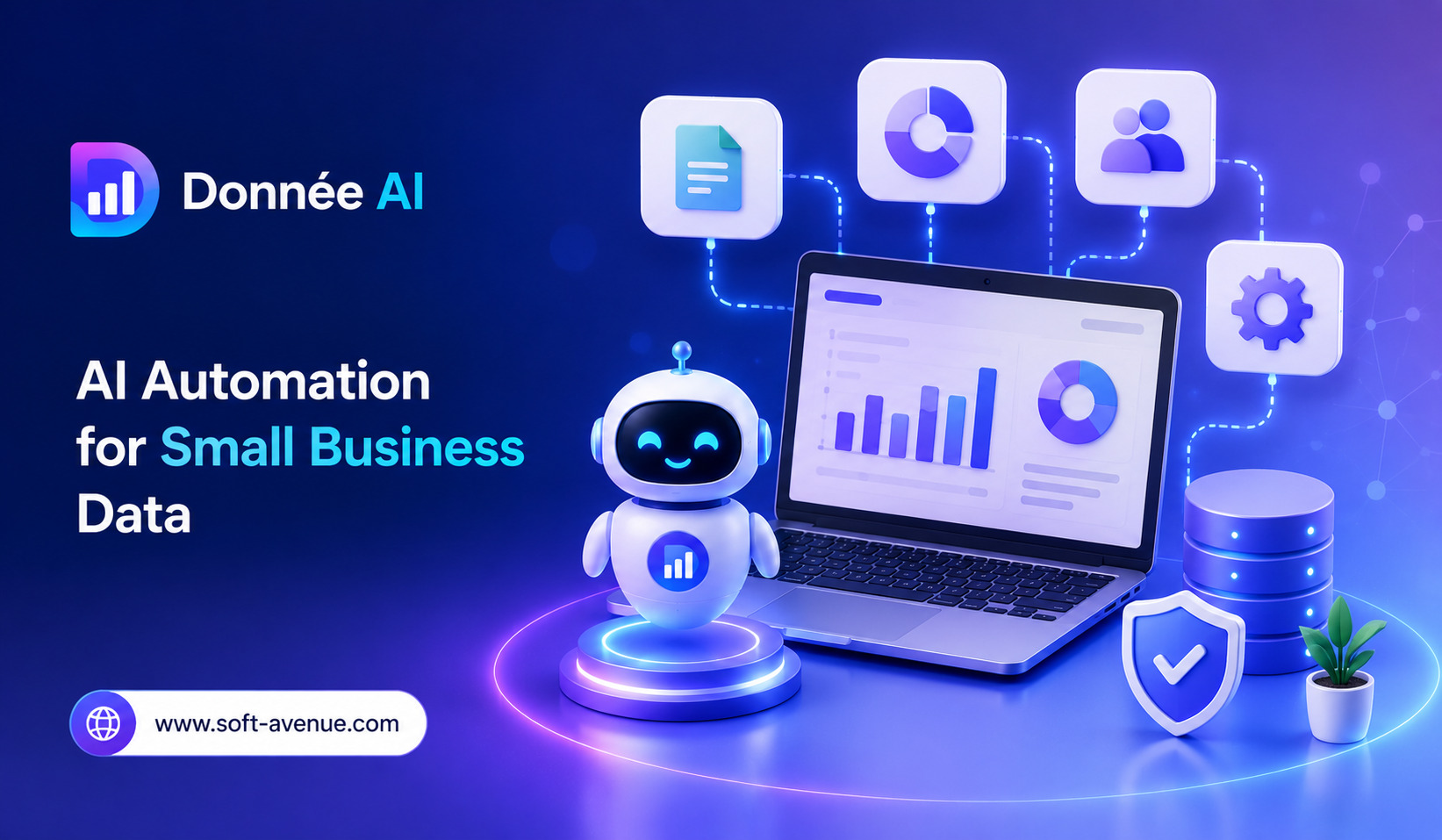
Artificial intelligence is creating new ways to automate these processes. Donnée AI represents the growing category of AI-powered solutions designed to help businesses work more efficiently with their data.
By combining automation with AI-driven data processing, businesses can potentially reduce manual work, organize information more effectively, and make faster decisions.
What Is Donnée AI?
Donnée AI can be viewed as an AI automation approach focused on helping businesses work with their data.
The basic idea is simple: instead of requiring employees to manually process every piece of information, AI can assist with repetitive data-related activities.
These activities can include organizing information, extracting important details, transforming data into useful formats, generating summaries, and supporting business workflows.
For small businesses, this can be particularly useful because they often operate with limited staff. A business owner may simultaneously handle sales, marketing, customer service, administration, and operations.
Automating routine data work can give small teams more time to focus on customers and growth.
Why Small Businesses Need Data Automation
Large companies often have dedicated data teams and sophisticated software systems.
Small businesses usually do not have the same resources.
A local retailer, service provider, online store, or growing startup may depend heavily on spreadsheets and manually updated software. While these systems can work at a small scale, they become increasingly difficult to maintain as the business grows.
Data automation can reduce some of this pressure.
Instead of manually transferring information from one system to another, automated workflows can potentially move and organize information automatically.
The result is a business process that requires fewer repetitive actions from employees.
Turning Scattered Data Into Useful Information
Business information is often spread across multiple places.
A company might store customer details in a CRM, sales information in accounting software, marketing statistics in another platform, and operational information in spreadsheets.
Looking at each system separately makes it difficult to understand the complete picture.
AI automation can help bring information together and transform raw data into more understandable outputs.
For example, a business could potentially use an automated workflow to collect sales information, identify important changes, summarize performance, and prepare a report for management.
Instead of spending hours preparing the report, employees can focus on understanding what the numbers mean.
Automating Data Entry
Data entry is one of the most repetitive business activities.
Employees may need to copy names, addresses, product information, order details, invoice numbers, or customer requests from one system into another.
Manual entry creates two problems: it consumes time and can introduce errors.
AI-powered automation can potentially extract information from documents, emails, forms, and other sources and transfer it into the appropriate business system.
This does not eliminate the need for review, particularly when the information is important or sensitive. However, it can significantly reduce the amount of repetitive typing involved.
AI for Business Reporting
Reports help business owners understand what is happening inside their company.
However, preparing reports can be time-consuming.
AI can assist by transforming raw business data into summaries that are easier to understand.
A small business owner could potentially receive a report highlighting sales changes, customer activity, inventory movements, or marketing performance without manually calculating every metric.
The important advantage is speed.
When information becomes easier to access, business owners can make decisions based on more current data rather than relying on outdated spreadsheets.
Customer Data Automation
Customer information is one of the most valuable types of business data.
Companies may collect names, contact details, purchase histories, support interactions, preferences, and engagement information.
Keeping this information accurate can become difficult as customer numbers increase.
AI automation can potentially help organize customer records and identify missing or inconsistent information.
It can also support workflows such as categorizing customer inquiries, summarizing interactions, or identifying customers who may require follow-up.
Better-organized customer data can ultimately support a more consistent customer experience.
Supporting Sales Teams
Sales teams generate significant amounts of data.
Every lead, conversation, proposal, follow-up, and purchase can create information that needs to be recorded.
For a small business, manually maintaining these records can be difficult.
AI automation can potentially help capture information from sales interactions and organize it into a CRM or another business system.
It can also help identify which leads require attention.
This allows salespeople to spend less time updating records and more time communicating with potential customers.
Automating Marketing Data
Marketing produces data from many different sources.
Businesses may track website visitors, email campaigns, social media activity, advertisements, search traffic, and conversions.
Collecting these numbers is only the first step.
The real challenge is understanding what they mean.
AI can potentially summarize marketing performance and identify changes that deserve attention.
For example, an automated system might highlight that website traffic has increased while conversions have declined.
That information can encourage the marketing team to investigate the reason rather than simply looking at traffic numbers.
Inventory and Operations
Data automation can also support everyday operations.
Retailers and product-based businesses need to monitor inventory, orders, suppliers, and product movement.
Manual updates can lead to delays or inconsistent records.
Automated workflows can potentially collect information from sales systems and update inventory-related records.
AI can also assist with identifying unusual patterns, such as products that are selling faster than expected or items that have remained inactive for an extended period.
This can help businesses respond before operational problems become larger issues.
Saving Time for Small Teams
One of the biggest benefits of AI automation is time savings.
A small company may not have enough employees to dedicate someone to every administrative task.
When repetitive processes are automated, existing employees can spend more time on work that requires human judgment.
For example, instead of manually preparing a daily report, an employee could spend that time speaking with customers.
Instead of copying information between systems, a salesperson could follow up with leads.
Automation therefore has the potential to increase the effective capacity of a small team without simply adding more employees.
Improving Data Accuracy
Human error is a natural part of repetitive data processing.
A misplaced number, incorrect customer name, duplicated record, or missing field can create problems later.
Automation can reduce certain types of manual errors by applying consistent processes.
However, automation itself is not guaranteed to be accurate.
AI systems can misinterpret information, especially when dealing with poorly formatted documents or incomplete data.
Businesses should therefore combine automation with validation and appropriate human review.
Data Privacy and Security
Small businesses should also think carefully about how AI systems handle business information.
Customer records, financial information, employee data, and internal documents can be sensitive.
Before adopting an AI automation platform, businesses should understand where data is processed, how it is stored, who can access it, and what security controls are available.
Access should be limited to the information required for each workflow.
Businesses should also avoid sending sensitive information to AI systems without understanding the relevant privacy and security implications.
AI Automation Without Replacing Employees
A common concern about AI is that automation will eliminate jobs.
For many small businesses, a more practical approach is to use AI as an assistant rather than a complete replacement for employees.
People remain important for judgment, communication, creativity, relationship building, and decision-making.
AI can take responsibility for repetitive data processing while employees oversee the process.
This creates a human-and-AI workflow where technology handles routine work and people concentrate on higher-value activities.
Challenges of AI Data Automation
AI automation is not a solution to every data problem.
Businesses need reasonably clean and organized information for automated systems to work effectively.
Poor data can produce poor results.
There can also be integration challenges when different software platforms use incompatible formats or lack appropriate connections.
Small businesses should therefore start with clearly defined processes.
Automating one repetitive workflow and measuring its results can be more effective than trying to automate the entire company immediately.
The Future of Small Business Data Management
As AI becomes more accessible, advanced data automation is likely to become available to smaller companies rather than remaining exclusive to large enterprises.
Future AI systems may be able to continuously monitor business information, identify unusual activity, generate reports, update records, and recommend actions.
This could make data management more proactive.
Instead of waiting for an employee to discover a problem in a spreadsheet, an AI system could potentially identify the issue and bring it to the owner’s attention.
The result could be a more responsive and data-driven small business.
Final Thoughts
Donnée AI represents the broader movement toward using artificial intelligence to automate small business data workflows.
For small companies, the value of AI automation is not simply about having sophisticated technology. It is about reducing repetitive work and making business information easier to use.
From data entry and customer management to reporting, sales, marketing, and inventory, AI can potentially help small teams process information more efficiently.
However, successful automation requires more than connecting an AI tool to business data. Companies need clear workflows, reliable information, appropriate permissions, privacy controls, and human oversight.
When implemented thoughtfully, AI-powered data automation can give small businesses something extremely valuable: more time to focus on customers, strategy, and growth instead of routine data management.
