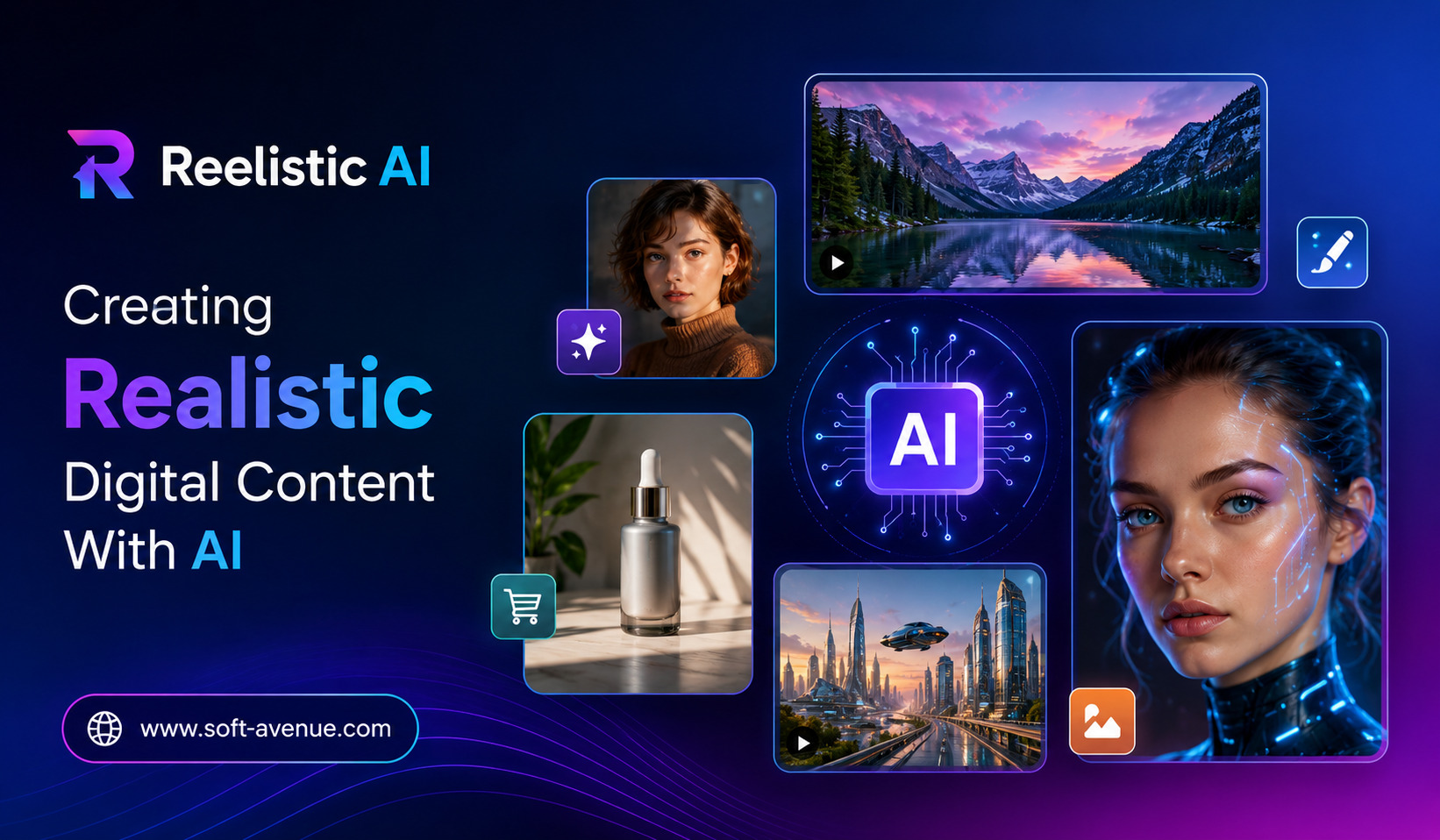
Artificial intelligence is changing the way digital content is created. Producing professional-looking images, videos, advertisements, presentations, product visuals, and social media content once required specialized software, expensive equipment, and significant production time.
Today, AI can automate many parts of that process.
Reelistic AI represents the growing category of AI-powered content creation tools designed to produce realistic digital content from simple instructions. Instead of building every visual element manually, users can describe what they want and use AI to generate or enhance the result.
This development is particularly relevant for marketers, creators, businesses, designers, educators, and anyone who needs high-quality digital content regularly.
What Is Reelistic AI?
Reelistic AI can be understood as an AI-powered approach to creating realistic digital media.
Traditional content production often requires multiple stages. A company creating a promotional image might need a photographer, location, lighting equipment, models, editing software, and a designer.
AI can reduce some of these requirements by generating visual concepts digitally.
A user can provide a description of a scene, product, character, environment, or marketing concept. The AI then interprets the instructions and creates content based on the requested characteristics.
The exact capabilities depend on the platform, but the broader goal is to make realistic digital production faster and more accessible.
Why Realistic AI Content Is Becoming Popular
The demand for digital content continues to grow.
Businesses need images for websites, social media, advertisements, online stores, presentations, and marketing campaigns. Creators need visuals for videos, blogs, thumbnails, and promotional material.
Producing everything manually can be expensive and time-consuming.
AI-generated content provides another option.
Instead of arranging a physical photoshoot for every concept, a business can potentially create digital visuals based on its requirements.
This can make experimentation faster and allow smaller teams to produce more content.
How AI Creates Realistic Digital Content
Modern generative AI systems can interpret natural-language prompts and convert them into visual outputs.
A user might describe a product placed on a modern office desk with specific lighting and a particular background.
The AI interprets details such as objects, composition, environment, style, and atmosphere before generating an image.
For video generation, AI can also create moving scenes based on descriptions or transform existing material according to instructions.
The technology is continually developing, making it possible to produce increasingly detailed digital media.
AI for Marketing Content
Marketing is one of the biggest areas where realistic AI content can be useful.
Brands constantly need fresh visuals for campaigns.
AI can help marketers create initial concepts for advertisements, social media posts, landing pages, banners, and promotional campaigns.
For example, a company launching a new product could generate several visual concepts before deciding which direction to use for its final campaign.
This can reduce the cost of experimentation.
Instead of investing heavily in one concept immediately, marketers can explore multiple possibilities first.
Product Visualization
E-commerce businesses rely heavily on product imagery.
High-quality product photography can be expensive, particularly for companies with large catalogs.
AI-generated visuals can potentially supplement traditional photography by creating backgrounds, environments, or promotional compositions.
For example, a product could be visualized in different settings for different campaigns.
However, businesses should be careful not to create visuals that falsely represent the actual product.
If an AI-generated image shows features, dimensions, colors, or materials that the real product does not have, customers could be misled.
Accuracy should therefore remain a priority.
AI-Generated Social Media Content
Social media requires a steady flow of new content.
Creators and businesses may struggle to maintain consistent visual output while handling other responsibilities.
AI can help generate content ideas and visual assets.
A marketing team could create different versions of a campaign for different platforms, while a creator could experiment with various visual styles.
The benefit is not simply producing more content.
AI can also make experimentation easier.
Users can test different concepts before deciding which ones deserve additional production effort.
Supporting Video Creation
AI-generated video is another rapidly developing area.
Traditional video production can involve cameras, locations, actors, lighting, editing, sound, and post-production.
AI can automate portions of this process.
Depending on the tool, users may be able to generate short scenes, animations, product demonstrations, backgrounds, or other digital video elements.
This can be especially useful for short-form marketing content and creative experimentation.
However, realistic video generation also creates additional concerns around authenticity and misinformation.
Digital Avatars and Virtual Presenters
AI can also be used to create digital presenters or avatars.
Businesses may use virtual presenters for training, product explanations, educational videos, or internal communications.
This can reduce the need to record a new video every time information changes.
For example, a company could potentially create a standardized digital presenter for instructional material.
However, realistic avatars should be clearly presented in appropriate contexts so audiences understand whether they are interacting with a real person or an AI-generated representation.
Benefits for Small Businesses
Large organizations may have dedicated creative teams, but small businesses often work with limited resources.
AI content tools can help smaller companies compete visually without building a large production department.
A small online store could create promotional visuals. A local service business could develop social media graphics. A startup could produce early advertising concepts.
This can lower some of the barriers associated with professional digital content production.
AI does not eliminate the need for good branding, but it can make content creation more accessible.
Faster Content Production
Speed is one of the strongest advantages of generative AI.
Traditional production may take days or weeks depending on the complexity of the project.
AI can produce initial concepts much faster.
This allows creative teams to move through the idea stage quickly.
Instead of spending significant resources creating one concept, teams can generate several possibilities, review them, and focus human effort on the strongest direction.
This can improve creative iteration.
Personalization at Scale
AI-generated content can also support personalization.
Businesses may want different visuals for different audiences, locations, products, or campaigns.
Creating every variation manually can be difficult.
AI can potentially help produce multiple versions based on predefined requirements.
For example, an advertising campaign could use different backgrounds or visual themes while maintaining consistent brand elements.
Human review remains important to ensure that every version is appropriate and accurate.
Challenges of Realistic AI Content
Realistic AI generation has limitations.
AI-generated images can sometimes contain visual inconsistencies, inaccurate details, or unnatural elements.
Video generation can produce problems with movement, object continuity, or physical interactions.
Text inside generated images can also be unreliable depending on the technology.
For professional campaigns, human review and editing are therefore still important.
AI-generated content should be treated as a creative production tool rather than an automatic guarantee of perfection.
The Authenticity Problem
The more realistic AI content becomes, the harder it can be for audiences to distinguish between real and synthetic media.
This creates an important responsibility for creators and businesses.
AI should not be used to deliberately misrepresent people, events, products, or experiences.
When synthetic content could reasonably confuse an audience, appropriate disclosure can help maintain trust.
Transparency is especially important when realistic digital people or manipulated real-world scenarios are involved.
Copyright and Ownership Considerations
AI-generated content can also raise questions about copyright and ownership.
Businesses should understand the terms of the AI platform they use and any applicable laws concerning generated material.
They should also avoid using protected brands, characters, people, or creative works in ways that could create legal problems.
AI tools can accelerate production, but legal responsibility does not automatically disappear because an algorithm created the content.
Protecting Personal Identity
Realistic AI technology can reproduce recognizable faces and appearances.
Users should be careful when working with images of real people.
Creating or manipulating someone’s likeness without permission can raise serious ethical and legal concerns.
Businesses should establish clear policies for using employee, customer, influencer, or public-figure imagery.
Consent and transparency are important when creating realistic digital representations.
AI Content and Human Creativity
AI-generated content does not necessarily mean human creativity becomes less important.
In many workflows, AI handles the repetitive or technically demanding parts while people focus on concepts, storytelling, brand direction, and final decisions.
A creative professional can use AI to explore ideas quickly and then refine the strongest concept manually.
This creates a collaborative workflow between human creativity and machine generation.
The Future of Realistic Digital Content
AI-generated digital media is likely to become increasingly sophisticated.
Future systems may provide greater control over characters, environments, camera movement, lighting, product placement, and visual consistency.
Businesses could eventually create entire campaign concepts from short creative briefs.
At the same time, standards around disclosure, consent, copyright, and authenticity will become increasingly important.
The challenge will not simply be making AI content look realistic. It will be using that realism responsibly.
Final Thoughts
Reelistic AI represents the broader movement toward realistic digital content creation powered by artificial intelligence.
AI can help businesses and creators produce images, videos, marketing materials, product visuals, and other digital assets faster than traditional workflows alone.
For small businesses, the technology can make professional-looking content more accessible. For creative teams, it can accelerate experimentation and reduce repetitive production work.
However, realistic AI content also comes with responsibilities. Accuracy, authenticity, privacy, consent, copyright, and transparency should remain central to any professional workflow.
The most effective approach is not to replace human creativity with AI, but to combine the speed of artificial intelligence with human judgment.
As generative technology continues to improve, the ability to create realistic digital content will become increasingly accessible. The businesses and creators that use it thoughtfully will be better positioned to benefit from its creative potential while maintaining audience trust.
