Introduction
Artificial Intelligence (AI) has moved beyond being a futuristic concept and has become a practical business technology that is reshaping the digital marketing industry. In 2026, businesses of every size—from local startups to multinational brands—are integrating AI into their marketing strategies to improve efficiency, enhance customer experiences, and make smarter business decisions. Instead of relying solely on manual processes and assumptions, marketers now use AI to understand consumer behavior, create personalized campaigns, automate repetitive tasks, and measure performance with greater accuracy .
The digital landscape has become more competitive than ever. Customers interact with brands through websites, search engines, social media platforms, mobile applications, and email. They expect instant responses, personalized recommendations, and relevant content regardless of where they engage with a business. Meeting these expectations manually is becoming increasingly difficult, especially for small marketing teams working with limited budgets and resources.
Artificial intelligence addresses these challenges by acting as an intelligent assistant rather than a replacement for marketers. It helps professionals complete repetitive tasks faster while providing insights that would otherwise require hours of research and analysis. This shift allows marketing teams to spend more time developing creative strategies, building stronger customer relationships, and delivering campaigns that create measurable business results.
The Evolution of Digital Marketing in the AI Era
Digital marketing has experienced significant changes over the past decade. Earlier, marketers depended heavily on manual keyword research, spreadsheet analysis, campaign monitoring, and audience segmentation. Every blog article, advertising campaign, email newsletter, and social media calendar required extensive planning and execution. While these traditional methods still play an important role, artificial intelligence has dramatically improved how efficiently these activities are performed.
Today’s AI-powered marketing platforms analyze large amounts of customer data in real time. They identify purchasing patterns, detect emerging trends, and recommend marketing actions based on consumer behavior. Instead of spending days analyzing reports, marketers receive actionable insights within minutes, enabling them to respond quickly to market changes.
This transformation has also made advanced marketing capabilities accessible to smaller businesses. Companies that previously lacked the budget for large marketing teams can now use AI-powered tools to compete with larger organizations, making digital marketing more efficient and data-driven than ever before.
AI Is Redefining Content Creation
Content remains the foundation of successful digital marketing, but maintaining a consistent publishing schedule is one of the biggest challenges businesses face. Modern brands need blog articles, landing pages, product descriptions, newsletters, videos, social media posts, and advertising copy to stay visible online.
Artificial intelligence has simplified this process by assisting marketers throughout the content creation journey. AI writing assistants generate outlines, suggest headlines, improve readability, rewrite paragraphs, and help overcome writer’s block. Instead of replacing writers, these tools reduce repetitive work and accelerate the first draft, allowing professionals to focus on editing, storytelling, and brand messaging.
Visual content has undergone a similar transformation. AI-powered design tools enable businesses to create social media graphics, banners, presentations, advertisements, and promotional materials without advanced graphic design skills. Video editing has also become faster through automated subtitles, background removal, voice generation, and intelligent editing suggestions.
As a result, businesses can produce more content in less time while maintaining consistent quality across multiple marketing channels.
Personalization Is Driving Better Customer Experiences
Today’s consumers expect brands to understand what they like and what they need. Generic marketing campaigns are becoming less effective because customers respond more positively to personalized experiences.
Artificial intelligence enables marketers to analyze customer interactions across websites, email campaigns, online stores, and social media platforms. By evaluating browsing history, purchase behavior, geographic location, and engagement patterns, AI helps businesses deliver highly relevant recommendations and personalized messaging.
For example, an online retailer can recommend products based on previous purchases, while a travel company can suggest destinations that align with a customer’s browsing history. Email campaigns can also be customized for different audience segments, increasing engagement and improving conversion rates.
Rather than treating every customer the same, AI enables businesses to communicate with individuals in ways that feel more relevant and valuable.
Smarter SEO Through Artificial Intelligence
Search engine optimization has become increasingly complex as search engines prioritize content that genuinely satisfies user intent. Traditional SEO methods often focused heavily on keyword density and manual competitor research. Today, AI is helping marketers adopt a more strategic approach.
AI-powered SEO platforms analyze search trends, evaluate competitors, identify content gaps, and recommend improvements based on user behavior. They assist marketers in selecting relevant keywords while ensuring that content remains informative, engaging, and easy to understand.
Instead of creating content primarily for search engines, businesses are using AI to better understand what audiences actually want. This approach not only improves search rankings but also builds trust with readers by delivering valuable information that answers their questions.
Social Media Marketing Is Becoming More Intelligent
Managing multiple social media platforms requires continuous planning, publishing, monitoring, and optimization. Artificial intelligence has simplified these responsibilities by helping businesses identify the best posting schedules, analyze audience engagement, monitor conversations, and discover emerging trends.
AI-powered tools evaluate customer interactions beyond simple metrics such as likes and shares. They analyze audience sentiment to determine whether responses are positive, neutral, or negative, allowing brands to adjust their communication strategies accordingly.
Advertising on social media has also improved through AI-driven optimization. Marketing platforms automatically adjust audience targeting, advertising budgets, and creative performance based on campaign results, enabling businesses to maximize return on investment without constant manual intervention.
Email Marketing Continues to Evolve
Despite the growth of social media and messaging platforms, email remains one of the most effective digital marketing channels. Artificial intelligence has enhanced email marketing by making campaigns more personalized and data-driven.
Instead of sending identical emails to every subscriber, AI analyzes customer behavior to determine the most relevant content, subject lines, product recommendations, and delivery times for each audience segment. This personalization improves open rates, click-through rates, and overall customer engagement.
AI also assists marketers by identifying inactive subscribers, recommending re-engagement campaigns, and predicting which customers are most likely to convert. These insights help businesses strengthen customer relationships while improving overall marketing performance.
Traditional Marketing vs AI-Powered Marketing
| Marketing Area | Traditional Marketing | AI-Powered Marketing |
| Content Creation | Manual writing and editing | Faster AI-assisted drafting with human refinement |
| Customer Targeting | Broad audience segmentation | Personalized messaging based on behavior |
| SEO | Manual research and optimization | AI-driven keyword analysis and content recommendations |
| Social Media | Manual scheduling and reporting | Automated publishing and engagement insights |
| Email Marketing | Generic campaigns | Personalized emails optimized by AI |
| Performance Analysis | Historical reports | Real-time predictive analytics |
Benefits Businesses Are Seeing
Businesses implementing AI in their marketing strategies consistently report measurable improvements. Instead of spending excessive time on repetitive administrative work, marketing teams can focus on creativity and long-term planning.
The most significant benefits include:
- Increased productivity through workflow automation.
- Better customer engagement with personalized marketing.
- Faster campaign execution and optimization.
- More accurate decisions supported by real-time analytics.
Challenges Businesses Should Consider
While AI provides significant advantages, successful implementation requires responsible use. Businesses should review AI-generated content carefully to ensure factual accuracy and maintain a consistent brand voice. Customer privacy should remain a priority, particularly when using AI systems that process personal information.
Employee training is equally important. AI tools are most effective when marketing professionals understand how to interpret insights, write effective prompts, and combine automation with strategic thinking. Organizations that balance technology with human expertise achieve the strongest results.
Conclusion
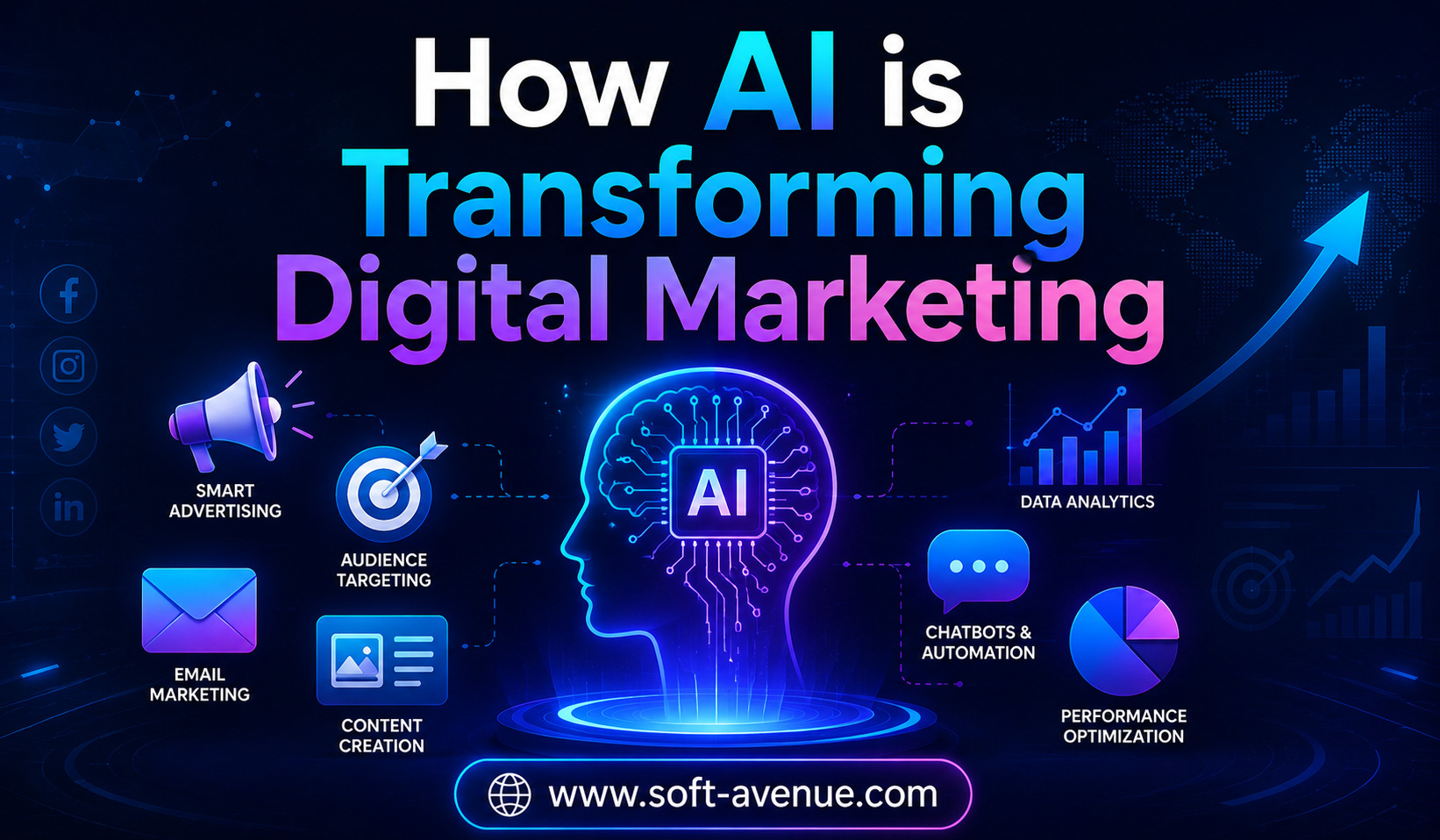
Artificial intelligence has fundamentally changed how digital marketing operates in 2026. It has transformed content creation, search engine optimization, customer engagement, social media management, advertising, and marketing analytics into faster, smarter, and more efficient processes.
However, technology alone does not create successful marketing campaigns. The most effective strategies combine AI-driven insights with human creativity, strategic planning, and authentic communication. Businesses that embrace this balanced approach will not only improve operational efficiency but also build stronger customer relationships and achieve sustainable long-term growth.
Frequently Asked Questions
What is AI in digital marketing?
AI in digital marketing refers to the use of artificial intelligence technologies to automate marketing tasks, analyze customer data, personalize campaigns, optimize advertising, and improve overall marketing performance.
How does AI improve SEO?
AI helps marketers identify valuable keywords, analyze competitors, understand user intent, optimize content, and monitor search trends, making SEO more efficient and data-driven.
Can AI replace digital marketers?
No. AI supports marketers by automating repetitive work and providing insights, but creativity, strategic planning, emotional intelligence, and storytelling remain human strengths.
Is AI suitable for small businesses?
Yes. Affordable AI tools allow small businesses to automate marketing activities, create content faster, improve customer service, and compete more effectively without large marketing teams.
What are the biggest benefits of AI in marketing?
The primary benefits include higher productivity, personalized customer experiences, improved campaign performance, faster decision-making, and better return on marketing investment.
What is the future of AI in digital marketing?
The future includes predictive analytics, conversational AI, voice search optimization, intelligent automation, hyper-personalization, and integrated marketing platforms that simplify complex workflows.
