Introduction
Video has become one of the most powerful forms of digital communication. From marketing campaigns and product demonstrations to online education and social media content, businesses and creators are producing more videos than ever before. However, creating professional-quality videos has traditionally required cameras, lighting equipment, editing software, voice-over artists, presenters, and significant production time. For many small businesses and independent creators, these requirements can make video production both expensive and time-consuming.
Artificial intelligence is changing that reality. One of the biggest innovations in this space is the rise of AI avatars—digital presenters that can speak naturally, express emotions, and deliver scripts in multiple languages without requiring a human to appear on camera. What once seemed like futuristic technology has quickly become a practical solution for businesses looking to create engaging videos faster and at a lower cost.
Over the past few years, AI avatar platforms have improved dramatically. Modern avatars feature realistic facial expressions, synchronized lip movements, natural voice generation, and customizable appearances that closely resemble real human presenters. As organizations continue embracing digital transformation, AI avatars are becoming valuable tools for marketing, customer support, employee training, education, and corporate communication.
Rather than replacing human creativity, AI avatars are helping creators produce high-quality content more efficiently. Businesses can now generate professional videos in minutes instead of days, making video communication accessible to organizations of every size.
What Are AI Avatars?
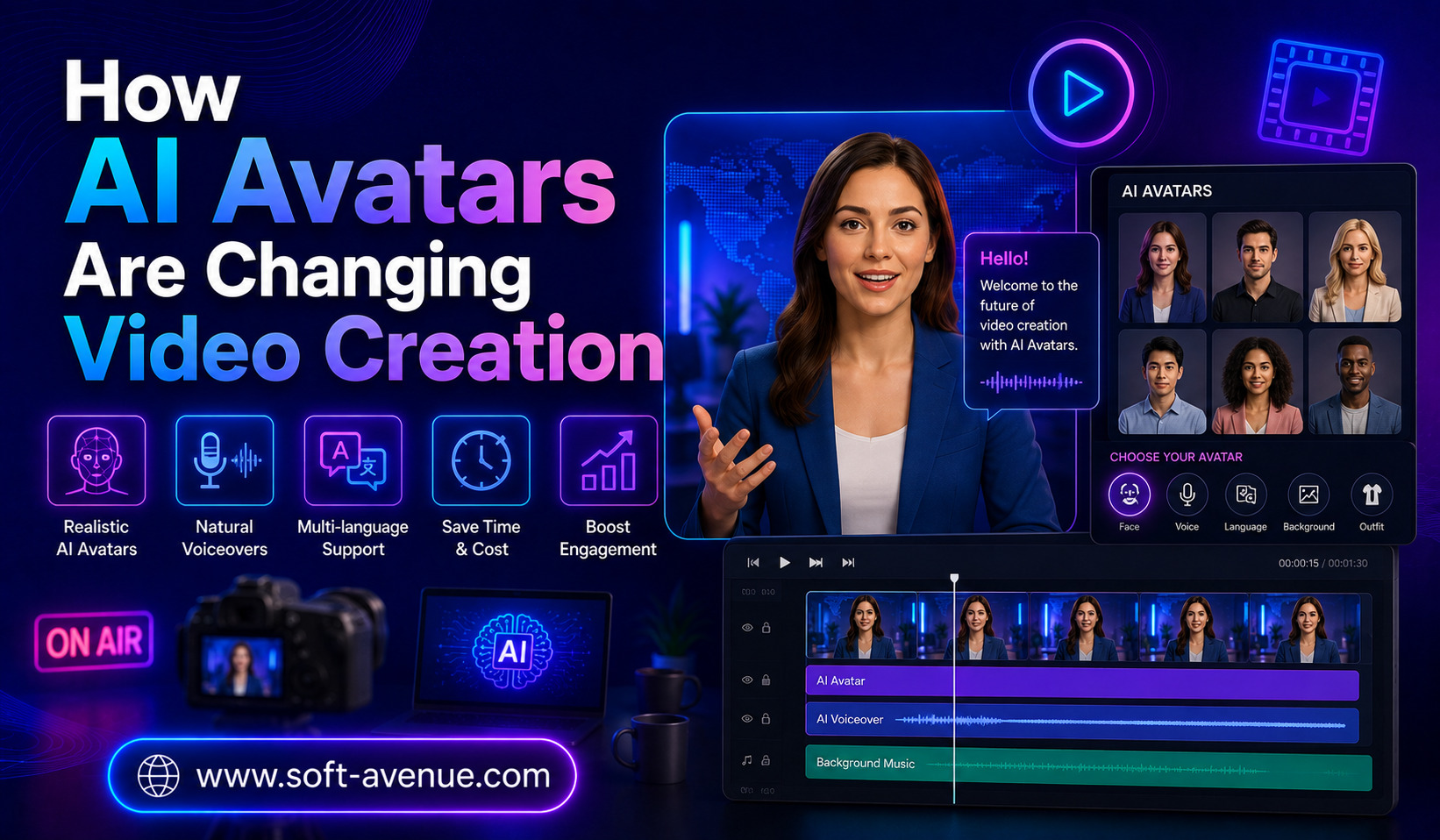
AI avatars are computer-generated digital humans capable of presenting information through realistic speech, facial expressions, and body language. Unlike animated cartoon characters, today’s AI avatars are designed to look and sound remarkably human. AI avatars turn written text into natural-sounding presentations by matching the voice with realistic lip movements and facial expressions, making the videos feel more engaging and lifelike.
Instead of hiring actors or recording videos repeatedly, users simply type a script, choose an avatar, select a voice, and generate a complete video. Many AI platforms also let users create custom avatars based on real people, helping businesses maintain a consistent brand identity across all their video content.
AI avatars are now capable of speaking dozens of languages with accurate pronunciation, making global communication much easier. Companies can create one video script and automatically generate localized versions for audiences around the world without recording separate videos for each language.
This technology has transformed video production from a complex creative process into a fast and scalable business solution.
Why AI Avatar Technology Is Growing So Quickly
The growing popularity of AI avatars is driven by several factors. Businesses are producing more digital content than ever before while facing increasing pressure to reduce production costs and deliver information quickly. Traditional video production often involves scheduling presenters, booking studios, recording multiple takes, editing footage, and making revisions whenever information changes.
AI eliminates many of these challenges. If a script needs updating, businesses simply edit the text and regenerate the video instead of organizing another recording session. This flexibility makes AI avatars especially valuable for industries where information changes frequently, such as software, healthcare, finance, and education.
Another reason for rapid adoption is the growing demand for personalized communication. Customers expect businesses to provide content in their preferred language and across multiple digital platforms. AI avatars make large-scale personalization possible without dramatically increasing production costs.
Remote work has also accelerated adoption. Organizations with distributed teams require consistent training materials, onboarding videos, internal announcements, and knowledge-sharing resources. AI-generated presenters help companies create professional communication quickly while maintaining a consistent brand voice.
How AI Avatars Create Professional Videos
Although AI avatar technology appears simple to users, it combines several advanced artificial intelligence technologies behind the scenes.
The process begins with text input. Users write a script just as they would prepare dialogue for a human presenter. Natural language processing analyzes the text to understand punctuation, sentence structure, emphasis, and speaking rhythm.
Next, AI-powered text-to-speech technology converts the script into realistic audio. Modern voice generation models produce natural pronunciation, pauses, tone variation, and emotional expression that sound increasingly similar to human speech.
Computer vision and deep learning algorithms then synchronize the avatar’s facial movements with the generated audio. Lip movements, blinking, head motion, and subtle facial expressions are automatically adjusted to match each spoken word.
Finally, the video generation engine combines the avatar, background, animations, graphics, subtitles, and branding elements into a finished presentation. What once required an entire production team can now be completed in a matter of minutes.
As AI technology continues to evolve, AI avatars are becoming more realistic, expressive, and capable of natural conversations.
How Businesses Are Benefiting from AI Avatars
Organizations across different industries are discovering that AI avatars can significantly improve communication while reducing production costs. Marketing departments use them to create promotional videos, product demonstrations, social media advertisements, and personalized customer messages without requiring expensive video shoots.
Training teams rely on AI presenters to produce onboarding videos, compliance courses, and instructional materials that can be updated whenever company policies change. Instead of re-recording an instructor every time new information becomes available, businesses simply modify the script and generate an updated version.
Customer support departments also benefit from AI-generated explainer videos that answer common questions. Rather than reading lengthy documentation, customers can watch short, engaging videos that clearly explain products or services.
Educational institutions have embraced AI avatars for online learning. Teachers and training providers create multilingual lessons, tutorials, and course introductions, making educational content more accessible to diverse audiences.
For global organizations, one of the greatest advantages is language localization. A single training video can be translated into multiple languages while maintaining the same presenter, ensuring consistent communication across international offices.
Industries Driving AI Avatar Adoption
AI avatars are no longer limited to technology companies. Their ability to simplify video production has made them valuable across many sectors.
Some of the industries seeing the fastest adoption include:
- Marketing and advertising for promotional videos and digital campaigns.
- Education for online lessons, tutorials, and virtual instructors.
- Corporate training for onboarding, compliance, and employee development.
- Healthcare for patient education and informational videos.
- E-commerce for product demonstrations and customer engagement.
- Customer support for FAQs and troubleshooting guides.
As AI becomes more affordable, even startups and small businesses are beginning to use avatar technology to compete with larger organizations.
Traditional Video Production vs AI Avatar Video Creation
| Feature | Traditional Video Production | AI Avatar Video Creation |
| Production Time | Several days or weeks | Often completed in minutes |
| Cost | High equipment and staffing costs | Significantly lower |
| Script Updates | Requires new recording sessions | Edit text and regenerate instantly |
| Language Support | Separate recordings for each language | AI translation and voice generation |
| Scalability | Limited by production resources | Create unlimited videos quickly |
| Consistency | Presenter availability varies | Same avatar and voice every time |
The comparison clearly shows why businesses are increasingly adopting AI avatar platforms. They reduce production time, lower costs, and make content updates far easier than traditional video workflows.
The Best AI Avatar Tools Available Today
Several AI-powered platforms now offer realistic avatars, natural voice generation, and simple video editing features. While each platform has its strengths, the right choice depends on your goals, budget, and content requirements.
Some tools focus on creating highly realistic digital presenters for corporate training and business communication. Others are designed for marketing teams that need engaging promotional videos for websites and social media. There are also platforms built specifically for educational content, multilingual communication, and personalized customer messages.
When selecting an AI avatar platform, businesses should consider a few important factors:
- Avatar quality and realism
- Voice options and language support
- Custom branding features
- Video editing flexibility
- Integration with existing workflows
- Pricing and scalability
Choosing a platform that matches long-term business needs is more important than simply selecting the one with the most features.
Real-World Applications of AI Avatars
The use of AI avatars extends far beyond marketing videos. Organizations are finding creative ways to use digital presenters across multiple departments.
Marketing teams create product launch videos, promotional campaigns, and personalized advertisements without scheduling expensive video shoots. This allows brands to respond quickly to market trends and seasonal promotions.
Human resources departments use AI avatars to welcome new employees, explain company policies, and deliver onboarding materials. Since company information changes regularly, training videos can be updated within minutes by editing the script instead of recording an entirely new presentation.
Educational institutions are using AI avatars to create online lectures, language lessons, and interactive tutorials. Students benefit from consistent, high-quality instruction that can be translated into multiple languages, making learning more accessible for global audiences.
Customer support teams also rely on AI-generated videos to answer common questions, explain products, and guide customers through troubleshooting steps. Short video explanations often improve customer satisfaction more effectively than lengthy written documentation.
Healthcare providers have started using AI avatars to explain medical procedures, appointment instructions, and wellness information in a simple and engaging format. Financial institutions, travel companies, and government organizations are exploring similar applications to improve public communication.
Challenges and Limitations
Although AI avatars offer impressive capabilities, they are not without challenges. One of the biggest concerns is authenticity. While modern avatars appear highly realistic, viewers may still recognize subtle differences between AI-generated presenters and real people. Businesses should be transparent when using AI-generated content to maintain trust with their audiences.
Another challenge involves emotional communication. AI voices and facial expressions continue to improve, but they may not always capture the depth of emotion required for sensitive topics or highly personal messages. In such cases, a real human presenter may still be the better choice.
Content accuracy is equally important. AI avatars only present the information provided to them. If the script contains outdated or incorrect details, the generated video will reflect those mistakes. Organizations should review all content carefully before publishing.
There are also ethical considerations related to deepfake technology and digital identity. Companies creating custom avatars based on real individuals should always obtain proper consent and implement safeguards to prevent misuse.
Despite these limitations, continued advancements in generative AI are steadily improving realism, emotional expression, and content quality.
The Future of AI Avatar Technology
The next generation of AI avatars is expected to become even more interactive and personalized. Instead of delivering pre-recorded scripts, future avatars may hold real-time conversations with customers, employees, and students using advanced conversational AI.
Businesses will likely create digital brand ambassadors capable of answering questions, explaining products, and providing personalized recommendations 24 hours a day. These avatars could integrate with customer relationship management systems, allowing them to tailor conversations based on individual customer preferences and purchase history.
Real-time language translation is another area of rapid development. Future AI avatars may speak multiple languages during live conversations while maintaining natural lip synchronization and voice quality, making international communication much more seamless.
Advances in emotion recognition may also allow avatars to adjust their tone, expressions, and responses based on audience reactions. Combined with augmented reality and virtual reality technologies, AI avatars could become central to immersive customer experiences, virtual meetings, online education, and digital events.
As computing power increases and AI models continue to evolve, digital presenters will become more realistic, interactive, and capable of handling increasingly complex communication tasks.
Best Practices for Using AI Avatars Effectively
Organizations can maximize the value of AI avatars by following a few practical guidelines:
- Use conversational, easy-to-understand scripts rather than overly technical language.
- Keep videos concise and focused on one main topic.
- Review AI-generated content carefully for accuracy before publishing.
- Maintain consistent branding across avatars, backgrounds, and voice styles.
- Combine AI-generated videos with human creativity to create authentic and engaging content.
AI should enhance communication rather than replace thoughtful storytelling. Businesses that balance automation with creativity are likely to achieve the best results.
Final Thoughts
From marketing campaigns and employee training to education and customer support, organizations are discovering new ways to communicate through realistic digital presenters.
While traditional video production will continue to play an important role for high-end creative projects, AI avatars provide a practical solution for businesses that need to produce content quickly and at scale. Their ability to simplify updates, support multiple languages, and reduce production costs makes them an increasingly valuable tool in today’s digital economy.
As the technology continues to mature, AI avatars are expected to become even more lifelike, interactive, and integrated into everyday business operations. Companies that adopt these tools responsibly and strategically will be well positioned to deliver engaging, personalized video experiences to audiences around the world.
Conclusion
AI avatars are transforming video creation by making professional content faster, more affordable, and easier to produce. Instead of relying on complex production workflows, businesses can now create polished videos using simple text prompts while maintaining consistent branding and supporting multiple languages. As AI technology continues to advance, digital presenters are becoming more realistic, opening new possibilities for communication across marketing, education, customer support, and corporate training.
Frequently Asked Questions (FAQs)
1. What is an AI avatar?
An AI avatar is a digital human powered by artificial intelligence that can speak, present information, and create professional videos using text-based scripts.
2. How do AI avatars create videos?
Users enter a script, select an avatar and voice, and the AI automatically generates a video with synchronized speech, facial expressions, and animations.
3. Which industries use AI avatars?
AI avatars are widely used in marketing, education, healthcare, corporate training, customer support, e-commerce, finance, and internal business communication.
4. Can AI avatars replace human presenters?
AI avatars are excellent for repetitive, informational, and multilingual content. However, human presenters remain important for highly emotional, creative, or relationship-driven communication.
5. Are AI-generated videos cost-effective?
Yes. They significantly reduce production costs by eliminating the need for studios, cameras, presenters, and repeated recording sessions.
