Artificial intelligence has become one of the fastest-growing categories in modern business software. There are now AI tools for writing, coding, customer service, sales, marketing, research, project management, design, data analysis, and many other tasks.
For a large organization with dedicated technology teams, evaluating these tools can be part of a structured procurement process. For a small team, however, choosing the right AI software can be surprisingly difficult.
A small company may not have enough time to test dozens of platforms. It may also have a limited budget and fewer employees available to manage complicated software setups.
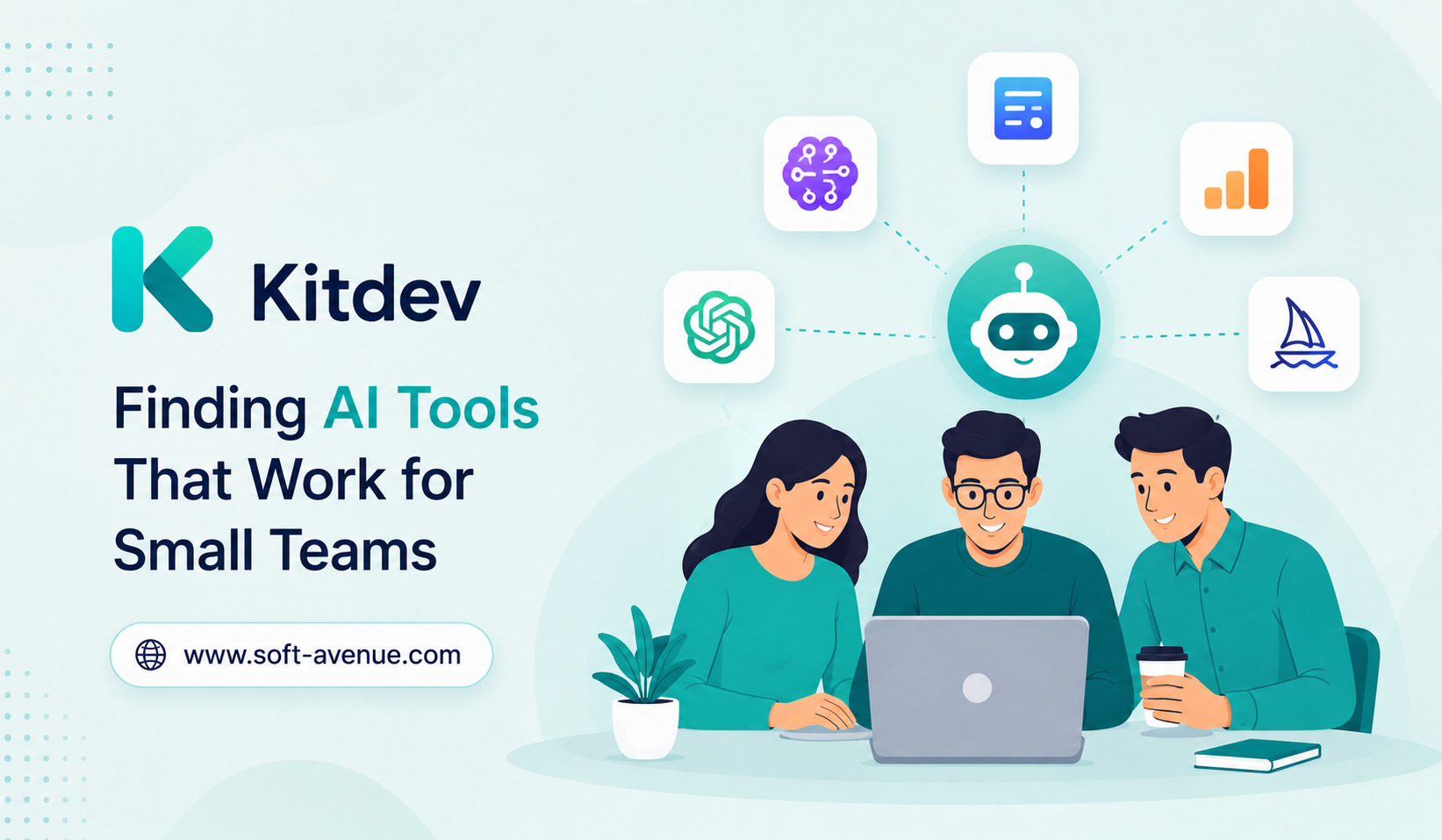
This is where Kitdev fits into the broader idea of discovering AI tools for small teams. Rather than assuming that every business needs the most advanced or expensive AI platform, the focus is on finding tools that solve practical problems and fit naturally into existing workflows.
What Is Kitdev?
Kitdev can be viewed as a resource for discovering AI tools and technologies that may be useful for developers, startups, and small teams.
The AI software market is crowded. New products appear regularly, while existing platforms continue adding new features. This creates an information problem: finding an AI tool is easy, but finding one that actually fits a team’s needs can be much harder.
A discovery-focused platform can help narrow that search by making different AI tools easier to explore and compare.
For small teams, this can save time because they can focus on solutions that are relevant to their specific work rather than trying every new AI product that appears online.
Why Small Teams Need a Different AI Strategy
Small businesses often have different requirements from large enterprises.
A five-person team does not necessarily need an expensive enterprise platform with hundreds of features. In many cases, the best AI tool is simply the one that solves a specific problem quickly and reliably.
For example, a small marketing team may need help creating content briefs. A software startup might need an AI coding assistant. A customer-support team could benefit from an automated response system.
The priority should be practical value rather than adopting AI simply because it is popular.
This is why AI discovery is becoming increasingly important for small businesses.
The Challenge of Choosing From Too Many AI Tools
The number of AI tools available today can make decision-making difficult.
Search for almost any business task and you will likely find multiple AI-powered solutions claiming to improve productivity.
Some platforms are specialized, while others attempt to combine many functions into one application.
Features can also be difficult to compare. Two tools may both describe themselves as AI assistants but offer completely different workflows, pricing structures, integrations, and levels of automation.
For a small team, spending days evaluating software may not be practical.
A focused discovery resource can make the process more manageable by helping users identify tools worth investigating.
Finding AI Tools Based on Actual Problems
One of the best ways to choose AI software is to start with the problem rather than the technology.
Instead of asking, “Which AI tool should we use?” a team can ask:
“What task is taking too much time?”
Maybe employees spend hours summarizing meetings. Perhaps developers repeatedly write similar code. A sales team could be manually entering lead information, while a marketing team may be spending too much time creating first drafts.
Once the problem is clear, finding an appropriate AI tool becomes easier.
Kitdev’s relevance comes from this broader approach to AI discovery: helping teams explore tools that can potentially address specific development and business needs.
AI Tools for Small Development Teams
Small software teams are among the biggest potential users of AI tools.
Developers can use AI assistants for code generation, debugging, documentation, testing, code explanation, and refactoring.
For a startup with a small engineering department, these tools can help reduce repetitive work and allow developers to concentrate on more complicated product decisions.
However, teams should avoid assuming that AI-generated code is automatically production-ready. Developers still need to review generated code, test it, check security implications, and make sure it follows the project’s architecture.
The right AI tool should support developers rather than replace engineering judgment.
AI Tools for Marketing Teams
Small marketing teams can also benefit from AI.
Content research, brainstorming, social media planning, email drafting, keyword analysis, and basic image creation can all involve repetitive work.
An AI tool can help create an initial draft or organize information more quickly.
The important factor is maintaining quality. AI-generated content still needs human editing, fact-checking, and brand-specific adjustments.
For a small team, the ideal tool is often one that removes repetitive effort while leaving creative and strategic decisions with humans.
AI Tools for Customer Support
Customer support is another area where AI can provide practical value.
Small businesses may not have the resources to maintain a large support department. AI assistants can potentially answer common questions, organize inquiries, summarize conversations, and help human agents find information faster.
A small team can therefore use AI to extend its support capacity without making every interaction fully automated.
Human support should remain available for complicated complaints, sensitive issues, and situations requiring judgment.
How Small Teams Should Evaluate AI Tools
Finding an AI tool is only the first step. Teams also need to determine whether it is actually worth adopting.
Start by considering the problem it solves. If the problem is minor, a complex AI platform may not be justified.
Next, look at ease of use. Small teams usually do not have time for lengthy implementation processes.
Pricing is another major consideration. A tool should provide enough value to justify its recurring cost.
Teams should also examine integrations. An AI tool that works with software the team already uses may be much more useful than an isolated application.
Finally, consider reliability and output quality. A tool that requires extensive correction may not actually save time.
Avoiding AI Tool Overload
One common mistake is adopting too many AI tools.
A small team might subscribe to separate platforms for writing, research, meetings, project management, customer support, design, and automation.
Eventually, employees may spend more time switching between applications than actually benefiting from them.
A better approach is to identify a few high-impact tasks and select tools specifically for those workflows.
AI adoption should simplify work rather than create another layer of complexity.
Security and Privacy Matter
Small teams should also consider how AI tools handle business information.
Before uploading confidential documents, customer information, source code, financial data, or internal plans, businesses should understand the platform’s data policies.
Teams should review permissions, data retention practices, account controls, and available security features.
This is especially important when employees use AI tools independently. Establishing basic internal guidelines can help prevent sensitive information from being shared with unsuitable services.
Measuring Whether an AI Tool Works
The best way to evaluate an AI tool is to measure its impact.
Suppose a team spends ten hours every week creating reports. If an AI tool reduces that workload to six hours while maintaining acceptable quality, there is a measurable productivity benefit.
The same principle applies to coding, sales, support, marketing, and administration.
Teams should compare the time saved, quality of results, subscription cost, and amount of human supervision required.
An AI tool that looks impressive in a demonstration may not deliver meaningful value in everyday work.
Why AI Discovery Platforms Can Help
The AI market changes quickly. New tools appear, existing products evolve, and features that once required specialized software can become standard.
This makes discovery an ongoing process.
Platforms and resources centered on AI tool discovery can help small teams stay aware of new options without constantly searching the internet for every category.
Kitdev fits into this broader need by providing a way to explore AI tools and discover technologies that may be relevant to smaller development-focused teams.
The Future of AI for Small Teams
AI is likely to become increasingly accessible to small businesses.
As implementation becomes easier, a small team may be able to automate tasks that previously required dedicated employees or expensive software.
The competitive advantage will not necessarily come from using the largest number of AI tools. Instead, it may come from choosing the right tools and integrating them thoughtfully into daily operations.
Teams that understand their workflows and identify repetitive tasks will be better positioned to use AI effectively.
Final Thoughts
Kitdev highlights an important part of the AI ecosystem: helping small teams discover tools that can provide practical value without unnecessary complexity.
For startups, developers, and small businesses, choosing AI software should begin with a clear problem. The right tool can reduce repetitive work, improve productivity, and give a small team more time to focus on important tasks.
At the same time, businesses should avoid adopting AI simply because a product is trending. Cost, usability, security, integrations, reliability, and measurable results all matter.
As the AI software market continues to expand, effective discovery will become just as important as the technology itself. For small teams, a focused approach to finding and evaluating AI tools can turn a crowded market into a useful source of productivity opportunities.
