
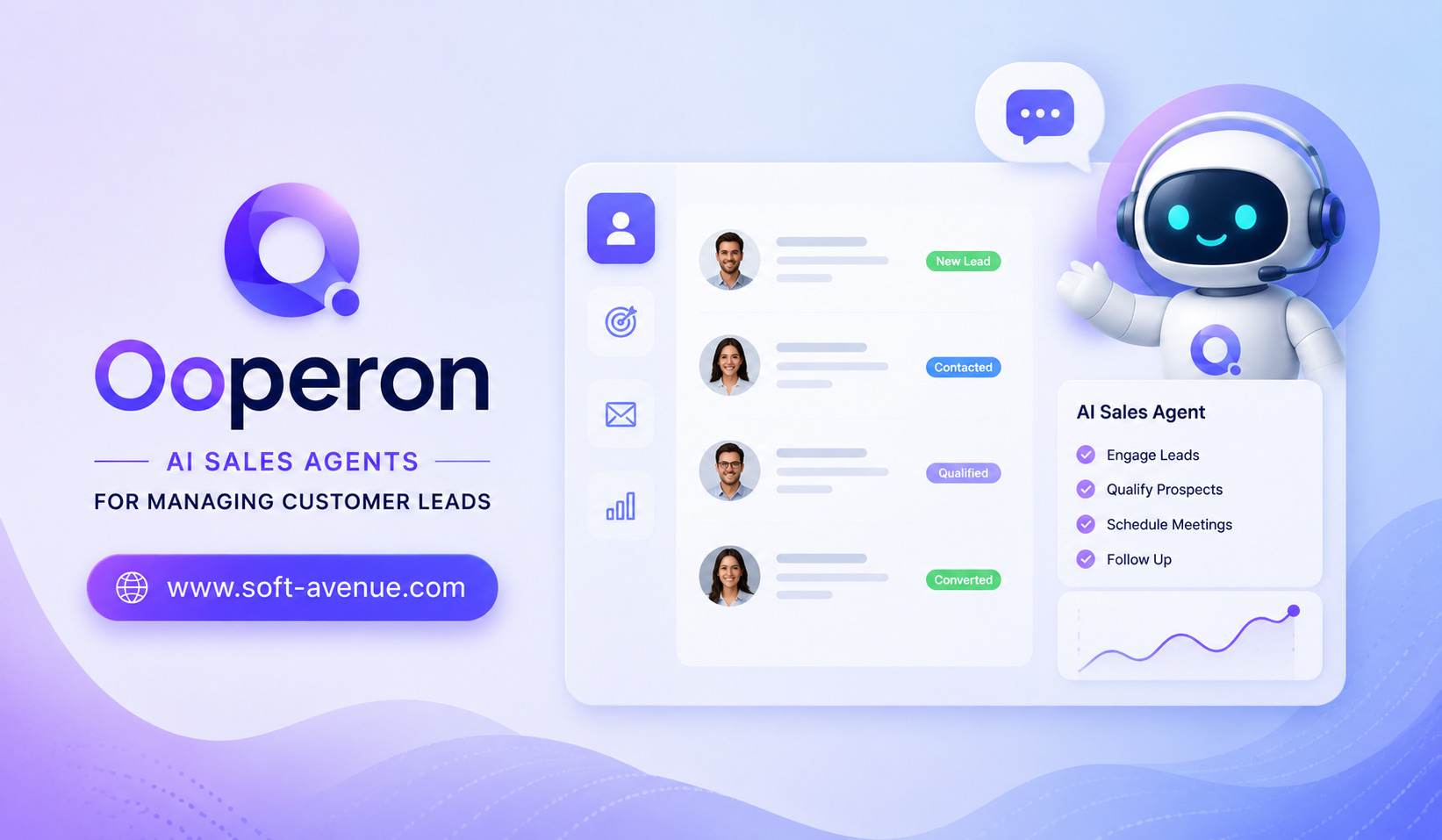
Managing customer leads is one of the most important parts of growing a business. A company can generate hundreds or even thousands of potential customers through websites, advertisements, social media, email campaigns, and other marketing channels. However, generating leads is only the beginning. Businesses also need to respond to prospects, understand their requirements, follow up at the right time, and move qualified opportunities toward a sale.
This process can become difficult when sales teams have too many leads to handle manually. Missed follow-ups, delayed responses, and inconsistent communication can cause valuable opportunities to disappear.
Ooperon represents the growing use of AI sales agents for customer lead management. Instead of relying entirely on sales representatives to perform repetitive lead-related tasks, AI agents can help businesses organize conversations, engage prospects, and support different stages of the sales process.
The idea is not simply to automate sales. It is about using AI to help sales teams spend more time on high-value opportunities while routine activities are handled more efficiently.
What Is Ooperon?
Ooperon can be understood in the context of AI-powered sales agents designed to assist businesses with customer leads.
Traditional lead management usually involves several steps. A business collects a prospect’s information, evaluates the lead, contacts the potential customer, answers questions, follows up, and eventually decides whether the person is ready to purchase.
Many of these activities require repetitive communication.
An AI sales agent can assist with parts of this process by interacting with prospects, collecting information, answering common questions, and helping sales teams identify promising opportunities.
This can create a more responsive lead-management workflow.
Why Lead Management Is Challenging
Sales teams often struggle with lead management because not every lead arrives at the same stage of the buying journey.
Some prospects are ready to purchase immediately. Others may only be researching their options. Some may need additional information before making a decision.
Treating every lead in exactly the same way can waste valuable time.
Human sales representatives also have limited availability. If a team receives a large number of inquiries at once, responding to every prospect quickly can become difficult.
AI sales agents can provide an additional layer of support, helping businesses respond to more leads without requiring employees to manually handle every initial interaction.
How AI Sales Agents Manage Customer Leads
The basic workflow begins when a potential customer enters the sales funnel.
A prospect may arrive through a website form, advertisement, social media campaign, or another marketing channel. An AI sales agent can then engage with the prospect and begin gathering useful information.
For example, the agent might help determine what the customer is looking for, what type of product or service they are interested in, and whether they have specific requirements.
This information can help businesses understand which leads deserve immediate attention.
Instead of simply creating a large list of contacts, the sales process can become more focused around the prospects most likely to become customers.
Faster Lead Responses
Speed can make a major difference in sales.
When someone expresses interest in a product or service, waiting too long to respond can cause that person to lose interest or contact a competitor.
AI sales agents can potentially respond immediately to incoming inquiries.
This means prospects do not necessarily have to wait until a salesperson becomes available before receiving an initial response.
Fast communication can be particularly useful for businesses that receive inquiries outside regular working hours.
Lead Qualification With AI
Not every lead has the same value.
Sales teams need to determine which prospects are a strong fit for their products or services. This process is known as lead qualification.
An AI agent can assist by asking predefined or context-aware questions and collecting information from prospects.
For example, a business selling software to companies might want to understand the prospect’s company size, business requirements, current tools, and expected timeline.
The AI can collect these details before passing the conversation to a human sales representative.
This allows the salesperson to enter the conversation with more context.
Automating Follow-Ups
Follow-up is one of the most important parts of sales, but it is also one of the easiest tasks to overlook.
A salesperson may speak with a prospect and intend to follow up later, only to become busy with other customers.
AI-powered workflows can help make follow-up more systematic.
An AI sales agent can potentially continue conversations according to predefined rules and customer interactions. This can keep prospects engaged without requiring sales representatives to manually remember every follow-up.
However, businesses should ensure that automated communication remains useful rather than becoming repetitive or intrusive.
Handling Common Customer Questions
Prospects frequently ask similar questions before making a purchase.
They may want to know about pricing, features, availability, delivery, integrations, service options, or basic policies.
If sales representatives answer the same questions repeatedly, valuable time can be consumed.
AI sales agents can handle many routine questions when they have access to accurate business information.
This allows human representatives to focus on more complex conversations where their expertise is more valuable.
Helping Sales Teams Prioritize Leads
Lead volume can become a major challenge as a business grows.
Imagine a company receiving hundreds of inquiries every week. A salesperson cannot spend the same amount of time with every prospect.
AI can help organize available information and identify leads that may require greater attention.
Factors such as customer requirements, engagement, responses, and buying intent can potentially be used to prioritize conversations.
The sales team can then focus on prospects that appear more relevant instead of working through leads in an arbitrary order.
Benefits for Small Businesses
AI sales agents can be particularly interesting for small businesses.
Large organizations may have dedicated sales development teams, account executives, customer-success departments, and support staff. Small businesses often operate with much smaller teams.
A business owner might be responsible for marketing, sales, customer service, and operations at the same time.
AI assistance can help reduce some repetitive sales work.
By responding to basic inquiries and organizing lead information, an AI sales agent can give small teams more time to focus on closing deals and serving existing customers.
AI Sales Agents and Human Salespeople
AI should not necessarily be viewed as a replacement for human sales representatives.
Sales often involves relationships, negotiation, trust, and understanding complex customer needs. These areas can require human judgment and communication skills.
AI can instead handle the repetitive parts of the process.
A practical workflow might involve an AI agent engaging with a new prospect, collecting initial information, answering common questions, and identifying potential buying intent. A human salesperson can then take over when the conversation becomes more complex.
This combination can create a more efficient sales process.
Challenges of AI Lead Management
AI-powered sales automation also has limitations.
The quality of an AI sales agent depends heavily on the information and instructions provided to it. Incorrect product details or outdated pricing can lead to poor customer experiences.
Businesses should therefore keep their AI systems connected to reliable and current information.
Another challenge is personalization. Customers may become frustrated if automated messages feel generic or repetitive.
Privacy is also important. Lead management involves customer information, so businesses need appropriate security practices and access controls.
Finally, customers should have a clear way to reach a human representative when they want additional assistance.
Measuring the Impact of AI Sales Agents
Businesses should evaluate AI sales tools using measurable results.
Useful metrics can include response time, qualified-lead rates, appointment bookings, conversion rates, follow-up completion, and sales-team productivity.
The goal should not simply be to automate as many conversations as possible.
A better objective is to determine whether AI is helping the business generate better customer experiences and improve sales efficiency.
If an AI agent handles thousands of conversations but produces very few qualified opportunities, the workflow may need improvement.
The Future of AI-Powered Sales
AI sales agents are likely to become more capable as businesses connect them with customer relationship management systems, marketing platforms, communication channels, and business databases.
Future sales agents may be able to support more of the customer journey, from the first inquiry to qualification, appointment scheduling, follow-up, and handoff to account managers.
This could create a sales environment where human representatives spend less time on administrative work and more time building customer relationships.
Final Thoughts
Ooperon highlights how AI sales agents can change the way businesses manage customer leads. Instead of requiring sales teams to manually handle every inquiry, AI can assist with initial conversations, qualification, common questions, follow-ups, and lead prioritization.
The biggest benefit is efficiency. Businesses can respond faster while allowing human salespeople to concentrate on prospects that need personal attention.
However, successful AI sales automation requires accurate information, thoughtful workflows, privacy safeguards, and human oversight. Automation works best when it complements the sales team rather than creating another barrier between businesses and their customers.
As companies continue to look for smarter ways to manage growing numbers of prospects, AI sales agents could become an increasingly important part of modern lead-management strategies.
