Artificial intelligence agents are becoming increasingly capable of performing tasks that once required people to search, compare, organize, and analyze information manually. From market research to competitive analysis, AI agents can potentially handle complex workflows involving large amounts of online information.
But there is an important requirement behind many of these workflows: reliable and usable data.
An AI agent cannot make useful decisions from web information if that information is difficult to access, poorly structured, outdated, or inconsistent. This is where web crawling and data extraction become important.
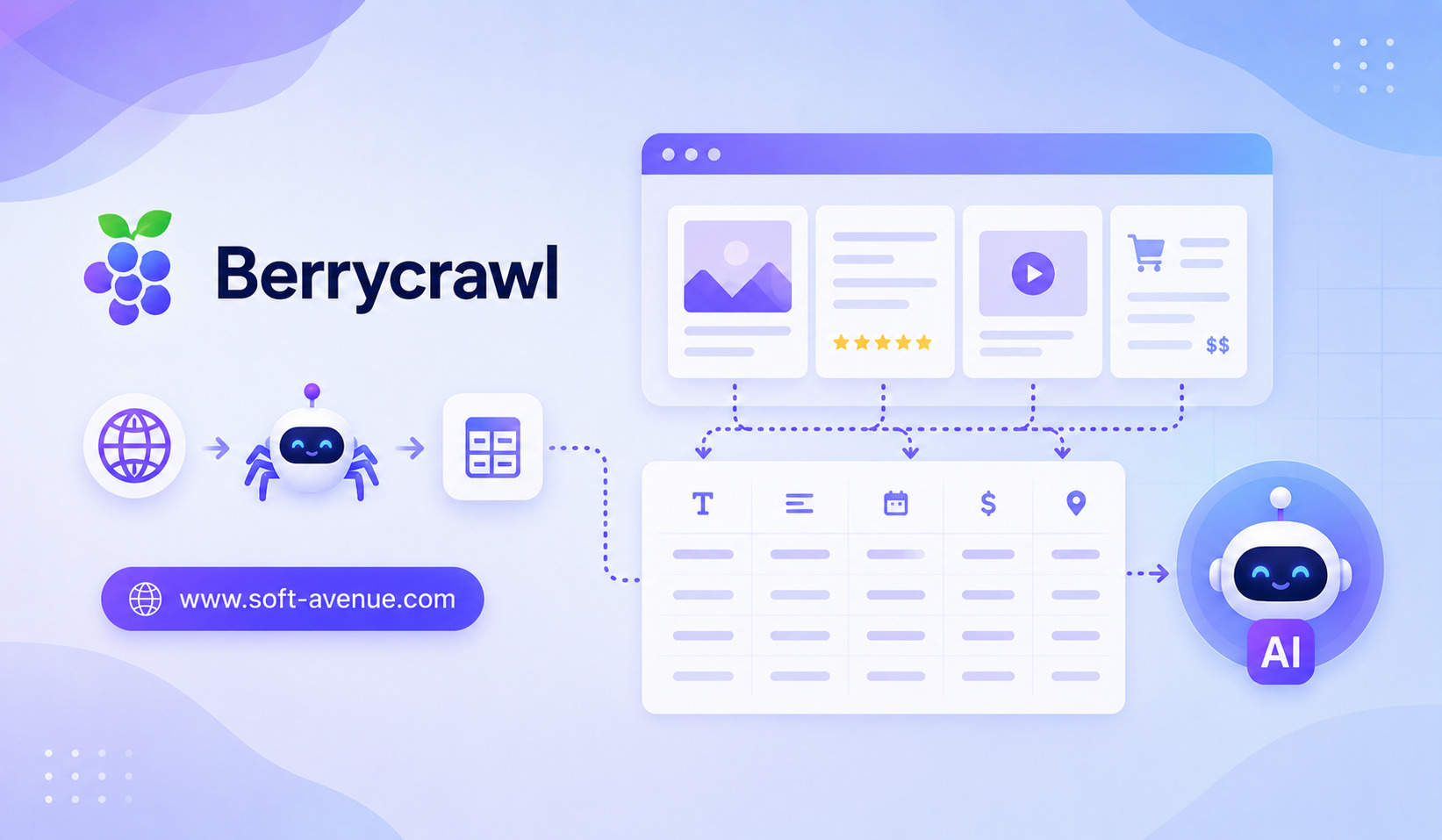
Berrycrawl represents the idea of collecting information from websites and converting it into a format that can be more useful for AI agents. Instead of expecting an AI system to navigate unstructured web pages for every task, structured web data can provide a cleaner foundation for automated research and analysis.
What Is Berrycrawl?
Berrycrawl can be understood as a web data collection approach designed around the needs of modern AI applications.
The internet contains an enormous amount of information, but websites are primarily designed for people to browse. A webpage may contain text, images, navigation elements, advertisements, scripts, tables, product information, and other components.
An AI agent often needs only a specific portion of that content.
Web crawling can help locate relevant pages, while data extraction can identify and organize the information that matters.
For AI agents, this can create a more efficient path between online information and automated workflows.
Why AI Agents Need Web Data
AI agents can reason and perform tasks, but many business tasks require information that changes frequently.
Consider an agent responsible for competitor research. It may need current product details, pricing information, new announcements, or changes to a company’s website.
General AI knowledge may not contain this latest information.
Giving the agent access to fresh web data can make its analysis more relevant.
Similarly, an AI agent working on market research may need information from dozens of websites rather than relying on a single source.
This is where web crawling becomes a valuable part of the AI data pipeline.
From Unstructured Pages to Structured Data
Websites are not always organized in a way that is convenient for AI systems.
A human can visually recognize that a webpage contains a product name, price, description, and availability.
A data-processing system needs to identify those elements more explicitly.
The goal of structured extraction is to transform information into predictable fields.
For example, product information could be represented through fields such as:
- Product name
- Description
- Price
- Category
- Availability
- URL
Once information is structured, an AI agent can process it more efficiently.
Instead of repeatedly interpreting an entire webpage, the agent can work with relevant data fields.
How Web Crawling Supports AI Agents
A typical AI-agent workflow may involve several stages.
First, the system identifies relevant websites or pages.
Next, a crawler retrieves the available information.
The content is then cleaned and structured.
Finally, the processed information is delivered to an AI model or application for analysis.
This separation is important because the AI agent does not necessarily need to perform every technical step itself.
A specialized web-data layer can handle information collection while the AI focuses on reasoning and decision-making.
AI-Powered Market Research
Market research is one of the clearest applications for structured web data.
Businesses may want to understand competitors, products, customer trends, industry developments, or pricing.
An AI agent can potentially analyze information gathered from multiple online sources and summarize important findings.
For example, a company could monitor competitor product pages and identify changes over time.
Instead of manually checking dozens of websites, an automated system could collect relevant information and make it available to the AI agent.
This can significantly reduce repetitive research work.
Competitive Intelligence
Competitive intelligence involves monitoring what other companies are doing.
Businesses may track new products, pricing changes, website updates, job postings, announcements, or changes in messaging.
A web crawling system can help collect this information regularly.
AI agents can then analyze the collected data and highlight notable changes.
The combination of automated collection and AI analysis can turn a large volume of web information into a more manageable stream of business intelligence.
Product and Price Monitoring
E-commerce and retail businesses often need to monitor product information.
Prices can change frequently, while products may become unavailable or receive updated descriptions.
Automated web data collection can help businesses monitor these changes.
An AI agent can then analyze the information and identify patterns or significant updates.
For example, an agent could compare product pricing across several competitors and generate a summary for a marketing or purchasing team.
The usefulness of this workflow depends heavily on the accuracy and freshness of the collected data.
Creating Data for AI Search
Structured web data can also support AI-powered search systems.
Traditional search often depends on keywords. Modern AI search can use semantic understanding to identify information that is conceptually related to a query.
If web content has been collected and structured properly, it can become a useful knowledge source for an AI retrieval system.
Users could ask questions in natural language while the system retrieves relevant information from its processed web-data collection.
This approach can support more contextual search experiences.
Supporting Retrieval-Augmented Generation
Structured web data can also be useful for retrieval-augmented generation, commonly called RAG.
In a RAG workflow, an AI system retrieves relevant information before generating an answer.
Instead of depending entirely on a model’s internal knowledge, the system can provide current or specialized information as context.
For example, a company could maintain a collection of relevant industry pages and use an AI assistant to answer questions based on that information.
Web crawling and data extraction can therefore become an important upstream component of a RAG pipeline.
Why Data Quality Matters
Collecting large amounts of web information is not enough.
Poor-quality data can lead to poor AI results.
Web pages may contain duplicate information, outdated content, navigation elements, advertisements, broken text, or misleading claims.
A useful data pipeline needs to clean and organize information before passing it to an AI system.
Businesses should also consider the reliability of the sources being collected.
An AI agent can process information extremely quickly, but speed does not automatically make the underlying information trustworthy.
Handling Frequently Changing Websites
The web is constantly changing.
Pages are updated, products are removed, companies redesign their websites, and new information appears.
A useful crawling system therefore needs to account for freshness.
Depending on the use case, data may need to be refreshed daily, hourly, weekly, or according to another schedule.
The appropriate frequency depends on how quickly the information changes and how important real-time accuracy is.
A pricing-monitoring system, for example, may require much more frequent updates than a system collecting evergreen documentation.
Challenges of Web Data Collection
Web crawling has several technical challenges.
Websites can have different structures, making it difficult to create one extraction method that works everywhere.
Some pages rely heavily on JavaScript to display information. Others may use dynamic loading, pagination, or complicated navigation.
There are also legal and ethical considerations.
Organizations should respect website terms, applicable laws, access restrictions, copyright rules, and privacy requirements when collecting online information.
Responsible web data collection is therefore just as important as technical capability.
Structured Data Makes AI More Efficient
AI agents are often described as autonomous systems, but their performance depends on the tools and information available to them.
Providing clean, structured data can reduce unnecessary processing.
Instead of asking an agent to navigate through a complicated webpage, a system can give it the specific information relevant to the task.
This can make workflows easier to design and potentially improve consistency.
The result is a division of responsibilities: the data layer gathers and organizes information, while the AI agent interprets it and takes appropriate actions.
Benefits for Developers
Developers building AI agents can use structured web data to create applications for many different industries.
A developer could build an agent for real estate research, travel information, product monitoring, market intelligence, job discovery, or industry analysis.
The common requirement is access to useful external information.
A dedicated crawling and extraction layer can provide the data needed by these applications without forcing every agent to implement web collection from scratch.
The Future of Web Data and AI Agents
As AI agents become more autonomous, their need for current information will continue to grow.
Future agents may routinely research markets, monitor competitors, compare products, track industry changes, and gather information before taking action.
This means the quality of the underlying data infrastructure will become increasingly important.
Tools and platforms focused on web crawling, extraction, and structured data can serve as the connection between the open web and AI-powered applications.
The more effectively that information can be collected, cleaned, and organized, the more useful AI agents can become.
Final Thoughts
Berrycrawl represents an important part of the growing AI-agent ecosystem: turning web information into usable data for automated systems.
AI agents can perform sophisticated research and analysis, but they need access to relevant information to do their work effectively. Web crawling provides a way to collect that information, while structured extraction makes it easier for AI systems to process.
From market research and competitive intelligence to product monitoring and AI search, structured web data can support a wide range of applications.
However, businesses should focus on more than simply collecting large amounts of information. Data freshness, accuracy, source quality, privacy, and responsible collection practices are equally important.
As AI agents move from answering questions toward completing real-world digital tasks, the ability to provide them with reliable external data could become one of the most important parts of the AI infrastructure behind them.
