Artificial intelligence is no longer limited to a single model or provider. Businesses, developers, creators, and everyday users now have access to a growing selection of AI models designed for different tasks.
Some models are excellent at reasoning. Others are optimized for coding, writing, image understanding, speed, or large-context workloads. Choosing the right model can improve results, but using several AI providers can also make AI more complicated and expensive.
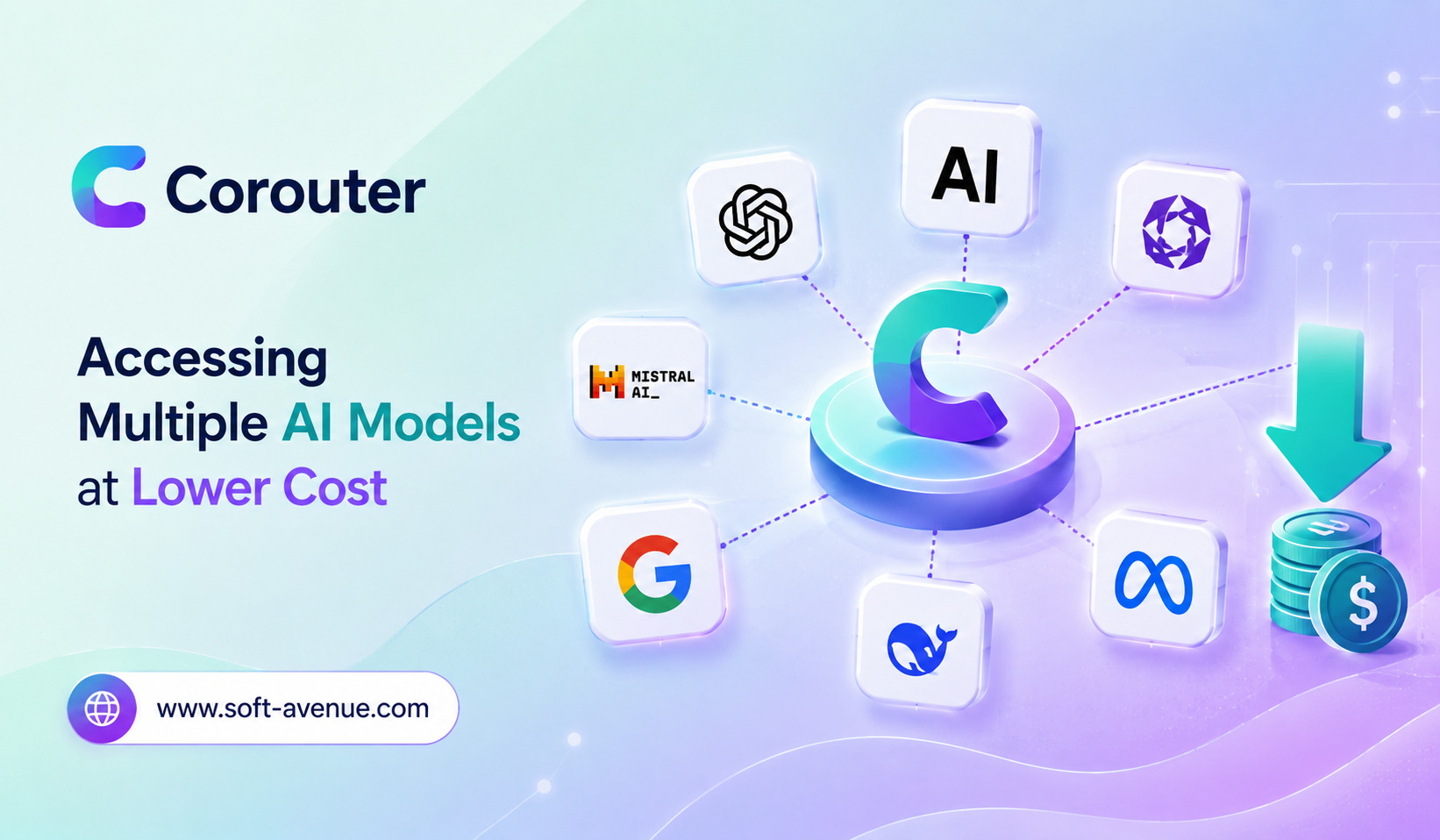
This is where Corouter represents an interesting approach: using model routing to access multiple AI models while potentially reducing the overall cost of AI usage.
Instead of sending every request to the same expensive model, an intelligent routing layer can help direct different tasks toward appropriate models based on requirements such as performance, speed, capability, or price.
What Is Corouter?
Corouter can be understood as a multi-model AI routing approach that helps users access different artificial intelligence models through a unified workflow.
Rather than building separate integrations for every AI provider, a routing layer can sit between an application and multiple models.
When a user sends a request, the system can determine which available model is suitable for the task.
For example, a simple text transformation may not require the same level of reasoning as a complex programming problem. Sending every request to a premium model could therefore result in unnecessary costs.
A router can potentially match simpler tasks with lower-cost models while reserving more capable models for demanding requests.
Why Use Multiple AI Models?
Different AI models have different strengths.
One model may produce excellent code, while another may be better at creative writing. A third may offer faster responses, while another may handle large amounts of context more effectively.
Using multiple models gives organizations more flexibility.
However, managing several APIs, authentication systems, pricing structures, usage limits, and technical integrations can become difficult.
A routing platform can simplify this process by creating a single access layer.
This means applications can potentially interact with multiple models without requiring developers to completely redesign their architecture every time they change providers.
How AI Model Routing Works
The basic idea behind AI routing is relatively straightforward.
A user submits a request to the routing layer.
The router evaluates the request and determines which model should process it.
The selected model generates the response, which is then returned to the application or user.
The routing decision can potentially consider several factors.
For example, a system could route:
- Simple tasks to lower-cost models
- Complex reasoning to advanced models
- Coding requests to models optimized for programming
- High-volume requests to faster or more economical models
The exact routing capabilities depend on the platform and configuration.
Reducing AI Costs
One of the biggest reasons companies consider AI routing is cost.
Premium AI models can be expensive, particularly when applications generate thousands or millions of requests.
However, not every request requires the most powerful model available.
Imagine a business application handling 100,000 AI requests every month.
If most requests involve simple classification, rewriting, extraction, or basic questions, using an expensive reasoning model for all of them may be inefficient.
A routing system could potentially send simpler workloads to more affordable models.
The expensive model could then be reserved for tasks where its additional capability provides meaningful value.
Cost Optimization Without Sacrificing Quality
Lowering AI costs does not necessarily mean choosing the cheapest model for everything.
The goal is to find the right balance between cost and performance.
A low-cost model may be sufficient for straightforward tasks but produce weaker results for complex requests.
A premium model may cost more but provide better reasoning or accuracy.
Model routing allows organizations to treat these models differently.
The system can potentially allocate more expensive resources only where they are needed.
This creates a more efficient AI strategy than using a single model for every workload.
Useful for AI Developers
Developers building AI applications often need flexibility.
An application may start with one model during development but later require additional models because of pricing, performance, availability, or changing requirements.
A routing layer can make this transition easier.
Instead of hard-coding one model into every part of the application, developers can build around a model-independent interface.
This can reduce vendor dependency and make it easier to experiment with new AI models.
Avoiding Vendor Lock-In
Depending entirely on one AI provider can create operational risks.
Pricing may change. Usage limits may change. Service availability can fluctuate. A model may also become less suitable for a particular workload over time.
A multi-model architecture provides more flexibility.
If several models are available behind a routing layer, organizations can potentially switch workloads between providers.
This can create a more adaptable AI infrastructure.
Vendor flexibility may become increasingly important as the AI model market continues to expand.
Routing Based on Task Complexity
Not all AI requests are equally difficult.
A routing system can potentially classify tasks according to complexity.
For example, a short request asking AI to correct grammar could be handled by a lightweight model.
A request involving multiple documents, complex reasoning, or detailed software architecture could be routed to a more capable model.
This approach resembles intelligent resource allocation.
Instead of treating every request equally, the system assigns resources according to the requirements of the task.
Routing Based on Latency
Cost is not the only consideration.
Some applications require fast responses.
For example, a customer-facing chatbot may need to respond almost immediately, while an overnight research workflow can tolerate longer processing times.
A router can potentially consider response speed when selecting a model.
A fast model may be chosen when latency is critical, while a more computationally intensive model could be used for tasks where response time is less important.
This can help organizations optimize both performance and cost.
AI Routing for Customer Service
Customer service is one potential use case.
Businesses may receive thousands of customer questions, but many requests are relatively simple.
An AI routing system could potentially use a lower-cost model for routine questions and escalate more complicated cases to a stronger model.
For example, basic product information could be handled automatically, while complicated troubleshooting questions might receive more advanced reasoning.
This can help businesses control AI expenses while maintaining service quality.
AI Routing for Content Creation
Content teams also use multiple AI models.
A business may need AI for brainstorming, summarization, editing, research, translation, and content generation.
These tasks do not necessarily require identical model capabilities.
A routing system could potentially match different content tasks with different models.
This can help content teams experiment with various AI systems without managing each provider separately.
AI Routing for Coding Workflows
Software development can involve many different AI tasks.
Developers may ask AI to explain code, generate simple functions, identify bugs, write tests, or reason through complex architecture.
A single model may not be optimal for all these tasks.
Routing can allow an application to use different models depending on the development requirement.
For example, straightforward code transformations might be assigned to a fast model, while complicated debugging or architecture questions could be sent to a more capable model.
The Importance of Routing Accuracy
AI routing is only useful when the routing decisions themselves are effective.
If a complex task is repeatedly sent to a model that cannot handle it properly, the cost savings may not be worth the lower quality.
Similarly, sending every task to an expensive model defeats the purpose of cost optimization.
A good routing strategy therefore needs to balance several variables.
These can include model capability, price, response time, reliability, context requirements, and task complexity.
Monitoring AI Usage
Cost optimization requires visibility.
Businesses should know which models are being used, how many requests are being processed, and how much each workload costs.
Usage monitoring can help identify unnecessary spending.
For example, a company may discover that a large percentage of requests are being processed by a premium model even though they could be handled by a cheaper alternative.
Routing rules can then be adjusted.
This creates a continuous optimization process.
Challenges of Multi-Model AI
Using multiple models also introduces complexity.
Different providers may use different APIs, input formats, output structures, pricing systems, and capabilities.
Models can also behave differently when given the same prompt.
A routing system needs to account for these differences.
There can also be challenges around privacy and data handling.
If a request is routed to an external AI provider, organizations need to understand how that provider handles the information.
Sensitive data may require additional controls or restrictions.
The Role of Evaluation
Model routing should ideally be based on measured performance rather than assumptions.
Organizations can test different models using representative workloads.
They can compare accuracy, latency, cost, reliability, and user satisfaction.
This allows teams to determine which model works best for each category of task.
AI routing can then become data-driven rather than simply choosing models based on popularity.
The Future of AI Routing
As the number of AI models continues to grow, routing may become an increasingly important part of AI infrastructure.
Instead of asking which single model is the best, businesses may increasingly ask which model is best for this particular task.
AI routing systems could eventually make these decisions automatically.
A complex application might use several models simultaneously, selecting the most appropriate one based on context, budget, performance requirements, and availability.
This could make AI infrastructure more flexible and economical.
Final Thoughts
Corouter represents the broader shift toward multi-model AI and intelligent model routing.
Instead of depending on one model for every task, businesses and developers can potentially use several models according to their individual strengths.
The biggest advantage is flexibility. A routing layer can help organizations balance cost, performance, speed, and model capabilities while reducing the need to manage every provider separately.
For high-volume AI applications, this approach could be particularly valuable. Simple requests can potentially be handled by economical models, while more demanding tasks can receive additional computing power from advanced systems.
However, successful AI routing requires careful evaluation, monitoring, privacy controls, and continuous optimization.
As the AI ecosystem becomes more competitive and diverse, the ability to choose the right model for the right task may become just as important as the models themselves. Multi-model routing could therefore become a key part of building efficient, scalable, and cost-conscious AI applications.
