
Artificial intelligence is moving beyond simple question-and-answer interactions. Modern AI agents are increasingly expected to complete tasks, interact with software, use external services, and make decisions based on information from multiple sources.
However, an AI agent is only as useful as the actions it can perform.
An agent might be able to understand a user’s request, but without access to the right tools, it may still be unable to complete the task. This creates an important challenge in the development of agentic AI: how can AI agents safely perform actions beyond the limited tools they normally have access to?
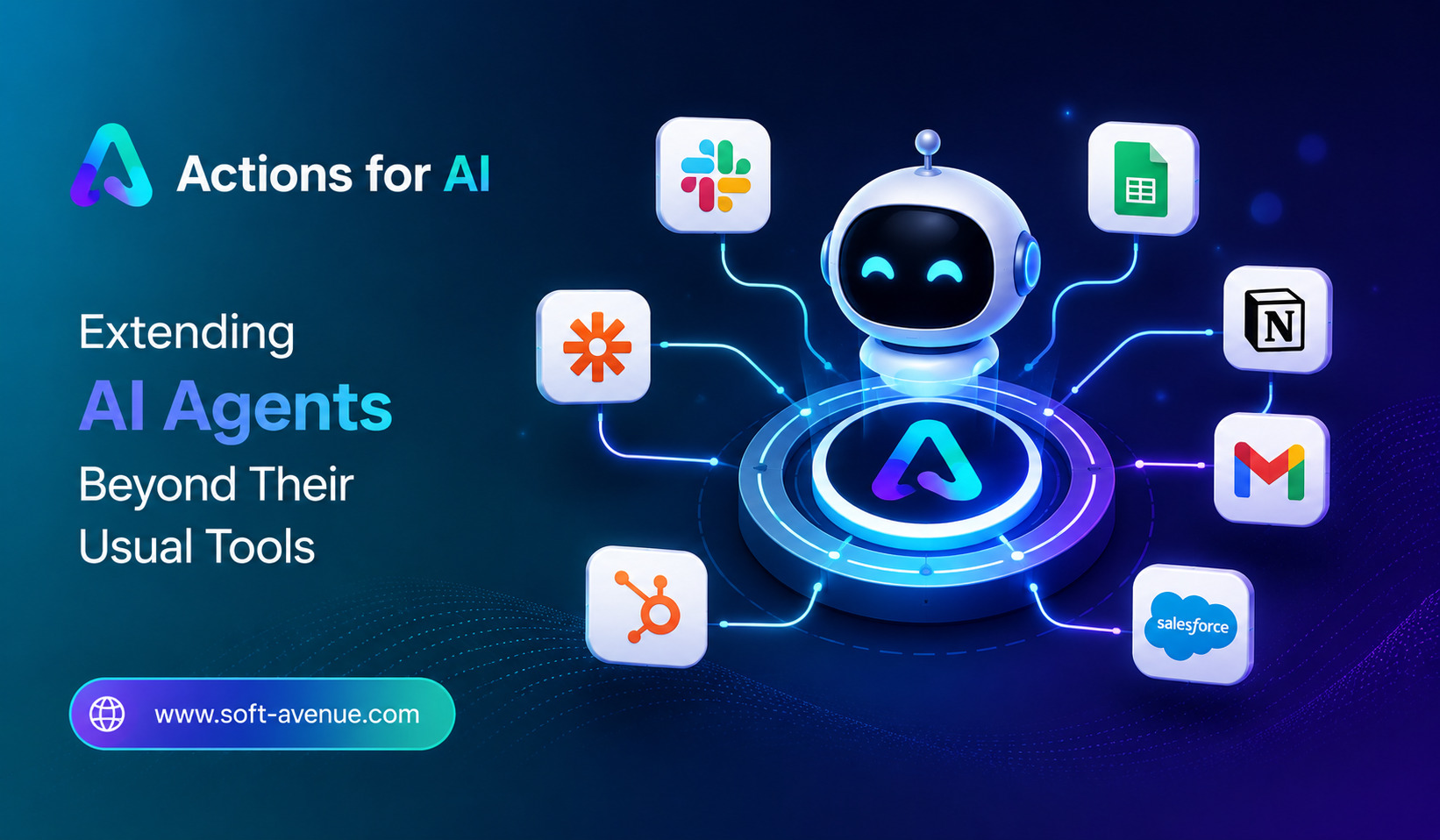
Actions for AI represents this broader concept of extending AI agents with additional capabilities. Instead of keeping an AI agent inside a fixed environment, action-based systems can allow agents to interact with more applications, services, and workflows.
What Is Actions for AI?
Actions for AI can be understood as an approach for giving AI agents access to additional actions and integrations.
Traditional AI assistants primarily generate information. They can write an email, explain a concept, summarize a document, or produce code.
An AI agent is expected to go further.
For example, a user could ask an agent to research information, update a spreadsheet, create a task, send information to another application, or trigger a business workflow.
To accomplish these tasks, the agent needs tools.
Actions provide the connection between the agent’s reasoning capabilities and external systems.
This makes actions an important part of the emerging agentic AI ecosystem.
Why AI Agents Need More Tools
AI agents are often designed around a specific set of built-in capabilities.
A coding agent may have access to a terminal and development environment. A research agent may have browsing capabilities. A productivity assistant may be connected to calendars and documents.
But real-world tasks rarely stay inside one application.
Consider a simple business workflow.
A user might want an AI agent to find information about a potential customer, record the information in a CRM, create a follow-up task, prepare an email, and notify a sales representative.
This requires multiple systems to work together.
Without external actions, the AI may only be able to describe what should happen.
With appropriate actions, the agent can potentially participate directly in the workflow.
From AI Responses to AI Tasks
The difference between an AI assistant and an AI agent is becoming increasingly important.
A traditional chatbot waits for a question and returns an answer.
An agent can potentially interpret a goal and determine the steps required to accomplish it.
Actions make this possible.
For example, instead of simply answering:
“What meetings do I have tomorrow?”
an agent with calendar access could retrieve the schedule.
An agent with additional actions could potentially identify available gaps, prepare a meeting agenda, create a reminder, or update another productivity system.
The AI becomes more useful because it can interact with the environment rather than simply talking about it.
How Actions Can Extend AI Agents
Action-based AI systems can connect agents with many categories of software.
These may include communication platforms, project management tools, databases, customer relationship management systems, cloud services, business applications, and internal company systems.
The exact capabilities depend on the available integrations and permissions.
A typical action workflow may look like this:
User Request → Agent Reasoning → Action Selection → External System → Result → Agent Response
The agent first understands the user’s objective. It then determines whether an external action is necessary and selects an appropriate capability.
The action is executed, the result is returned, and the agent can use that information to continue the task.
This creates a feedback loop between AI reasoning and external software.
Custom Actions for Specialized Workflows
One of the most valuable aspects of extending AI agents is customization.
Businesses rarely operate exactly like one another.
A company may have a specialized internal database, a proprietary application, or a unique approval process.
Generic AI tools may not understand these workflows automatically.
Custom actions can potentially connect an AI agent to these systems.
For example, an organization could create an action that allows an internal agent to retrieve inventory information from a company database.
Another action could create a support ticket when the agent identifies a customer issue.
This turns the AI agent into a layer that sits on top of existing business infrastructure.
Actions for Business Automation
Business automation is one of the strongest use cases.
Many employees spend considerable time moving information between applications.
A customer inquiry may arrive through one system, be copied into a CRM, assigned to an employee, added to a task manager, and followed up through email.
An AI agent equipped with suitable actions could potentially coordinate several of these steps.
The benefit is not simply saving a few clicks.
When many repetitive processes happen every day, small improvements can create significant productivity gains.
AI Agents and APIs
Application programming interfaces, or APIs, are an important foundation for action-based AI.
An API allows software systems to communicate with each other.
AI agents can use APIs to retrieve information or trigger operations in external applications.
For example, an agent might call an API to retrieve customer information or submit a new support request.
This creates a bridge between natural-language instructions and software operations.
Instead of requiring users to understand technical API commands, the AI agent can potentially translate a natural-language goal into the appropriate action.
The Importance of Permissions
Giving an AI agent more capabilities also creates additional risks.
Not every agent should be allowed to perform every action.
An assistant that can read a document is different from an agent that can delete files, make purchases, send messages, or modify financial information.
Permissions therefore become critical.
Organizations should define exactly what an agent can access and what it can change.
A useful principle is least-privilege access: give an agent only the permissions necessary to complete its assigned tasks.
Sensitive actions may also require explicit human approval.
Human Approval for Important Actions
AI agents can make mistakes.
An agent may misunderstand an instruction, use incorrect information, or select the wrong action.
For low-risk tasks, automatic execution may be acceptable.
For high-impact actions, human confirmation can provide an important safety layer.
For example, an agent might automatically draft an email but require approval before sending it.
Similarly, it could prepare a purchase request without actually completing the transaction until a person confirms it.
This creates a balance between automation and control.
Security Challenges
Action-enabled AI introduces a new category of security concerns.
If an AI agent can interact with external systems, attackers may attempt to manipulate the information that the agent sees.
Prompt injection is one example.
An agent could encounter malicious instructions embedded in a webpage, document, email, or other external content. If the system treats those instructions as trusted commands, the agent could potentially perform an unintended action.
Strong permission controls, input validation, action restrictions, confirmation requirements, and monitoring can reduce these risks.
Organizations should treat AI agents with access to external systems as software with real operational privileges.
Monitoring Agent Actions
Visibility is another important requirement.
Businesses should be able to understand what an agent did, which tools it used, and what information it accessed.
Action logs can help organizations investigate unexpected behavior and improve workflows.
Monitoring can also reveal inefficient processes.
For example, if an agent repeatedly performs unnecessary actions before completing a task, developers can optimize the workflow.
This makes observability an important part of reliable agentic AI.
Actions for Developers
For developers, action-based AI can make applications considerably more flexible.
Instead of building every feature directly into an AI application, developers can expose specific capabilities as tools.
This creates a modular architecture.
A developer can add a new action without completely redesigning the AI system.
As more actions become available, an agent can potentially handle a broader range of workflows.
This approach can also make experimentation easier because developers can test different tools and determine which ones provide the greatest value.
Actions for Productivity
Individual users can also benefit from action-enabled AI.
Imagine an assistant that can work across calendars, notes, documents, email, task managers, and other applications.
Instead of switching between multiple apps, the user could give the agent a high-level instruction.
The agent could potentially coordinate the individual steps.
For example, a user might ask an assistant to organize the follow-up process after a meeting.
The agent could summarize the discussion, identify tasks, create reminders, prepare follow-up messages, and organize the information in the appropriate workspace.
The value comes from connecting separate tools into one workflow.
The Future of AI Actions
AI agents are likely to become increasingly action-oriented.
Future systems may not simply answer questions or generate content. They may continuously monitor information, identify events, make recommendations, and execute approved workflows.
The key development will be the expansion of reliable tools that agents can use.
However, more actions do not automatically create better AI.
The quality of an agent will depend on how well it understands when an action should be used, whether the action is safe, and how effectively it handles the result.
This means agent design will increasingly involve both AI reasoning and software engineering.
Final Thoughts
Actions for AI highlights an important direction in the evolution of AI agents: giving them the ability to interact with the digital world rather than simply describe it.
By connecting agents to APIs, applications, databases, and specialized business systems, organizations can turn natural-language instructions into practical workflows.
The possibilities range from customer service and sales to software development, research, productivity, and internal operations.
At the same time, action-enabled AI requires careful attention to permissions, security, monitoring, and human approval.
The future of agentic AI may therefore not be defined only by increasingly powerful models. It may also depend on the quality of the actions those models can safely perform.
As AI agents gain access to more tools, the boundary between asking AI to do something and having AI actually do it will continue to become smaller.
