Introduction
Businesses today operate in one of the most competitive digital landscapes ever seen. Every day, companies launch new products, adjust pricing strategies, publish fresh content, and introduce innovative marketing campaigns to attract customers. Keeping track of these changes manually has become nearly impossible, especially for businesses competing across multiple online channels. This is where artificial intelligence (AI) is changing the way organizations approach competitor analysis.
Instead of spending hours collecting information from websites, social media platforms, search engines, and industry reports, AI-powered tools can gather, organize, and analyze competitive data within minutes. More importantly, these tools don’t simply collect information—they identify patterns, predict market trends, and generate actionable insights that help businesses make informed decisions.
Whether you’re running a startup, managing an e-commerce store, leading a marketing team, or overseeing product development, AI has become an essential assistant for understanding competitors and discovering opportunities before others do. Companies that leverage AI effectively can react faster to market changes, improve customer experiences, and develop stronger marketing strategies based on real-time intelligence.
Why Competitor Analysis Matters More Than Ever
Competitor analysis has always been an important part of business planning, but its role has become even more significant in today’s digital economy. Consumer preferences change rapidly, search engine algorithms evolve frequently, and social media trends can influence buying decisions overnight. Businesses that rely only on occasional market research often struggle to keep pace with these changes.
Traditional competitor research usually involves reviewing websites, monitoring social media accounts, comparing product prices, analyzing customer reviews, and studying advertising campaigns. While these methods remain valuable, they are time-consuming and often outdated by the time the research is completed.
Artificial intelligence transforms this process by continuously monitoring competitors across multiple digital channels. Instead of reviewing hundreds of pages manually, AI identifies the information that matters most and presents it in a structured format. This allows decision-makers to focus on strategy rather than spending valuable time gathering data.
Organizations can now understand not only what competitors are doing today but also identify emerging trends that may shape tomorrow’s market. This shift from reactive analysis to proactive intelligence provides businesses with a significant competitive advantage.
How AI Has Changed Competitor Analysis
The introduction of AI has fundamentally changed how businesses collect and interpret competitive information. Modern AI systems combine machine learning, natural language processing, predictive analytics, and automation to provide deeper insights than traditional research methods.
For example, AI can scan thousands of online articles, blog posts, customer reviews, product listings, news reports, and social media conversations simultaneously. It identifies recurring topics, customer sentiment, pricing trends, feature comparisons, and emerging market opportunities that would be extremely difficult for humans to detect manually.
Marketing teams can discover which competitor campaigns are generating engagement. Sales teams can identify pricing changes before customers mention them. Product managers can understand which features competitors are emphasizing, helping them prioritize future development.
As businesses continue adopting AI-powered analytics, competitor analysis is evolving from an occasional research activity into a continuous business intelligence process.
Benefits of Using AI for Competitor Analysis
AI delivers value far beyond automation. It helps businesses make faster, smarter, and more confident decisions while reducing the time required for research.
Some of the biggest advantages include:
- Faster collection of competitor data from multiple online sources.
- Identification of pricing trends and promotional strategies.
- Monitoring competitor content, SEO performance, and advertising campaigns.
- Detection of customer sentiment through reviews and social media discussions.
- Predictive insights that highlight future opportunities and potential risks.
Perhaps the greatest benefit is that AI reduces human bias. Rather than relying on assumptions, organizations can base strategic decisions on real-time market intelligence supported by large volumes of data.
Step-by-Step Guide to Using AI for Competitor Analysis
Many people think AI-powered competitor analysis is complicated, but most modern tools are designed for marketers and business owners, not programmers.
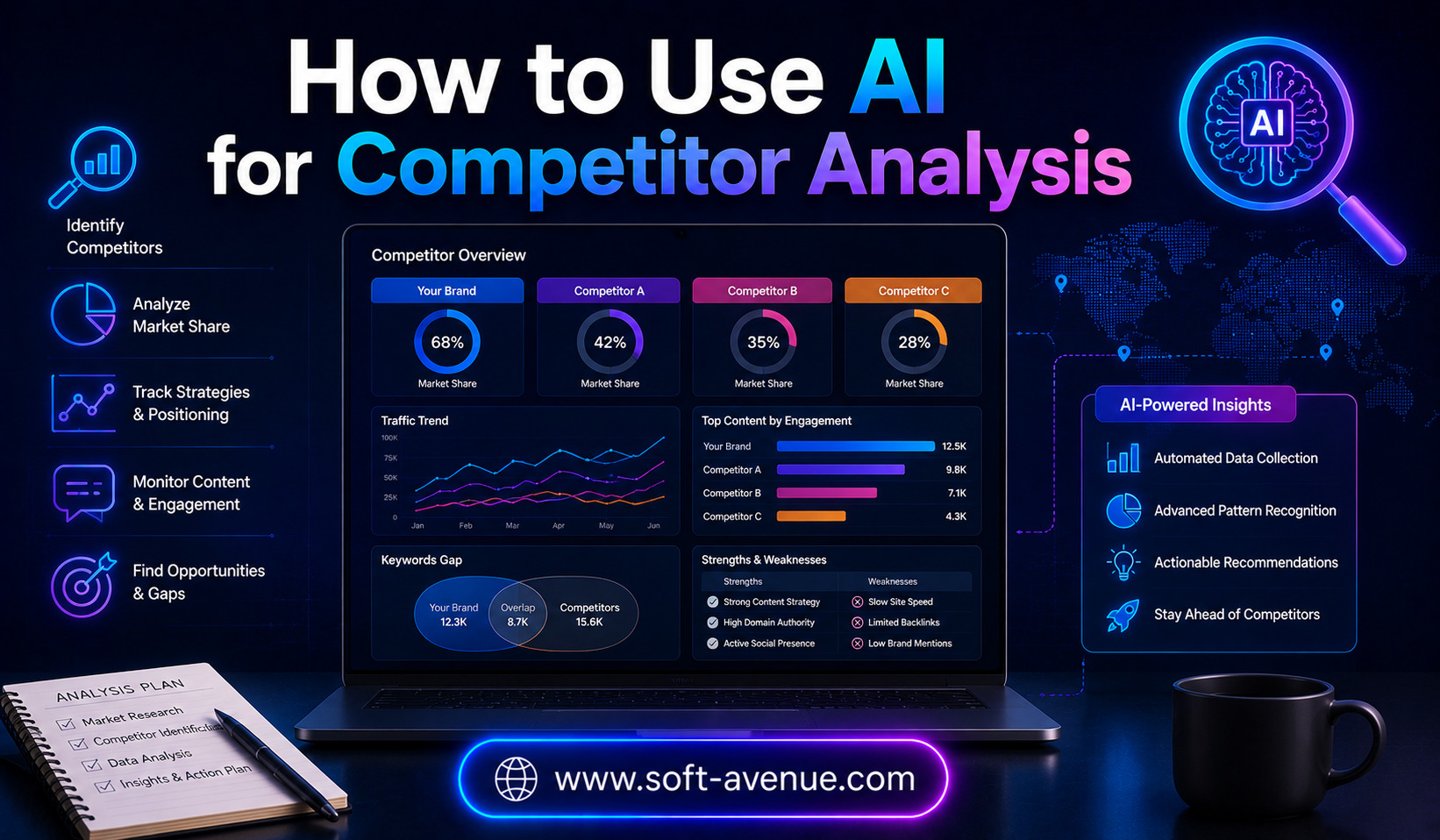
Start by deciding what you want to track, whether it’s pricing, SEO rankings, product launches, customer reviews, or marketing campaigns. Next, add your key competitors so the AI knows what to monitor.
The platform then gathers data from websites, search engines, social media, news, online marketplaces, and customer reviews, presenting everything in one easy-to-read dashboard. It also highlights trends, such as pricing changes, new product launches, or shifts in marketing strategies, that might otherwise go unnoticed.
The real benefit comes from turning these insights into action. Businesses can use the information to improve SEO, adjust pricing, strengthen marketing campaigns, enhance products, and make smarter decisions that support long-term growth.
Areas Where AI Provides the Greatest Competitive Insights
Although AI can analyze almost every aspect of a competitor’s online presence, certain areas consistently deliver the highest business value.
| Analysis Area | How AI Helps | Business Benefit |
| SEO Performance | Tracks keywords, backlinks, rankings | Improves search visibility |
| Content Marketing | Identifies popular topics and publishing frequency | Creates stronger content strategies |
| Social Media | Measures engagement and audience sentiment | Enhances brand awareness |
| Pricing Strategy | Detects price changes and promotional offers | Improves competitive pricing |
| Customer Reviews | Summarizes customer opinions and complaints | Identifies product improvement opportunities |
| Advertising | Monitors competitor campaigns and messaging | Optimizes advertising strategy |
Rather than examining each category separately, AI combines these insights to provide a comprehensive understanding of competitor performance.
Best Practices for Getting Accurate AI Insights
Businesses often assume AI automatically delivers perfect recommendations. However, the quality of insights depends largely on how the technology is used.
To maximize accuracy:
- Define clear research goals before collecting data.
- Monitor competitors consistently rather than occasionally.
- Combine AI-generated insights with human expertise.
- Compare multiple competitors instead of focusing on just one.
- Review AI findings regularly and adjust strategies based on market changes.
Successful organizations treat AI as a strategic decision-support tool rather than a replacement for human judgment. While AI excels at processing enormous amounts of information, experienced professionals remain essential for interpreting business context and making final decisions.
Best AI Tools for Competitor Analysis
The market now offers dozens of AI-powered competitor analysis platforms, each focusing on different aspects of business intelligence. Some specialize in SEO and digital marketing, while others monitor pricing, customer sentiment, advertising campaigns, or website performance.
For businesses looking to improve search visibility, SEO-focused platforms analyze keyword rankings, backlinks, and content strategies. These tools help marketers discover which search terms competitors rank for, identify content gaps, and uncover new opportunities to attract organic traffic.
Marketing teams often use AI-powered social listening platforms to monitor conversations across social media. Instead of manually reading thousands of posts and comments, AI identifies trends, measures audience sentiment, and highlights topics generating the highest engagement. This helps brands understand how customers perceive both their own business and competing companies.
E-commerce businesses frequently depend on AI pricing intelligence tools that monitor competitor pricing around the clock. Whenever a competitor changes prices or launches a promotional campaign, businesses receive alerts that allow them to react quickly without sacrificing profitability.
Content marketers benefit from AI writing and research assistants capable of analyzing popular articles, identifying trending subjects, and suggesting topics with high engagement potential. These tools reduce research time while helping teams create more competitive content.
Customer experience teams also use AI to analyze product reviews from multiple platforms. Instead of reading thousands of reviews individually, AI summarizes common compliments, complaints, and feature requests, providing valuable insights for future product improvements.
Turning AI Insights into Business Strategy
Collecting data is only the beginning. Successful companies use AI insights to improve multiple areas of their business simultaneously.
For example, if AI reveals that competitors receive significant organic traffic from educational blog content, a company may decide to invest more heavily in content marketing. If customer reviews consistently mention slow delivery times for competing products, businesses can highlight faster shipping as a competitive advantage.
Similarly, pricing intelligence may reveal that competitors regularly offer discounts during specific periods of the month. Rather than reacting after losing customers, businesses can prepare promotional campaigns in advance.
Marketing teams can also use AI-generated insights to refine advertising messages. Instead of copying competitor campaigns, they can identify underserved customer needs and develop unique value propositions that differentiate their brand.
The most effective organizations treat competitor analysis as an ongoing strategic process rather than a one-time research project. AI continuously monitors the market, allowing businesses to adjust strategies before opportunities disappear.
Comparing Traditional and AI-Powered Competitor Analysis
The differences between traditional research methods and AI-driven analysis are significant.
| Feature | Traditional Analysis | AI-Powered Analysis |
| Data Collection | Manual and time-consuming | Automated and continuous |
| Speed | Hours or days | Minutes or real time |
| Accuracy | Limited by human effort | Large-scale data processing |
| Market Monitoring | Periodic | Continuous |
| Trend Detection | Often reactive | Predictive and proactive |
| Decision Making | Based on limited information | Based on comprehensive insights |
This comparison highlights why many organizations are replacing manual research processes with AI-supported business intelligence systems.
Real-World Applications Across Industries
AI competitor analysis is no longer limited to technology companies. Businesses across nearly every industry are adopting these solutions.
Retail companies monitor competitor pricing, promotional campaigns, and seasonal discounts to optimize their own pricing strategies. By responding quickly to market changes, retailers can remain competitive without sacrificing profit margins.
Software companies analyze competitor product updates, customer reviews, and feature announcements to prioritize product development. AI helps identify which improvements customers value most and where competing solutions fall short.
Healthcare organizations use AI to monitor industry trends, patient engagement strategies, and emerging digital health services. Financial institutions study competitor offerings to improve customer experiences and launch innovative products.
Even small businesses benefit from AI competitor analysis. Affordable cloud-based platforms allow startups to access competitive intelligence that was previously available only to large enterprises with dedicated research teams.
Common Mistakes Businesses Should Avoid
Although AI simplifies competitor research, relying on it incorrectly can lead to poor decisions. One common mistake is focusing exclusively on competitors while ignoring customer needs. Competitor insights should complement customer research, not replace it.
Another mistake is collecting excessive amounts of data without defining clear objectives. Businesses often monitor dozens of competitors but fail to identify which information actually supports their strategic goals. Concentrating on a smaller group of key competitors usually produces more meaningful insights.
Organizations should also avoid blindly following competitor strategies. Just because another company introduces a new pricing model or marketing campaign does not guarantee it will succeed elsewhere. AI provides valuable intelligence, but business decisions should always consider brand identity, customer expectations, and long-term objectives.
Finally, businesses should remember that AI predictions are based on available data. Unexpected market events, economic changes, or shifts in consumer behavior may influence outcomes that AI cannot fully anticipate.
Final Thoughts
Artificial intelligence is transforming competitor analysis from a reactive research activity into a continuous source of strategic intelligence. Businesses no longer need to depend solely on manual research or occasional market reports because AI can monitor competitors around the clock, analyze enormous amounts of information, and highlight the insights that matter most.
However, the greatest competitive advantage comes from combining AI with human expertise. AI can identify trends, summarize data, and predict possible outcomes, but experienced professionals remain responsible for interpreting those insights and making strategic decisions.
As AI technologies continue to evolve, businesses that adopt intelligent competitor analysis today will be better prepared to respond to market changes, understand customer expectations, and build stronger competitive advantages in the years ahead.
Conclusion
Artificial intelligence has transformed competitor analysis from a slow, manual process into a dynamic source of real-time business intelligence. Companies no longer need to spend countless hours gathering information from multiple platforms because AI can continuously monitor competitors, identify emerging trends, and deliver insights that support smarter decision-making.
However, technology alone is not enough. The most successful businesses combine AI-powered analytics with strategic thinking to create marketing campaigns, pricing models, and customer experiences that stand out in increasingly competitive markets.
Frequently Asked Questions (FAQs)
1. What is AI competitor analysis?
AI competitor analysis uses artificial intelligence to collect, organize, and analyze information about competing businesses, including pricing, marketing strategies, customer feedback, SEO performance, and industry trends.
2. Which businesses benefit the most from AI competitor analysis?
Startups, e-commerce businesses, digital marketing agencies, software companies, manufacturers, and large enterprises can all benefit from AI-powered competitive intelligence.
3. Can AI replace traditional market research?
No. AI enhances market research by automating data collection and identifying patterns, but human expertise is still essential for interpreting results and making strategic decisions.
4. Is AI competitor analysis expensive?
Not necessarily. Many AI-powered tools offer affordable subscription plans suitable for freelancers, startups, and small businesses, while enterprise platforms provide advanced analytics for larger organizations.
5. How often should competitor analysis be performed?
Because AI continuously monitors competitors, businesses can receive real-time updates instead of conducting research only once every few months. Regular monitoring allows organizations to respond quickly to market changes.
6. What is the biggest advantage of AI in competitor analysis?
The greatest advantage is the ability to analyze vast amounts of data quickly and uncover trends, opportunities, and risks that would be difficult to identify through manual research alone.
