Artificial intelligence is no longer limited to a small number of well-known models. Today, developers and businesses can choose from a growing collection of AI models designed for different tasks, including writing, coding, reasoning, research, image analysis, and automation.
Having more choices sounds useful, but it can also create a new problem: which AI model should you use for each request?
A simple question may not require the same model as a complex reasoning task. A coding problem could benefit from a model optimized for programming, while a quick summary might be better handled by a faster and less resource-intensive option.
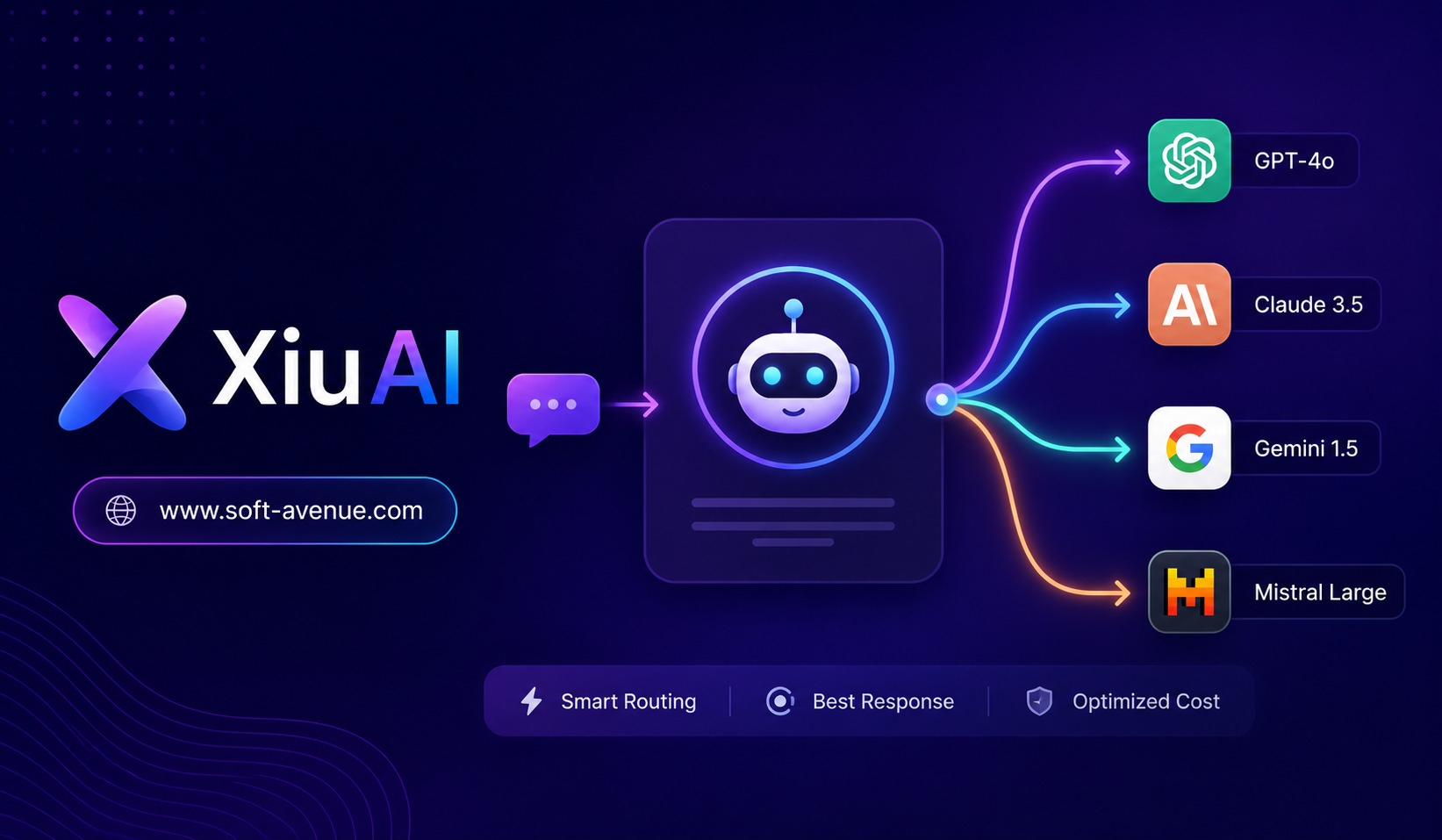
This is where AI model routing becomes valuable. XiuAI represents this approach by focusing on simplifying access to AI models through routing. Instead of forcing users or applications to manually decide which model should handle every request, a routing layer can help direct requests toward an appropriate model.
As AI ecosystems become more complicated, model routing could become an important part of building efficient and flexible AI applications.
What Is XiuAI?
XiuAI can be understood through the concept of AI model routing, where requests are directed to different AI models based on factors such as the task, requirements, performance, or availability.
Normally, using multiple AI models can require separate integrations. Developers may need different APIs, authentication systems, request formats, and configuration settings for each provider.
A routing layer can simplify this architecture.
Instead of building an application around one specific model, developers can place a routing system between their application and multiple models. The application sends a request to the router, and the routing logic determines where that request should go.
This creates a more flexible way to work with AI.
Why Model Routing Matters
Not every AI request needs the most powerful model available.
Suppose an application receives two requests. The first asks for a short sentence to be rewritten. The second requires a detailed analysis of a complicated technical problem.
Using the same large model for both tasks may not be the most efficient approach.
Model routing allows applications to think about AI usage more strategically. Simpler tasks can potentially be handled by faster or lower-cost models, while demanding requests can be sent to more capable systems.
This can help businesses balance quality, speed, and cost.
How AI Model Routing Works
The basic model-routing process can be relatively straightforward.
A user or application sends a request to the routing layer. The system evaluates the request and determines which available model is appropriate.
The decision could be based on the type of task, model capabilities, performance requirements, cost considerations, or predefined rules.
The selected model then processes the request and returns the response to the application.
From the user’s perspective, this can create a simpler experience because they do not necessarily need to understand the technical differences between every model available behind the system.
Simplifying Access to Multiple AI Models
One of the biggest advantages of a routing approach is abstraction.
Without a routing layer, developers working with multiple models may have to integrate each service individually.
That can increase development and maintenance work.
A unified routing system can provide a single interface through which applications communicate with different models.
This can make it easier to experiment with new models without completely redesigning the application.
If a better model becomes available, developers may be able to add it to the routing system and adjust routing rules rather than rebuilding every AI feature.
Choosing the Right Model for the Task
Different AI models have different strengths.
Some are designed for coding. Others focus on reasoning, conversational responses, long-context processing, speed, or specialized tasks.
Model routing provides a way to account for those differences.
For example, an AI application could potentially route a programming request toward a coding-oriented model while sending a lightweight classification task to a faster model.
The exact routing strategy depends on how the application is designed.
The important idea is that one model does not necessarily have to handle everything.
Reducing AI Costs
Cost management is another reason businesses may explore model routing.
Using a premium model for every request can become expensive as usage grows.
A routing system can potentially direct simple requests to models with lower usage costs while reserving more expensive models for tasks that genuinely require their capabilities.
Consider a customer-service platform receiving thousands of questions every day. Many questions may be straightforward, while a smaller percentage may require complex reasoning.
Routing can allow the application to treat those requests differently.
Over a large volume of interactions, even small efficiency improvements can have a meaningful impact.
Improving Application Performance
Model routing can also help applications optimize for speed.
Not every request needs a long reasoning process. If a user asks a simple question, waiting for a complex model to process it may create unnecessary latency.
A routing layer can potentially send straightforward requests to faster models.
For time-sensitive applications, this can make the overall experience more responsive.
However, routing decisions need to account for actual model performance. A faster model is not always better if it produces inaccurate or incomplete results.
Supporting AI Application Flexibility
AI technology changes quickly.
New models are introduced regularly, and older models may eventually become less attractive because of cost, speed, or performance.
Building an application around a single model can create a dependency on that provider.
A routing architecture can reduce some of that dependency by allowing applications to work with multiple models.
This gives developers greater flexibility when experimenting with different AI technologies.
It can also make it easier to adapt when model availability or pricing changes.
Model Routing for Developers
For developers, the biggest benefit may be architectural flexibility.
Instead of writing application logic specifically for one model, developers can build around a more general AI interface.
This can make testing easier because the same request can potentially be evaluated across multiple models.
Developers can compare response quality, latency, and cost before deciding how requests should be routed.
Such flexibility can be especially valuable during the early stages of an AI product, when teams are still discovering which models work best for their users.
Model Routing for Businesses
Businesses can use routing concepts beyond technical experimentation.
An organization may have different AI requirements across departments. Marketing might need content generation, engineering might need coding assistance, and customer support might need conversational automation.
A routing layer can potentially provide a common AI access point while allowing different requests to use different models.
This can simplify governance and make it easier for technical teams to manage AI infrastructure.
Businesses can also establish policies around which models should be used for particular types of requests.
Challenges of AI Model Routing
Model routing is not without challenges.
The first is routing accuracy. If the system sends a request to an unsuitable model, the response may be weaker than expected.
Another challenge is complexity. Although routing can simplify access from the application’s perspective, the underlying system still needs monitoring, configuration, and maintenance.
There is also the issue of consistency. Different models may produce noticeably different responses to the same request.
For applications where consistent behavior is important, developers need to carefully evaluate how model switching affects the user experience.
Finally, privacy and security need to be considered when requests may be sent to multiple AI providers.
The Future of AI Model Routing
As the number of AI models continues to grow, choosing the right model manually for every task will become increasingly impractical.
Model routing offers one possible solution.
Future routing systems could become more intelligent by evaluating requests dynamically and selecting models based on task complexity, historical performance, cost, latency, and user preferences.
This could move AI infrastructure toward a model where applications do not depend on one universal model.
Instead, different models could work together behind a unified interface.
Final Thoughts
XiuAI highlights an increasingly important idea in the AI ecosystem: access to multiple models does not have to mean managing every model individually.
Through model routing, applications can potentially direct different requests toward models that better match their requirements.
The benefits can include simpler integrations, improved flexibility, better cost management, and potentially faster responses. At the same time, effective routing requires careful testing, monitoring, privacy controls, and reliable decision-making.
As AI models continue to diversify, model routing could become an essential layer between applications and the growing collection of AI systems available to developers and businesses. XiuAI’s focus fits naturally into this broader shift toward making multi-model AI access easier and more practical.
