Introduction
Mobile applications have become an essential part of everyday life, helping people shop online, manage finances, communicate, learn, and access countless digital services. However, developing two separate applications for different operating systems often requires more time, a larger development team, and a higher budget.
To solve this challenge, many organizations are turning to cross-platform mobile app development frameworks. These frameworks allow developers to build a single application that runs on multiple platforms using one shared codebase. Instead of maintaining separate Android and iOS projects, businesses can reduce development time, lower costs, and release updates more efficiently.
In 2026, cross-platform development has become more advanced than ever. Modern frameworks deliver near-native performance, attractive user interfaces, cloud integration, and AI-powered development tools that help developers build feature-rich mobile applications quickly. As businesses continue investing in digital transformation, cross-platform development is becoming the preferred choice for startups, enterprises, and software development agencies alike.
Why Cross-Platform Development Is Growing
Building separate native applications has long been the standard approach for mobile development. While native apps can provide excellent performance, maintaining two independent codebases increases development costs and makes future updates more complicated.
Cross-platform frameworks simplify this process by allowing developers to write most of the application code once and deploy it across multiple operating systems. This significantly reduces development effort while maintaining a consistent user experience on different devices.
The approach also accelerates product launches. Businesses can introduce new features, fix bugs, and respond to customer feedback much faster because updates only need to be made once before being deployed to multiple platforms. For startups and growing businesses, this speed can provide a valuable competitive advantage.
Key Features to Look For
Although every framework has its own strengths, successful cross-platform development depends on selecting a solution that balances performance, flexibility, and long-term scalability.
Important features include:
- Single codebase for Android and iOS.
- High-performance user interface rendering.
- Access to native device features and APIs.
- Strong community support and documentation.
- Cloud integration and third-party plugin support.
These capabilities help developers build reliable mobile applications while reducing development complexity and ongoing maintenance.
Best Cross-Platform Mobile App Development Frameworks
Several frameworks have established themselves as industry leaders because of their performance, developer experience, and extensive ecosystem.
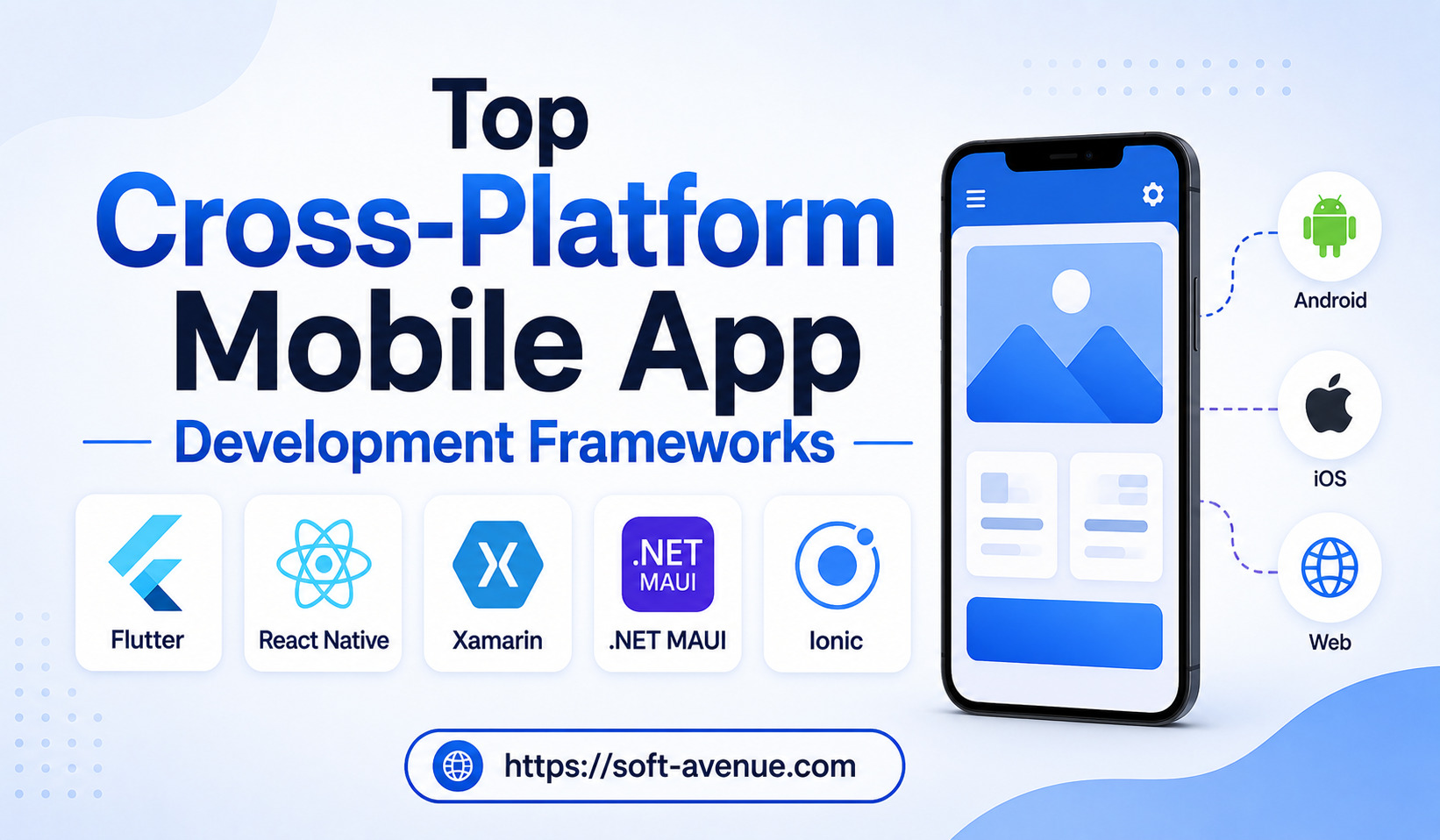
Flutter,developed by Google, remains one of the most popular cross-platform frameworks. It uses the Dart programming language and provides a rich collection of customizable widgets that enable developers to create visually appealing applications with near-native performance. Flutter’s hot reload feature allows developers to see changes instantly, making the development process faster and more efficient.
React Native, developed by Meta, continues to be a leading choice for businesses building mobile applications with JavaScript and React. It allows developers to reuse existing web development skills while creating apps that deliver a native-like user experience. Its large community and extensive library ecosystem make it suitable for projects of all sizes.
.NET MAUI, Microsoft’s modern cross-platform framework, enables developers to build Android, iOS, Windows, and macOS applications using C# and .NET. Organizations already using Microsoft’s development ecosystem often choose .NET MAUI because it integrates smoothly with Visual Studio and Azure services. .
Ionic is another widely used framework that combines web technologies such as HTML, CSS, and JavaScript to build mobile applications. It is particularly attractive for teams with strong web development experience because it reduces the learning curve while supporting multiple platforms.
Comparison of Popular Frameworks
| Framework | Best For | Key Strength |
| Flutter | High-performance apps | Rich UI and near-native performance |
| React Native | JavaScript developers | Large ecosystem and flexibility |
| .NET MAUI | Microsoft developers | Cross-platform development with C# |
| Ionic | Web developers | HTML, CSS, and JavaScript support |
| Kotlin Multiplatform | Shared business logic | Native development flexibility |
Each framework has unique advantages, so businesses should evaluate their team’s technical expertise, project requirements, long-term maintenance needs, and expected scalability before making a decision.
AI Is Changing Mobile App Development
Artificial intelligence is reshaping how mobile applications are developed. Modern development tools now assist programmers by generating code, identifying bugs, recommending improvements, and automating repetitive development tasks.
Many frameworks also integrate easily with AI services for chatbots, image recognition, voice assistants, personalized recommendations, and predictive analytics. This allows businesses to build smarter applications without developing complex AI models from scratch.
As AI-powered development continues to improve, creating feature-rich mobile applications will become faster and more accessible for development teams of all sizes.
More Cross-Platform Frameworks Worth Considering
The mobile development ecosystem continues to evolve, giving developers more choices based on project requirements and technical expertise. Alongside Flutter, React Native, .NET MAUI, and Ionic, several other frameworks are helping businesses build high-quality mobile applications efficiently.
Kotlin Multiplatform has gained popularity because it allows developers to share business logic across Android and iOS while still creating native user interfaces for each platform .This approach gives businesses more flexibility while still delivering strong app performance. It is a practical choice for companies that want to reuse code across platforms without compromising the smooth, native-like experience users expect.
NativeScript is another framework that enables developers to build mobile applications using JavaScript or TypeScript while accessing native APIs directly. It is well suited for applications that require deeper integration with device hardware without sacrificing development speed.
Apache Cordova remains relevant for lightweight projects and simple business applications. Although newer frameworks offer better performance, Cordova continues to be useful for organizations that already have web-based applications and want to convert them into mobile apps with minimal effort.
Each framework has its own strengths, so businesses should choose one that aligns with their development goals, team skills, and long-term maintenance plans.
Conclusion
Cross-platform mobile development has changed the way businesses approach app development by making it possible to build applications for multiple platforms without creating completely separate codebases. For companies looking to reach both Android and iOS users, this approach can reduce development costs, shorten project timelines, and make ongoing maintenance much easier.
Modern frameworks have also come a long way in terms of performance and user experience. Updates and improvements can often be managed from a shared codebase, which can save development teams significant time and effort compared with maintaining separate applications for each platform.
Another major advantage is faster time to market. Businesses can test their ideas, launch products, and respond to customer feedback more quickly when much of the development work can be shared across platforms. This is particularly useful for startups and growing businesses that need to make the most of limited development resources.
However, cross-platform development is not the right choice for every project. Apps that require highly specialized hardware features, advanced platform-specific capabilities, or extremely customized performance may still benefit from native development. The best approach depends on the application’s goals, technical requirements, budget, and expected user experience.
Benefits of Cross-Platform Development
The biggest advantage of cross-platform frameworks is efficiency. Instead of maintaining two separate development teams and codebases, businesses can develop one application for multiple platforms, saving both time and money.
A shared codebase also makes maintenance easier. When developers introduce new features or fix bugs, changes are made once and then deployed across supported platforms. This shortens update cycles and helps ensure users receive a consistent experience regardless of the device they use.
Some of the main benefits include:
- Faster application development and deployment.
- Lower development and maintenance costs.
- Consistent user experience across Android and iOS.
- Easier updates and feature releases.
- Better collaboration among development teams.
These advantages have made cross-platform development the preferred choice for startups, growing businesses, and even many enterprise organizations.
Challenges Businesses Should Consider
Although cross-platform frameworks offer significant benefits, they are not the perfect solution for every project. Applications that rely heavily on advanced graphics, complex animations, or hardware-specific features may still achieve the best performance with native development.
Another challenge is compatibility with new operating system updates. Framework developers need to release updates that support the latest Android and iOS features, so businesses should select frameworks with active communities and regular maintenance.
Performance optimization is also important. While modern frameworks provide near-native performance, poorly optimized code or excessive third-party plugins can affect application speed and responsiveness. Careful planning and good development practices remain essential for delivering high-quality apps.
Final Thoughts
Cross-platform mobile app development has changed how businesses build and deliver applications. By allowing developers to create a single codebase for multiple operating systems, these frameworks reduce development costs, simplify maintenance, and help companies launch products faster.
Frameworks such as Flutter, React Native, .NET MAUI, Ionic, Kotlin Multiplatform, NativeScript, and Apache Cordova each offer unique strengths. Some focus on high-performance user interfaces, while others emphasize native integration, web technologies, or enterprise development.
Organizations that choose the right platform and follow modern development practices will be well positioned to create reliable, engaging mobile applications that meet the evolving needs of users in 2026 and beyond.
Frequently Asked Questions (FAQs)
1. What is a cross-platform mobile app development framework?
A cross-platform framework allows developers to build mobile applications for Android and iOS using a single shared codebase, reducing development time and maintenance effort.
2. Which cross-platform framework is best in 2026?
Flutter and React Native remain two of the most popular choices because of their strong performance, large developer communities, and extensive ecosystem. Other excellent options include .NET MAUI, Ionic, and Kotlin Multiplatform.
3. What are the advantages of cross-platform development?
It reduces development costs, speeds up project delivery, simplifies maintenance, enables faster updates, and provides a consistent user experience across multiple mobile platforms.
4. Is Flutter better than React Native?
Both frameworks are excellent, but the choice depends on project requirements. Flutter is known for its rich UI and high performance, while React Native is popular among JavaScript developers and offers a vast library ecosystem.
5. Can cross-platform apps deliver native performance?
Modern frameworks can deliver near-native performance for most business applications. However, highly graphics-intensive or hardware-dependent apps may still benefit from native development.
6. How is AI influencing mobile app development?
AI helps developers generate code, detect bugs, automate repetitive tasks, improve testing, and integrate intelligent features such as chatbots, voice assistants, image recognition, and personalized recommendations into mobile applications.
